

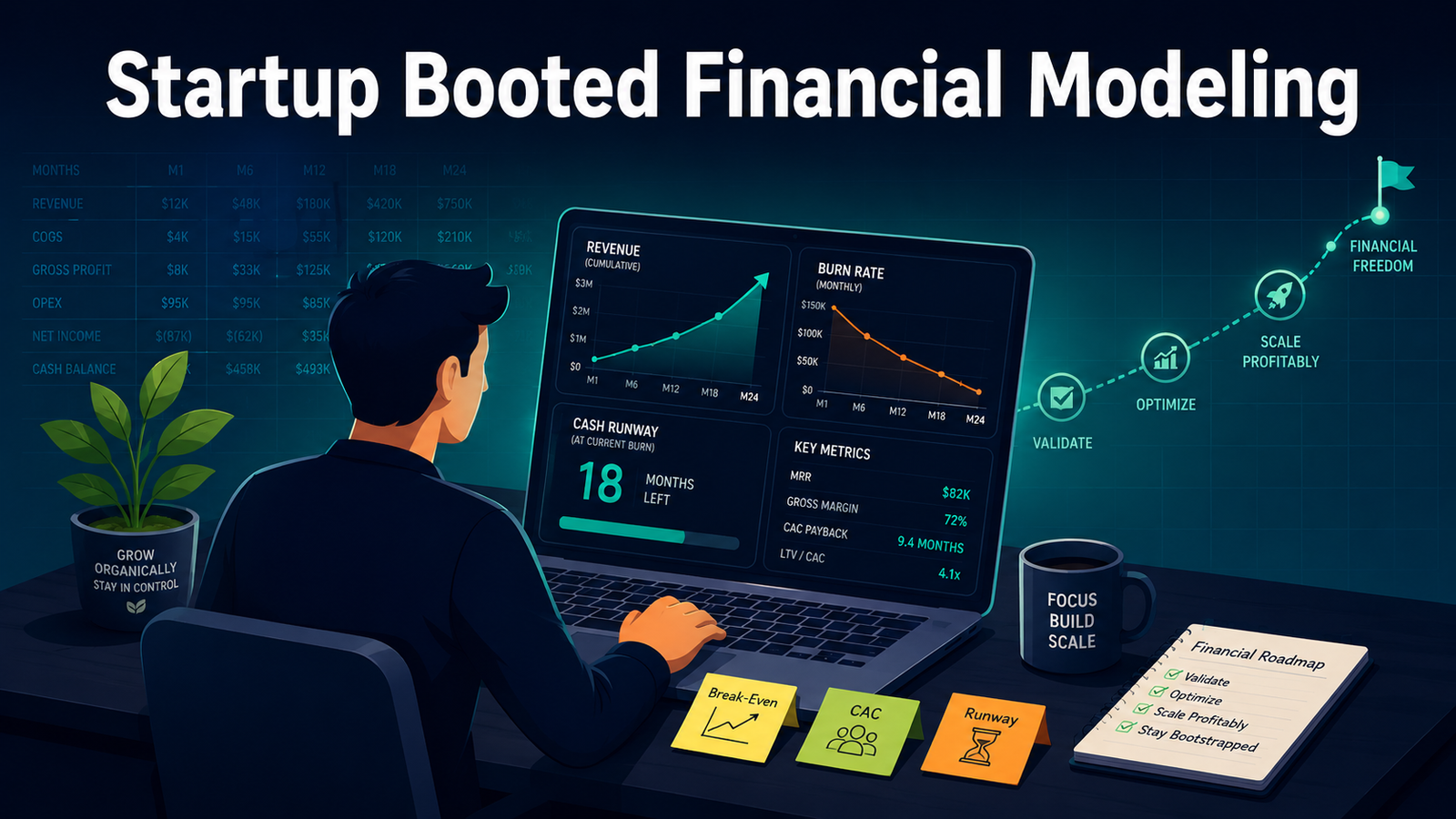
Building a business without outside investors is one of the most demanding things a founder can do. There are no safety nets, no bridge rounds to bail you out, and no investor dashboards to keep you accountable. Everything depends on how well you understand your own numbers. That is exactly why startup booted financial modeling has become one of the most important disciplines for self-funded founders in 2025 and 2026. It is not just a spreadsheet exercise. It is the backbone of every decision you make — from hiring your first employee to expanding into a new market.
This guide breaks down everything you need to know about building a financial model that works without external capital. Whether you are just validating your idea or approaching your first profitable month, these frameworks will give you clarity, confidence, and a roadmap grounded in reality.
What Is Startup Booted Financial Modeling and Why Does It Matter
Startup booted financial modeling refers to the practice of forecasting a startup’s financial future based entirely on internally generated revenue rather than venture capital or outside investment. It is a method of financial planning where startup growth is funded and governed by internally generated revenue, not investor capital, and the model prioritizes cash flow, unit economics, and break-even clarity. Unlike the aggressive, growth-at-all-costs models that VC-backed companies use, a booted financial model is designed for survival first and expansion second.
The reason this matters so much in the current economic climate is straightforward. Companies that have mastered booted financial modeling — companies like Basecamp, Mailchimp before its acquisition, and Zoho — consistently demonstrate one key advantage during market downturns: they don’t panic. When funded competitors cut headcount, freeze roadmaps, and scramble for bridge rounds, booted companies simply continue operating. Their financial discipline is not a limitation — it is a competitive advantage. In a bootstrapped startup, there is profitability and survivability first. When stress exceeds revenue, the company can be destroyed very quickly, which is why startup booted financial modeling is considered the leading decision-making tool.
How Booted Financial Modeling Differs from Investor-Backed Models
The difference between a booted financial model and a VC-backed financial model goes far deeper than the source of funding. In a traditional investor-backed model, founders project growth assuming they will raise capital and then plan spending accordingly. The model is essentially built around a future funding event. Ignoring cash flow timing — recording revenue when invoiced and not when cash actually arrives — inflates apparent cash position and creates dangerous blind spots in runway analysis. Booted models treat this error as unacceptable because there is no incoming capital to cover the gap.
A booted model is also far more conservative by design. Using VC-style aggressive growth projections means projecting 10x revenue growth without a validated customer acquisition channel. This produces a fictional plan rather than an operational model. Booted founders cannot afford fictional plans. Every assumption in the model must be grounded in real data — existing customers, actual conversion rates, and verified cost figures. This discipline, while sometimes uncomfortable, results in a far more reliable planning tool than any optimistic projection deck built to impress investors.
The Five Core Pillars of a Strong Booted Financial Model
Every solid startup booted financial model rests on five core pillars that keep it grounded and functional. The key pillars include realistic revenue assumptions, a flexible cost structure, cash flow forecasting, break-even analysis, and a margin buffer strategy. Each of these pillars serves a distinct purpose, and neglecting any one of them creates a blind spot that can quietly destroy the business before the founder realizes there is a problem.
The first pillar — realistic revenue assumptions — requires building projections from the bottom up rather than the top down. Start with your actual or projected price per unit or per client and multiply by the realistic number of customers you can serve in month one. Use bottom-up forecasting: build from individual sales upward, not from top-down market share estimates. The second pillar, flexible cost structure, means classifying every expense as either fixed or variable so you understand what you owe every month regardless of revenue. Fixed costs create your burn floor, which is the minimum your business spends even if revenue drops to zero. Variable costs move with the business and grow when revenue grows. Together, these two pillars form the structural foundation on which all other modeling work is built.
Building Your Revenue Forecast on Real Data
Revenue forecasting is where many bootstrapped founders make their first serious mistake. It is tempting to look at the size of your target market and reverse-engineer a growth trajectory that justifies your effort. But that approach bypasses the one thing a booted model cannot do without: validation. Your revenue forecasting for early-stage startups must rely on real data, not optimism. If you acquire 15 customers monthly at $2,000 each, your projected revenue is $30,000. Data-driven assumption validation prevents you from overestimating early income.
For subscription-based and SaaS businesses, revenue forecasting requires tracking several moving parts simultaneously. Your model tracks new Monthly Recurring Revenue from fresh customers, expansion MRR from customers who upgrade, contraction MRR from customers who downgrade, and churned MRR from customers who leave. Net Revenue Retention above 100% is the signal that your existing customer base is growing revenue on its own, even without new acquisition. For product or service businesses, the same principle applies in a different form: every projection should trace back to a specific number of transactions, average order values, and realistic repeat purchase rates based on what your current customers are actually doing.
Understanding Cash Runway and Burn Rate
Cash runway and burn rate are two numbers that every booted founder must know at all times. Cash runway is the single most critical metric in booted financial modeling. It answers: how many months can this business survive at its current burn rate? The formula is simple but powerful — divide your current cash balance by your monthly net burn rate. A bootstrapped startup with $30,000 in the bank spending $5,000 per month has six months of runway. That number should never be a surprise; it should be something you recalculate every single month.
Burn rate itself has two layers that founders often confuse. Gross burn rate is your total monthly cash outflow excluding any revenue, reflecting your overall operating expenses like rent, salaries, software, and marketing. Net burn rate accounts for incoming revenue and shows your true monthly cash loss. Focusing only on gross burn without accounting for revenue distorts your actual financial picture. Bootstrapped founders should maintain a minimum of six to twelve months of runway at all times. Falling below three months without a clear revenue acceleration path is a critical warning signal. Treating runway as a real-time dashboard rather than an annual review item is what separates founders who survive unexpected downturns from those who don’t.
Unit Economics: The Heart of Sustainable Growth
Unit economics are the metrics that tell you whether your business model works on a per-customer basis before you attempt to scale it. Understanding metrics like Customer Acquisition Cost, Lifetime Value, and churn is essential for making informed strategic decisions. By dissecting these key performance indicators, you can evaluate the profitability of individual customers and identify areas where improvements can lead to overall growth. For a booted startup, this is non-negotiable because there is no outside capital to subsidize a broken unit economics model.
A healthy booted startup targets an LTV to CAC ratio of at least 3 to 1, meaning each customer generates three times what it cost to acquire them. If you spend $100 to acquire a customer but they only generate $80 in lifetime revenue, no amount of growth fixes that fundamental problem. Target benchmarks for healthy unit economics include gross margin above 70% for SaaS businesses, LTV-to-CAC above 3 to 1, CAC payback within 12 months, and monthly churn below 5% for SMB customers or below 2% for mid-market customers. Monitoring these numbers monthly, not quarterly, gives founders the early warning signals they need to adjust pricing, improve retention, or rethink their acquisition channels before a problem becomes a crisis.
Break-Even Analysis and Setting Financial Milestones
Break-even analysis might sound like a basic accounting concept, but inside a booted financial model it serves as something far more strategic. It gives you a precise monthly revenue target to work toward and a clear line that separates the survival phase of your business from the growth phase. The break-even point is the revenue level at which total income equals total expenses — the moment the business stops losing money and begins generating real profit. Every startup booted financial model must calculate this number clearly and track progress toward it monthly. A visible break-even target gives the entire organization a measurable financial finish line.
The formula for calculating break-even revenue is straightforward: divide your total fixed costs by your gross margin percentage. Achieving break-even validates startup financial planning without funding. Once you break even, the startup’s financial modeling shifts focus from survival to calculated reinvestment. Setting progressive milestones on the path to break-even — hitting 25%, then 50%, then 75% of the required revenue — keeps the team focused on meaningful financial progress rather than abstract growth metrics. Each milestone should also trigger a corresponding decision, such as whether to bring on a new hire, invest in a new marketing channel, or expand the product offering.
Scenario Planning and Financial Stress Testing
No financial model is complete without scenario planning. A single-scenario forecast assumes the future will unfold as expected, and any experienced founder knows that it rarely does. In a rapidly evolving environment, assumptions made today may not hold tomorrow. By routinely revising your model and testing various scenarios, you ensure that your projections remain relevant and resilient against market fluctuations. Building three scenarios — conservative, base, and optimistic — into every booted model is not pessimism. It is professional-grade risk management.
A practical way to build this is to create an assumptions tab in your financial model where every input is entered manually in one place. Add a toggle or dropdown that switches the key variables between conservative, base, and optimistic values. With that setup, switching between scenarios takes one click and immediately shows how runway, break-even, and unit economics shift under each set of conditions. Stress testing your model against specific questions — what happens if sales drop by 30%? What if a key supplier raises prices? — forces you to think through contingencies before they become emergencies. A healthy booted model also requires maintaining a 20 to 30 percent contingency buffer to protect your startup’s financial planning without relying on outside funding.
Common Mistakes Bootstrapped Founders Make in Financial Modeling
Even founders with a solid grasp of financial concepts make predictable errors when building their first booted financial model. Converting one strong month of revenue into a permanent salary commitment is the most common way bootstrapped startups damage their financial health. Wait for consistent performance across three to six months before hiring. One good month is not a trend — it is a single data point. Treating it as permission to add fixed costs is one of the fastest ways to destroy the runway you have worked hard to build.
Another common mistake is treating the profit and loss statement as a proxy for actual cash position. Revenue recorded in your P&L may not arrive in your bank account for thirty, sixty, or ninety days depending on your payment terms, yet your expenses are due now. Building a forecast using industry average growth rates instead of your own real conversion and retention data is not modeling — it is guessing with more steps. The third major error is building a model once and never updating it. A modern financial model must be agile and data-informed. Regular revisions and scenario analysis are at the heart of iterative forecasting. Updating your model every month and comparing projected figures against actual bank statements is what transforms a static spreadsheet into a living decision-making engine.
Tools and Frameworks to Build Your Booted Financial Model
The good news for founders who feel intimidated by financial modeling is that you do not need expensive software or a finance degree to build a functional model. For most early-stage booted startups, Google Sheets is entirely sufficient. Don’t let tool complexity become a reason to delay building your model. Start with a simple cash flow forecasting sheet that tracks monthly inflows and outflows for the next twelve months, then add layers of sophistication as your business grows and your needs evolve.
A well-structured booted financial model includes a KPI dashboard covering CAC, LTV, LTV-to-CAC ratio, payback period, churn rate, MRR growth rate, and gross margin — all in one view and updated monthly against real results. As your revenue scales and complexity increases, dedicated tools like Causal or Mosaic offer more advanced scenario planning capabilities and integrations with your accounting software. AI-driven financial platforms can analyze historical spending, seasonal trends, and growth patterns to predict cash flow needs and guide resource allocation. One SaaS startup that adopted an AI-driven financial platform extended its cash runway by six months simply by consolidating expense data and identifying unnecessary recurring costs — without cutting any core operations. The right tool is the one you will actually use consistently, updated with real numbers every month, so that it reflects your business as it actually is rather than as you hope it will be.
Also Read: The End of the “Growth at All Costs” Operator — And What Replaces Them
Conclusion
Startup booted financial modeling is ultimately about clarity — knowing exactly where your money comes from, where it goes, how long it will last, and what you need to do next. It strips away the noise of vanity metrics and forces founders to confront the real economics of their business. For self-funded founders, that clarity is not just useful — it is survival. The founders who master these frameworks are the ones who build businesses that last, scale without burning out, and earn the kind of profitability that no investor can take away from them.
