
Every business reaches a point where ambition outpaces available resources. Whether you are a first-time founder with a bold idea or an experienced entrepreneur ready to double your market share, understanding how to navigate the funding landscape can be the single most transformative decision you make. Growth navigate funding is not just about finding money — it is about finding the right money at the right time, structured in a way that supports your long-term vision rather than undermining it. When entrepreneurs treat funding as a strategic tool rather than a desperate measure, the entire journey from early-stage validation to sustainable scale becomes far more manageable and far less chaotic.
What Growth Navigate Funding Actually Means
The phrase “growth navigate funding” captures something that many traditional business financing guides miss: the idea that funding is a journey with a compass, not just a destination. Businesses do not simply raise capital — they navigate through multiple stages, each with its own terrain, investor expectations, and capital requirements. A seed-stage startup pitching to a growth equity firm is like showing up to the wrong port entirely. Understanding where you are in the business lifecycle shapes every funding decision that follows, from the type of capital you seek to the terms you are willing to accept.
At its core, growth navigate funding is about alignment. Your funding strategy must align with your business model, your growth phase, your market opportunity, and your long-term ownership goals. A SaaS company with strong monthly recurring revenue has very different funding options than a product-based business still searching for product-market fit. The smartest founders start by mapping their actual capital needs against the realistic options available at their stage, then work backwards to build a fundraising strategy that is both achievable and sensible. This kind of intentional, phase-aware approach to securing capital is what separates businesses that scale sustainably from those that burn bright and fade fast.
Understanding the Funding Stages Every Business Moves Through
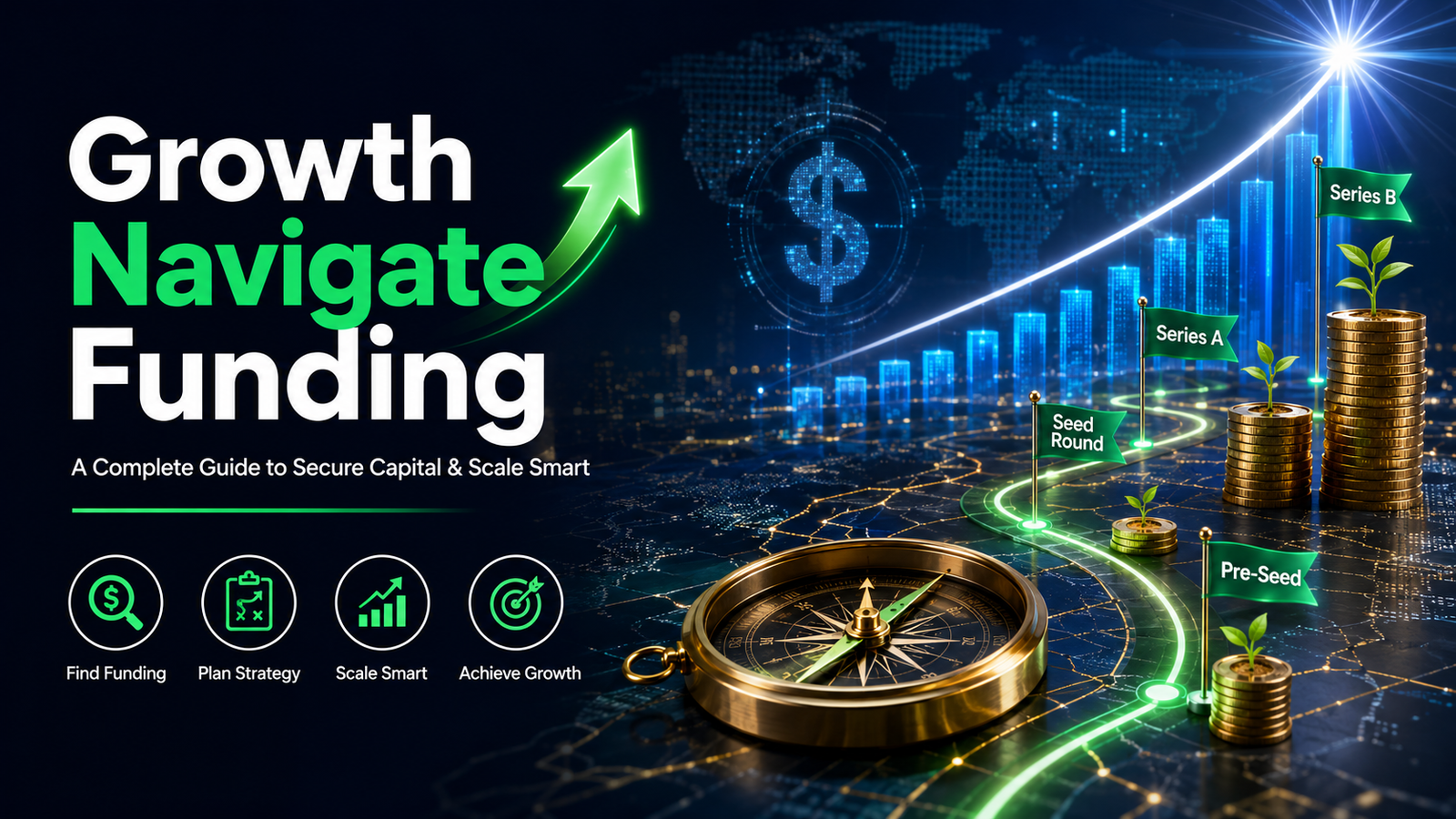
One of the most important frameworks any entrepreneur can internalize is the concept of funding stages. Most businesses move through a predictable sequence: pre-seed, seed, Series A, Series B, and later-stage rounds, each serving a distinct purpose. Pre-seed funding, often drawn from personal savings, friends and family, or early angel investors, is about proving that an idea has enough merit to pursue. At this stage, you are not yet asking investors to bet on a proven business — you are asking them to bet on you and your ability to validate a concept worth building.
Seed funding becomes relevant once a business has developed a minimum viable product and demonstrated some early traction in the market. According to data from 2025, the median seed round in the United States sits at approximately $3.1 million, a figure that reflects both the growing cost of building early-stage companies and the increasing competition for investor attention. Series A funding, which typically averages around $11 million, marks the shift from building a product to scaling a business. Investors at this stage want to see clear traction, a repeatable revenue model, and evidence that the team can execute at the next level. Understanding these benchmarks helps founders set realistic expectations and avoid the costly mistake of raising either too little or too much capital for their current phase.
The Most Effective Funding Options Available Today
The funding landscape in 2025 and 2026 offers entrepreneurs more options than at any point in history, though not all of them suit every business equally well. Venture capital remains the dominant path for high-growth technology companies with large addressable markets and a clear path to significant returns. Angel investors, who are typically high-net-worth individuals investing their own capital, often provide crucial support at the earliest stages, bringing not just money but mentorship, industry introductions, and hard-won operational wisdom that institutional investors rarely offer.
Beyond equity-based options, revenue-based financing has grown significantly as a compelling alternative for businesses with predictable, recurring revenue. Under this structure, a company receives upfront capital and repays it through a fixed percentage of future monthly revenue until the total repayment amount is reached. There is no equity dilution, no board seats surrendered, and no fixed monthly payment schedule — the repayment flexes with your revenue performance. Crowdfunding platforms like Kickstarter and Indiegogo have also proven remarkably effective for consumer-facing businesses, with over $80 million raised on these platforms by startups in 2024 alone that later went on to secure institutional venture funding. Each of these paths fits different business models, and the most sophisticated founders often combine multiple sources rather than relying on a single channel.
Building a Strategic Growth Plan Before You Raise
A critical mistake that many entrepreneurs make is approaching investors before they have a clear, well-documented growth plan. Investors at every stage — from angel investors writing their first $25,000 check to venture firms managing billion-dollar funds — want to understand exactly how their capital will be deployed and what milestones it will unlock. A strong growth plan answers these questions before they are asked: it outlines the specific business objectives the funding will support, the financial projections that justify the capital need, and the key performance indicators that will demonstrate progress along the way.
Financial forecasting sits at the heart of any credible funding strategy. Founders who can show exactly how much capital they need, precisely where it will be allocated, and what the expected return on that investment looks like are far more compelling to investors than those who arrive with vague ambitions and round numbers. A sensible capital allocation framework — directing roughly 40% to operations, 30% to sales and marketing, 20% to product development, and keeping 10% in reserve — signals financial maturity and operational discipline. When you walk into an investor meeting with this level of clarity, you are not asking for a favor. You are presenting a partnership opportunity backed by structured thinking and defensible data.
How Investors Evaluate Your Business in 2025 and 2026
The standards investors apply when evaluating funding candidates have evolved considerably. Gone are the days when a compelling narrative and impressive user growth were enough to close a round. Today’s investors scrutinize profitability pathways, unit economics, and operational sustainability with far greater rigor than at any point in the past decade. According to recent data, startups with monthly recurring revenue growth above 15% are twice as likely to close a Series A round successfully, underscoring just how important revenue quality has become relative to raw growth metrics.
Investors now place enormous weight on the clarity and honesty of a founder’s financial reporting. Transparency about burn rate, customer acquisition costs, customer lifetime value, and gross margin is not just appreciated — it is expected. Any startup that cannot articulate its unit economics with precision will find the fundraising process unnecessarily difficult, even if the underlying business is genuinely strong. Beyond numbers, investor scrutiny also extends to team credibility. Founders with demonstrated experience in scaling businesses, navigating market uncertainty, and building cohesive teams attract capital at better valuations and under more favorable terms than those without a comparable track record.
Avoiding the Most Common Funding Mistakes
Many businesses fail not because of a flawed product or a weak market, but because of poor funding decisions that create structural problems difficult to unwind later. One of the most prevalent mistakes is overfunding at an early stage — accepting more venture capital than the business genuinely needs in exchange for excessive equity dilution. When founders surrender too much ownership too early, they lose the financial leverage and decision-making authority that becomes critically important in later rounds. The pressure to deliver returns that justify an inflated early valuation can also push founders toward growth-at-all-costs decisions that damage long-term sustainability.
On the opposite end, underfunding creates its own painful problems. A startup that raises just enough capital to reach its next milestone but not enough to handle unexpected delays or market shifts will find itself back in fundraising mode at exactly the wrong moment, often from a position of weakness rather than strength. Experienced advisors consistently recommend that founders begin fundraising conversations six to twelve months before their capital needs become urgent. This gives enough time for relationship building, due diligence, negotiation, and the inevitable delays that characterize most funding processes. Building those investor relationships long before the ask creates a foundation of trust that makes the eventual conversation far more productive.
The Role of Product-Market Fit in Securing Investment
No concept is more fundamental to attracting serious funding than product-market fit, yet it remains one of the most misunderstood milestones in the startup journey. Product-market fit is not a single moment of clarity — it is a spectrum of evidence that your product genuinely solves a problem customers care deeply about, that they are willing to pay for it repeatedly, and that organic word-of-mouth growth is beginning to emerge without heavy marketing spend. Investors at the seed and Series A stages are looking for early signals of this fit, even if the evidence is still imperfect.
The growth stage of a business, which formally begins once product-market fit has been established, is where the focus shifts to achieving business-model fit — creating a repeatable, scalable, and profitable model where the product creates as much value for the company as it does for the customer. This distinction matters enormously in a funding context because growth-stage capital is fundamentally different from early-stage capital. Growth equity investors, private equity firms, and later-stage venture funds expect you to have already answered the “does this work?” question. What they are funding is your ability to do it faster, at greater scale, and across larger markets than you currently reach.
Also Read: Growth Enterprises Market: What It Is, How It Works, and Why It Matters in 2026
Emerging Funding Trends Reshaping Capital Markets
The funding environment of 2025 and 2026 is being reshaped by several powerful forces that entrepreneurs would do well to understand. Artificial intelligence has transformed how founders identify and approach investors, with data platforms now enabling targeted outreach based on investment thesis, industry focus, check size, geography, and portfolio history. While AI tools make the early research process significantly more efficient, they cannot replace the relationship-building and credibility that ultimately closes rounds. The technology is a better map, not a substitute for the journey.
Sustainability-focused funding is another trend gaining serious momentum. Investors are increasingly directing capital toward businesses that demonstrate environmental responsibility, social impact, and governance clarity alongside traditional financial metrics. Decentralized finance is also creating alternative pathways to capital that bypass traditional intermediaries entirely, though these channels remain more relevant for certain technology businesses than for traditional small and medium-sized enterprises. AI-sector startups deserve special mention: seed-stage AI companies recorded valuation premiums of approximately 42% compared to non-AI peers at the same stage in 2025, reflecting the extraordinary investor appetite for artificial intelligence businesses with defensible data advantages and clear commercial applications.
Managing Capital After You Raise It
Securing funding is only half the equation. How a business manages, deploys, and accounts for its capital once received often determines whether a second round is possible — and on what terms. Investors expect founders to maintain rigorous financial discipline from the moment funds arrive, tracking burn rate carefully, reporting milestones honestly, and adjusting capital allocation when market conditions change. A business that raises $5 million and deploys it without a clear system for monitoring outcomes will struggle to demonstrate the responsible stewardship that follow-on investors demand.
Accounting infrastructure matters far more post-funding than most early-stage founders anticipate. As growth accelerates, revenue streams multiply, equity compensation plans come into play, and audit readiness becomes a practical necessity rather than a theoretical concern. Founders who invest early in proper bookkeeping systems, financial reporting processes, and experienced financial leadership — whether through a full-time CFO or a fractional one — position themselves to enter subsequent fundraising conversations with clean data, credible projections, and the kind of operational clarity that builds genuine investor confidence. The businesses that handle post-funding financial management with the same rigor they applied to securing the investment in the first place are the ones that earn access to growth capital again and again.
Building Long-Term Investor Relationships That Drive Sustainable Growth
The most successful founders consistently describe their investor relationships as genuine partnerships rather than transactional arrangements. An investor who deeply understands your market, believes in your vision, and brings a meaningful network to the table is worth significantly more than a check written by someone with no operational familiarity with your space. Taking the time to research investor portfolios, understand their investment theses, and approach only those whose experience genuinely complements your company’s needs is not just good fundraising strategy — it is good long-term business strategy.
Transparent, consistent communication is the foundation on which these relationships are built. Sharing realistic expectations, honest reporting on setbacks as well as successes, and a clear articulation of your evolving vision fosters the kind of trust that transforms investors into advocates. Investors who trust their founders refer deal flow to them, open doors to strategic partnerships, and provide counsel during difficult periods that no amount of capital could replace. In a funding environment where investor skepticism toward manipulated financials is at an all-time high, the founders who win the long game are those who treat integrity not as a compliance requirement but as a genuine competitive advantage. Growth navigate funding, done right, is ultimately about building a business that earns its next round — not one that is forced to raise it.
This article is intended for informational purposes and reflects publicly available data and industry research as of 2025–2026. Always consult qualified financial and legal advisors before making funding decisions.
