

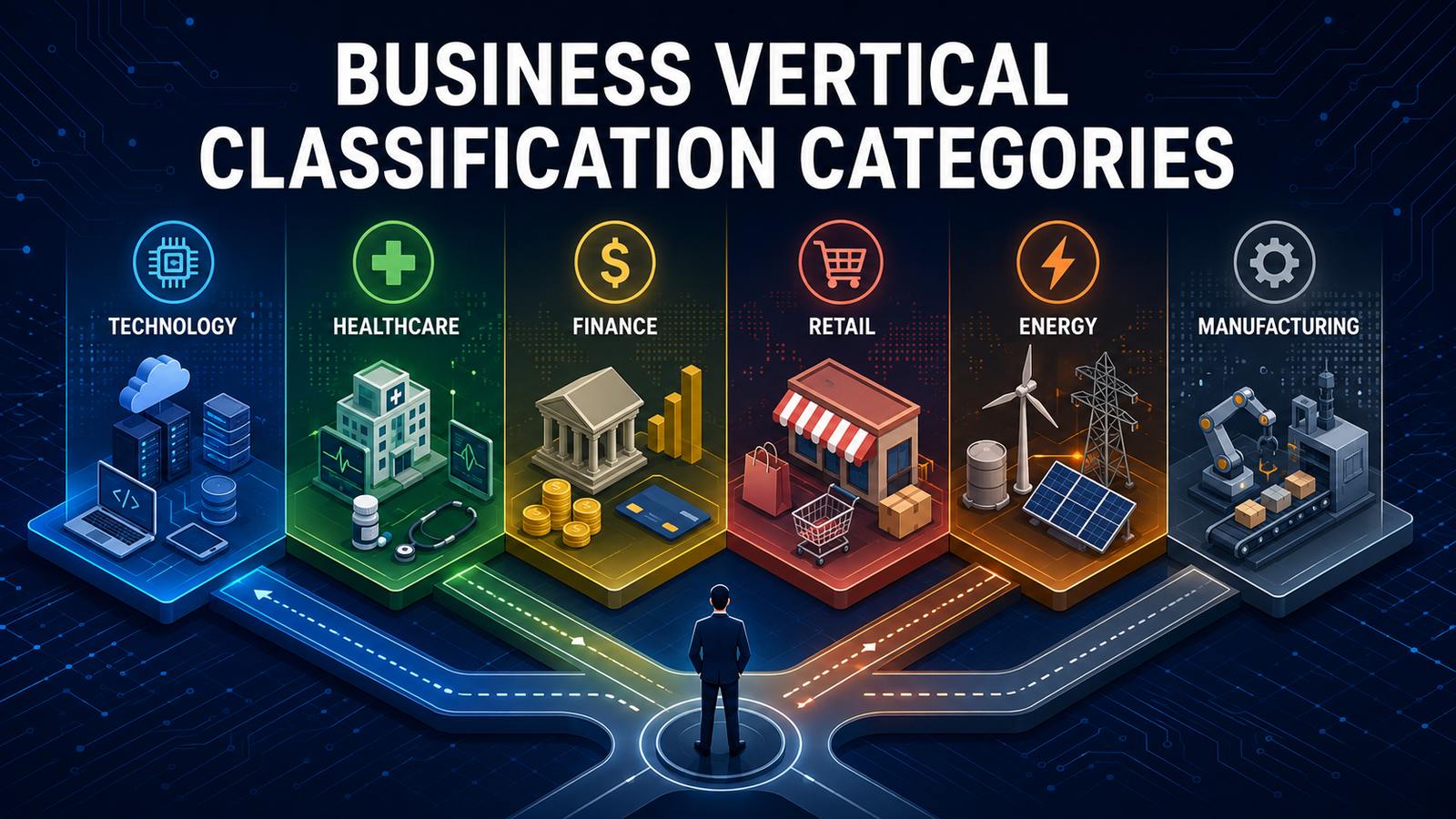
Every business operates somewhere in the economic landscape — but knowing where you operate, and being able to communicate that clearly, is far more powerful than most business leaders realize. Business vertical classification categories are the structured frameworks that define which industry a company belongs to, what markets it serves, and how it competes. Whether you are a startup founder trying to attract investment, a marketer crafting industry-specific messaging, or an analyst comparing companies across sectors, understanding these categories is not optional — it is foundational. This guide breaks down everything you need to know about business verticals, how they are classified, why they matter, and how they are evolving in today’s fast-moving economy.
What Are Business Vertical Classification Categories?
At their core, business vertical classification categories are organized systems that group companies based on the primary products, services, or markets they serve. The word “vertical” reflects a deep, industry-specific focus — a company in a vertical market serves a narrow, well-defined niche rather than casting a wide net across many industries. A hospital belongs to the healthcare vertical. A cybersecurity firm fits inside the technology vertical. An asset management company operates within the financial services vertical. These labels might seem straightforward, but they carry enormous strategic weight.
Unlike horizontal markets — where a business like a general accounting software platform might serve clients across retail, manufacturing, and healthcare simultaneously — vertical markets go deep into a single industry. The distinction matters because vertical businesses build specialized expertise, develop industry-specific products, speak the language of their customers fluently, and ultimately compete on depth of knowledge rather than breadth of reach. Classification categories make this depth visible and measurable, giving the business world a common vocabulary to analyze, compare, and act on market data.
The Major Classification Systems Used Globally
Three principal frameworks dominate how industries are classified around the world: the Standard Industrial Classification (SIC), the North American Industry Classification System (NAICS), and the Global Industry Classification Standard (GICS). Each was designed for a different purpose, and understanding the difference between them helps businesses select the right framework for their needs.
The SIC system was established in the United States in 1937, making it the oldest formal classification standard still in active use. Though NAICS officially replaced it in 1997 for U.S. government reporting, many commercial databases, business lists, and legacy systems continue to rely on SIC codes for targeting, segmentation, and CRM operations. NAICS, maintained by the U.S. Census Bureau, uses a production-oriented structure to classify businesses by their primary economic activities and is also shared by Canada and Mexico — making cross-border industrial comparisons possible in a way the SIC system never supported.
GICS, developed in 1999 by MSCI and S&P Dow Jones Indices, was created specifically for investment research and portfolio management. It organizes the market into 11 sectors, 24 industry groups, 69 industries, and 158 sub-industries — giving portfolio managers and equity analysts a granular yet consistent lens for benchmarking and performance attribution. While NAICS and SIC are the practical standards for sales targeting and operational databases, GICS is the go-to framework for public equity analysis. Knowing which system applies to your context — whether you are filing regulatory documents, running a CRM campaign, or attracting venture funding — can save both time and costly misalignment.
The Core Business Vertical Categories You Need to Know
While classification systems like NAICS and GICS organize industries through hundreds of specific codes, most business verticals fall within a handful of well-recognized core categories. The technology and software vertical encompasses companies that design, develop, and distribute digital solutions — from cloud computing platforms and enterprise software to artificial intelligence tools and cybersecurity firms. This vertical continues to expand rapidly, driven by rising global demand for automation and data-driven decision-making.
Healthcare and life sciences represent another critical vertical, covering pharmaceutical companies, hospitals, medical device manufacturers, diagnostic labs, and health technology platforms. The financial services vertical brings together banks, insurance firms, investment managers, and the fast-growing fintech sector. Retail and e-commerce, education, real estate, logistics and transportation, manufacturing, and energy each form their own distinct verticals with unique buyer behaviors, regulatory environments, and competitive dynamics. Understanding where a business sits within these categories — or across several of them — is the first step toward building a coherent market strategy.
Why Vertical Classification Shapes Marketing Strategy
One of the most practical applications of business vertical classification is in marketing. When a company understands its vertical, it can craft messaging that resonates specifically with the pain points, terminology, and priorities of its target audience. A SaaS company serving hospitals, for example, will emphasize compliance, patient data security, and clinical workflow integration — none of which would matter to a retail e-commerce client who instead cares about conversion rates and cart abandonment. Vertical-specific messaging consistently outperforms generic campaigns because buyers feel that the seller genuinely understands their world.
Market segmentation by industry also enables smarter allocation of marketing budgets. Rather than running broad awareness campaigns that reach irrelevant audiences, businesses with clear vertical positioning can invest in industry-specific trade publications, conferences, associations, and digital channels where their exact buyers gather. Sales cycles shorten because the trust-building process accelerates when a prospect immediately recognizes that a vendor operates exclusively within their space. This is why many of the most successful B2B companies in the world — whether in legal tech, construction software, or agricultural data analytics — are deeply vertical in their positioning rather than horizontal and generic.
How Investors Use Vertical Categories to Evaluate Businesses
Venture capitalists and institutional investors rely heavily on vertical classification when evaluating companies and constructing portfolios. Each vertical carries its own benchmarks for growth rates, churn, customer acquisition costs, total addressable market (TAM), and margin profiles. A SaaS company in the education vertical will be measured against entirely different expectations than one in enterprise finance, even if both have similar revenue figures. Without a shared classification framework, these apples-to-oranges comparisons would be nearly impossible to make reliably.
Vertical classification also simplifies regulatory risk assessment, which is a significant factor in investment due diligence. Healthcare companies face HIPAA regulations; financial services firms navigate SEC and FINRA oversight; energy companies must comply with environmental standards that vary by region. Investors who know a company’s vertical immediately understand the compliance landscape it operates in and can price that risk accordingly. For startups and growth-stage companies, operating clearly within a recognized vertical — and communicating that clearly — can materially improve how investors perceive the scalability and defensibility of the business.
Regulatory Implications of Business Vertical Classification
Beyond marketing and investment, vertical classification has real regulatory consequences. Governments and regulatory bodies often design rules, tax incentives, licensing requirements, and reporting standards specifically around industry verticals. A business misclassified under the wrong vertical code may find itself subject to incorrect regulations — or miss out on government contracts, subsidies, and programs for which it actually qualifies. In the United States, for instance, small business designations and set-aside contracts from federal agencies are often tied directly to NAICS codes.
In more heavily regulated verticals such as healthcare, finance, and energy, correct classification is not simply a strategic preference — it is a compliance necessity. A healthtech company that does not properly identify itself within the healthcare vertical may inadvertently bypass HIPAA training, fail to implement required data security protocols, or neglect mandatory licensing in the states it serves. Similarly, financial technology companies that fall under banking regulations but classify themselves loosely as “software companies” can face enforcement actions for failing to register with the appropriate authorities. Getting your vertical right protects the business legally and operationally.
Also Read: Growth Enterprises Market: What It Is, How It Works, and Why It Matters in 2026
The Vertical vs. Horizontal Business Model Distinction
Understanding vertical classification naturally raises a strategic question: should your business be vertical or horizontal? A vertical business model focuses deeply on one industry, building products and services specifically designed for that niche. A horizontal business model, by contrast, offers solutions applicable across many industries without deep customization. Both models work — but they succeed in fundamentally different ways, and the choice has long-term implications for growth, competition, and brand positioning.
Vertical models tend to win on trust, retention, and premium pricing. When a customer in the legal industry buys software built exclusively for law firms — complete with billing codes, case management workflows, and bar compliance features — they are getting something a generic project management tool simply cannot match. That depth of specialization creates a defensible competitive position that is difficult for horizontal competitors to replicate quickly. On the other hand, horizontal models can scale broadly and often achieve higher revenue faster by serving large, diverse markets. The critical insight is that many businesses begin horizontally and later “verticalize” their offerings as they discover which industries generate the most value and loyalty.
Emerging and Hybrid Verticals in the Modern Economy
The traditional boundaries between business verticals are becoming increasingly porous. Digital transformation has given rise to hybrid verticals that blend the characteristics of two or more established sectors. Fintech is the clearest example: it sits at the intersection of financial services and technology, drawing regulatory frameworks from one and innovation cycles from the other. Similarly, healthtech, edtech, agritech, and climate tech have all emerged as recognized verticals precisely because technology is reshaping legacy industries from the inside out.
Climate tech in particular is redefining how vertical classification works. According to the World Economic Forum’s 2026 Energy Outlook, global clean energy investment reached a record $2.2 trillion in 2025 — a number that spans energy, manufacturing, agriculture, and real estate simultaneously. The creator economy represents another emerging category that barely existed a decade ago and still lacks an official NAICS or SIC code, yet commands significant venture capital attention and revenue. These new verticals challenge classification systems to evolve, and they signal to business leaders that vertical positioning is not a one-time decision — it requires ongoing reassessment as market boundaries shift.
How to Identify and Define Your Own Business Vertical
Determining which vertical your business belongs to does not need to be complicated, but it does require honest analysis. The most reliable starting point is revenue: which industry generates the majority of your income? That industry almost certainly defines your primary vertical. From there, look at your most specialized offering — the product or service that you provide in a way that is specifically designed for a particular type of customer or industry context. That specialization is the clearest indicator of your true vertical home.
Once you have identified your primary vertical, look at how your best customers describe their own industry and the problems your product solves for them. Their language will reveal the vertical vocabulary you should adopt in your marketing, sales, and investor communications. It is also worth consulting resources like the NAICS Association’s code lookup tool or GICS sector descriptions to ensure your classification aligns with recognized standards — particularly if you are seeking government contracts, filing regulatory documents, or preparing for investment rounds. A business that understands and communicates its vertical clearly gains credibility faster, attracts more relevant partners, and builds a stronger, more focused brand in the long run.
The Future of Business Vertical Classification
As artificial intelligence, automation, and data analytics continue to mature, the process of classifying businesses into verticals is itself becoming smarter. AI tools are now capable of analyzing vast datasets to group companies into nuanced categories, identifying micro-verticals and sub-segments that traditional code-based systems would miss. Machine learning is being applied to classification workflows to reduce manual effort and improve accuracy, particularly for fast-moving sectors where new business models emerge faster than official standards can keep up.
Sustainability is also emerging as a classification dimension in its own right. ESG — environmental, social, and governance — considerations are increasingly influencing how investors and analysts group and evaluate companies, creating an overlay on top of traditional vertical categories. A manufacturing company that prioritizes zero-emission production may be classified differently by a responsible investment fund than an identical manufacturer without those commitments. As industries continue to evolve through technology, regulation, and shifting consumer values, business vertical classification categories will remain one of the most powerful tools available for making sense of the complex, interconnected global economy — and for positioning any business to thrive within it.
