
The startup funding world in 2026 looks nothing like it did five years ago. On the surface, the headlines are dazzling — Q1 2026 shattered all records with over $300 billion invested globally in a single quarter, largely driven by colossal AI mega-rounds. But beneath those breathtaking numbers lies a reality that most early-stage founders know all too well: that money is not coming their way. The venture capital market has bifurcated sharply, and for founders building outside the narrow AI infrastructure lane, the traditional path to funding has become more competitive, more dilutive, and less accessible than at any point in recent memory.
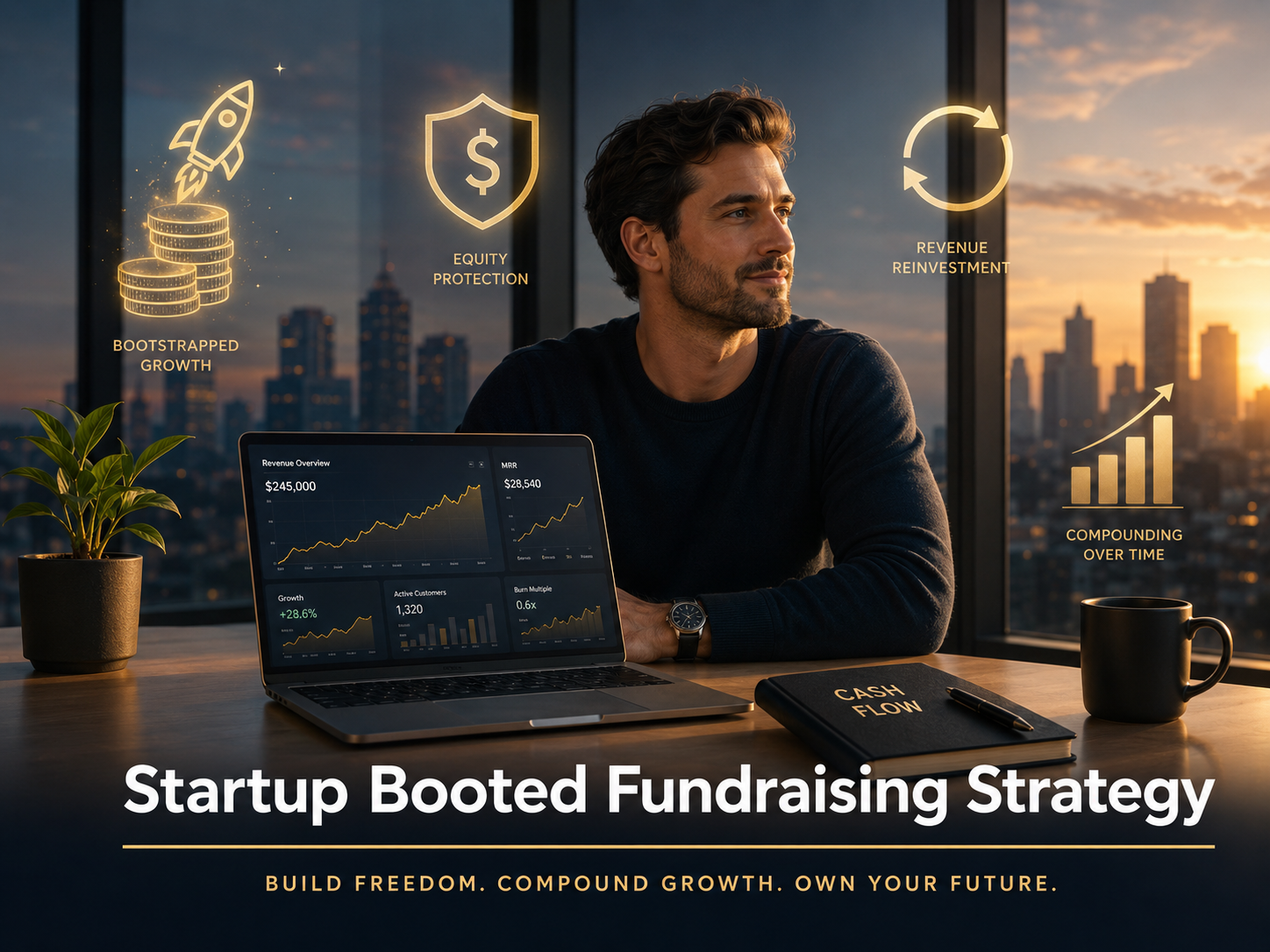
This is precisely why the startup booted fundraising strategy has moved from a niche philosophy into one of the most discussed and practiced models among serious founders in 2026. It is a founder-led growth methodology that combines bootstrapping discipline with strategic, selective use of non-dilutive capital — allowing you to build real traction, validate real demand, and eventually raise external funding from a position of genuine leverage. This guide covers everything you need to understand about this strategy, why the current market makes it more relevant than ever, and how to execute it step by step.
What the Startup Booted Fundraising Strategy Actually Means in 2026
A startup booted fundraising strategy is a founder-led approach that prioritizes building revenue, proving market demand, and maintaining financial control before seeking — or instead of seeking — traditional equity investment. The term “booted” captures the essence of the model precisely. You boot up your own business, revenue-first and lean by design, before deciding if and when outside capital will genuinely accelerate your growth rather than simply fund your survival. It sits deliberately between pure bootstrapping, which avoids all external capital indefinitely, and the traditional VC-backed model, which hands over significant equity at the earliest possible stage in exchange for speed.
What makes this model distinct in 2026 is how it has matured into a complete operating philosophy rather than just a funding workaround. Smart founders using this strategy are not simply avoiding investors out of stubbornness or necessity. They are following a deliberate sequence: create the business first, demonstrate demand with paying customers, build a system of repeatable revenue, and then decide whether capital can meaningfully accelerate what is already working. This approach gives founders control of the most important variable in any fundraise — leverage — and it produces businesses that are more resilient, more profitable, and far better positioned to negotiate favorable terms when external funding eventually becomes the right tool for the next stage of growth.
The 2026 Funding Landscape: Why the Booted Model Is Now Essential
To fully appreciate why the startup booted fundraising strategy is having its defining moment in 2026, you need to understand what has happened to the venture capital market. Q1 2026 saw over $300 billion invested globally, but that figure is almost entirely a mirage for most founders. AI companies captured 80% of all funding in that quarter, and the late-stage segment alone absorbed $246.6 billion across just 584 deals. As SaaStr’s analysis of Q1 2026 data noted, 75% of all venture money effectively went to just five VC funds and five startups. For founders building in vertical SaaS, marketplaces, or developer tools, that capital is simply not in play regardless of how strong the business fundamentals are.
The two-tier nature of the 2026 market is now structural rather than temporary. AI and machine learning startups captured 64.3% of total venture deal value in recent months, leaving a materially tougher environment for every other category. At the early stage specifically, the median seed deal sits at just $2 million, and pre-revenue raises are becoming rarer as Series A investors now typically require $1 million to $2 million in ARR before writing a check. In this context, the startup booted fundraising strategy is not a consolation prize — it is a rational, data-backed response to a market structure that has fundamentally shifted against early-stage founders who lack AI credentials or an existing relationship with a top-tier fund. Building on proven revenue before approaching any investor is no longer just good practice; in 2026, it is often the only realistic path forward.
Building Revenue First: The Core Engine of the Booted Model
The philosophical center of the startup booted fundraising strategy is treating revenue as the foundation of the business rather than a milestone to unlock after securing investor money. In practice, this means validating that customers will pay for your solution before investing heavily in building it, launching the smallest revenue-generating version of your product within 60 to 90 days, and immediately establishing weekly cash flow tracking as a non-negotiable operating habit. Every expense is evaluated based on its direct contribution to revenue generation, and growth channels are only scaled after their unit economics are confirmed to work. The critical metric governing everything is the relationship between customer acquisition cost and customer lifetime value — a minimum 3:1 ratio, and ideally closer to 5:1.
This revenue-first operating model creates compounding advantages that funded startups routinely sacrifice in pursuit of growth metrics designed to satisfy board expectations rather than build real businesses. Bootstrapped startups in 2026 show three times higher profitability odds in their first three years compared to VC-backed peers, spend approximately one-quarter as much on customer acquisition, and achieve comparable growth rates — roughly 20% versus 22% in recent data — while retaining complete ownership. The five-year survival rate for bootstrapped companies runs between 35 and 40%, compared to just 10 to 15% for VC-backed startups. That gap reflects the fundamental difference between building a sustainable business and racing toward a return event on someone else’s timeline. Every financial constraint the booted model imposes is, in practice, a discipline that produces smarter decisions and more durable companies.
Why Equity Dilution Is Even More Costly Than Most Founders Realize
The arithmetic of venture capital dilution has always been unfavorable for founders who look at it carefully, but in 2026’s compressed deal environment, it deserves particular scrutiny before any decision to raise early. Most institutional funding rounds require approximately 20% equity dilution, and over multiple rounds spanning seed through Series B or C, founders typically retain only 15 to 25% of their company at exit — meaning the business you built from nothing may be 75 to 85% owned by others by the time you reach the finish line. Research from Harvard Business Review found that up to 40% of startup founders are eventually replaced by their investors, a pattern that is not hypothetical but well-documented and regularly observed across startup ecosystems worldwide.
The startup booted fundraising strategy is a direct response to this pattern. Founders who bootstrap through early product development and arrive at investor meetings with 12 or more months of monthly recurring revenue data, strong retention numbers, and a clear use of funds consistently secure better valuations and less dilution than founders who pitch at the idea stage. According to Carta’s 2024 State of Startups data, founders with revenue traction secured 15 to 25% better valuation multiples than pre-revenue peers. That advantage compounds significantly across multiple rounds. The booted approach essentially converts the time and discipline invested in building traction into a direct financial return at the negotiating table, preserving maximum ownership throughout the early building phase and dramatically improving the quality of investor relationship that becomes possible once you approach from a position of genuine strength.
Non-Dilutive Capital: Your 2026 Funding Toolkit
One of the most important aspects of the startup booted fundraising strategy is that it does not mean operating with zero external funding — it means accessing capital without surrendering equity. The ecosystem of non-dilutive funding tools has expanded meaningfully in 2026, giving bootstrapped founders more options than ever before. The SBIR/STTR program, reauthorized in April 2026 through 2031, now offers Phase I grants of $200,000 to $305,000 and Phase II grants up to $2 million for technology startups. A significant new addition is the SBIR Strategic Breakthrough Awards, capable of providing up to $30 million for breakthrough innovations — a scale of non-dilutive support that was simply not available to founders even two years ago. Government non-dilutive programs now distribute over $4 billion annually across federal agencies, including the NSF, NIH, DOD, and DOE, requiring no equity and no repayment.
Revenue-based financing has matured into one of the most practically useful tools in the non-dilutive toolkit, providing SaaS founders with upfront capital that is repaid as a percentage of monthly recurring revenue until the advance is settled — no equity surrendered, no board seats, no fixed debt schedule. Providers like Lighter Capital, Capchase, and Pipe have expanded their offerings significantly as this category has grown. Cloud compute credits from AWS Activate, Microsoft for Startups, and Google for Startups represent additional non-dilutive capital that can cover tens or hundreds of thousands of dollars in infrastructure costs during early growth phases. Together these tools allow booted founders to access real operational capital without giving away ownership, keeping equity intact and growing for a future raise where leverage is genuinely on the founder’s side.
How AI Tools Have Made Bootstrapping More Viable Than Ever
One of the structural forces making the startup booted fundraising strategy more executable in 2026 than at any previous point is the dramatic reduction in what it actually costs to build and scale a software business. A SaaS founder who needed a $500,000 development budget in 2020 to produce a working MVP can now accomplish the same outcome with a team of two people and a stack of AI-assisted development, design, and operations tools. AI now enables smaller founding teams to handle customer support, content marketing, sales outreach, and product iteration at a quality and volume that previously required significant headcount and capital. The 97.1% of pre-seed startups and 84% of seed-stage companies that either use or plan to use AI in their products or operations in 2026 are not just building more competitive products — they are building them at a fraction of the historical cost.
This cost compression fundamentally changes the bootstrapped growth calculation. When the capital required to reach initial revenue milestones shrinks by 50 to 80%, the period during which a founder must operate without external funding shortens accordingly, and meaningful traction becomes achievable on a founder’s personal resources or early customer revenue. The best founders in 2026 are combining AI-powered lean operations with grants, revenue-based financing, and disciplined cash flow management into a deliberate capital stack rather than relying on any single funding source. This multi-tool approach is what makes the booted strategy genuinely competitive with the venture-backed model — not just as a philosophical alternative but as a path to building a faster, leaner, and more durable business in a market environment that rewards exactly those qualities.
When to Raise External Capital and How to Do It Right
The startup booted fundraising strategy does not permanently exclude venture capital or angel investment. What it changes is the timing and terms of any eventual raise in ways that are substantially more favorable to founders. The right moment to begin exploring external capital is when you have identified a specific, time-sensitive growth opportunity — a new market segment, a proven acquisition channel that needs fuel, or a critical hire that organic revenue cannot fund quickly enough — and when you have the traction to demonstrate that capital will accelerate something already working. Raising out of survival pressure produces the worst possible terms at the worst possible valuation, and in 2026’s disciplined funding environment, investors can identify that desperation more quickly than ever.
The real-world validation of this sequencing approach is compelling. Founders who arrive at fundraising conversations with 12 or more months of MRR data, strong customer retention, confirmed unit economics, and a clear articulation of exactly what the capital will accomplish consistently raise at better valuations and with less dilution. Companies like Mailchimp, which grew for two decades on customer revenue before its $12 billion acquisition by Intuit, Zoho, which built a global SaaS platform serving over 100 million users without any outside investors, and Basecamp, which has operated profitably for over 25 years without needing a single institutional check, demonstrate that this sequencing can produce extraordinary outcomes at scale. These are not anomalies — they are the clearest possible proof that the booted model, executed with discipline, produces companies worth owning and outcomes worth waiting for.
The Key Metrics Every Booted Founder Must Track
Running a startup on the booted model requires a sharper, more disciplined relationship with financial data than the VC-backed model typically demands, because there is no investor capital buffer to absorb the consequences of unclear thinking. Net revenue retention is the single most important number: anything above 100% means existing customers are expanding their spend faster than you are losing revenue to churn, which means your business grows even if you pause new customer acquisition entirely. Top-performing SaaS companies in 2026 target 120% net dollar retention or higher, and reaching this level signals clearly that your product is delivering genuine, compounding value rather than one-time utility that fades after the initial purchase.
Beyond net revenue retention, founders operating on the booted model should track monthly recurring revenue growth rate, CAC payback period targeting under 18 months, gross margin targeting above 70% for SaaS businesses, cash runway in months, and the burn multiple — the ratio of net burn to net new ARR, where lower is always better. Maintaining weekly cash flow visibility is not optional; it is the most important single operational practice for any founder funding growth from customer revenue. These metrics tell you not just how the business is performing today but how much room you have to make decisions, experiment with growth channels, and navigate slower periods. When the time comes to raise external capital, arriving with 12 months of clean, compelling data built on these fundamentals shifts the entire investor conversation in your favor.
Read More: Startup Booted Financial Modeling: The Complete Guide for Founders Who Fund Themselves
Conclusion: Building the Company You Actually Want to Own
The startup booted fundraising strategy in 2026 is not a fallback for founders who cannot access venture capital. It is a deliberate, increasingly well-supported, and data-validated approach to building a company that you actually own, that grows because customers genuinely need what you built, and that operates from a foundation of financial strength rather than dependency on a funding environment you cannot control.
The structural shifts in 2026 — the AI concentration that has absorbed the vast majority of early-stage venture capital, the rising bar for institutional funding, the expansion of non-dilutive programs, and the cost compression driven by AI-powered tools — have made this model more relevant and more practically executable than at any point in startup history. What remains is the decision: validate the market, build revenue first, earn the leverage, and raise capital only when doing so is genuinely on your terms. For most founders in 2026, that is not just a viable strategy. It is the smartest path available.
