

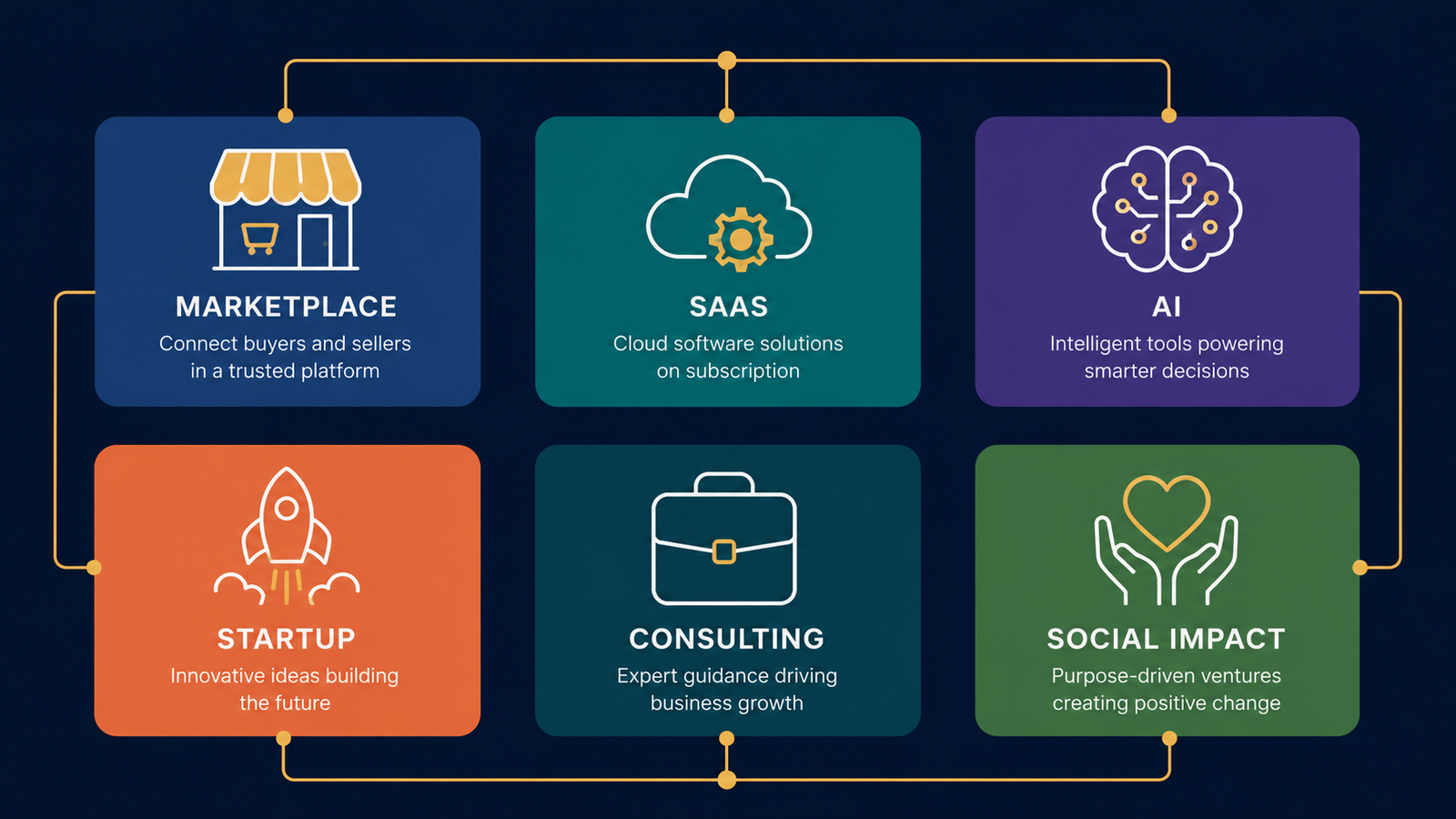
Learn how to map any business summary to the right startup category with real examples. A practical framework covering SaaS, marketplace, AI-native, and more. Every week, thousands of founders pitch their businesses using vague language that tells investors nothing useful. “We’re a platform that connects X with Y.” “We use AI to solve Z.” “We’re disrupting the W industry.”
These summaries fail because they don’t map to a recognizable startup category — and categories matter more than most founders realize. When an investor, accelerator, or strategic partner hears your business summary, the first thing they are doing (consciously or not) is mapping it to a category. That mapping determines what benchmarks they apply, what comparables they reach for, what questions they ask, and ultimately whether they engage further.
Understanding how to correctly map a business summary to a startup category is not just a pitch skill. It is a strategic clarity tool. Companies that know exactly which category they are operating in make better product decisions, target the right investors, benchmark against the right competitors, and avoid the “complexity tax” that comes when industry focus conflicts with business model, forcing teams to change their plan or pay a complexity tax in architecture, sales cycles, and support.
This guide provides a systematic framework for mapping any business summary to its correct startup category — with real examples throughout.
Why Category Mapping Matters in 2026
The startup category landscape has never been more complex. Real companies are messy hybrids where industry dictates constraints like regulation and data risk, business model shapes monetization mechanics, development stage determines what to build next, and target market defines sales motion and trust requirements.
In 2026, a product isn’t enough. A service isn’t enough. Even talent isn’t enough — not without the right model behind it. Businesses that thrive don’t just sell — they structure. And the most ambitious are reshaping their core by aligning with the most adaptable, efficient, and forward-thinking types of business models.
At the same time, AI is creating entirely new category problems. Artificial intelligence is not just a feature you add to an existing product. It is creating structurally new business model categories. A law firm that uses AI to draft contracts is neither a SaaS company nor a traditional professional services firm — it occupies a new category with fundamentally different economics.
The founders who get category mapping right early gain three advantages:
Investor targeting accuracy. Different categories attract different investor types. A marketplace startup and a vertical SaaS startup have completely different investor profiles, even if their revenue figures are identical.
Benchmark selection. You cannot evaluate your CAC payback period, NRR, or gross margin without knowing which category’s benchmarks apply to you. A fintech company has very different margin expectations than a pure software company.
Strategic clarity. When category lenses align, product strategy gets simple. When they conflict, the team must change the plan — otherwise it pays a complexity tax.
The Four-Lens Framework for Category Mapping
Before mapping any business summary, apply these four lenses in order:
Lens 1: Industry — What sector does the business operate in? (Healthcare, Fintech, EdTech, Legal, Construction, etc.)
Lens 2: Business Model — How does the company make money? (Subscription, Transactional, Usage-based, Marketplace commission, Advertising, Licensing)
Lens 3: Development Stage — Where is the company in its lifecycle? (Lifestyle, Small Business, Scalable Venture, Buyable, Large Company Extension, Social)
Lens 4: Target Market — Who is the customer? (B2B, B2C, B2B2C, Government, Enterprise, SMB, Consumer)
The intersection of these four lenses produces your startup category. Most confusion about category comes from conflating one lens with another — treating “industry” as if it fully describes the startup type, or confusing “business model” with “target market.”
The Core Startup Categories with Business Summary Examples
Category 1: Scalable Venture / VC-Backed Startup
Definition: A startup designed from inception for exponential growth, typically seeking venture capital, with a product that can scale without proportional increases in cost.
Key characteristics: Requires significant upfront capital, prioritizes growth over profitability in early stages, typically aims for $100M+ revenue potential, investor exit via IPO or acquisition.
Business summary examples:
- “We are building an AI-powered procurement platform for mid-market manufacturers. Our software identifies $50K-$500K in annual savings per customer, charges 20% of savings captured, and has signed 12 enterprise contracts in 8 months.” → Category: Vertical AI SaaS / B2B Scalable Venture
- “We connect independent pharmacists with pharmaceutical wholesalers, charging a 2.5% transaction fee. We have $4M GMV in month 6.” → Category: B2B Marketplace / Scalable Venture
- “Our developer tool auto-generates API documentation using LLMs. Freemium with $49/month Pro plan. 8,000 users, 400 paying.” → Category: Developer Tools SaaS / Scalable Venture
Mapping signal: Look for mentions of TAM size, investor backing, rapid growth rates, or explicit comparables to large companies.
Category 2: Micro-SaaS / Lifestyle Startup
Definition: A small, often solo-operated software business targeting a specific niche problem. Profitable and sustainable at modest scale. Not seeking VC.
Key characteristics: Typically $5K-$100K MRR ceiling by design, bootstrapped, high margins, founder retains equity, optimized for cashflow over growth.
Lifestyle startups are created by lifestyle entrepreneurs — individuals who turn their passion or expertise into a business opportunity. The goal is to spread the founder’s passion and generate sufficient income, rather than hypergrowth.
Business summary examples:
- “I built a Notion template management tool for solopreneurs. $2,800 MRR, 190 paying customers, 0 employees, profitable from month 2.” → Category: Micro-SaaS / Lifestyle Business
- “We make invoicing software specifically for freelance photographers. $8K MRR, 65% gross margin, no outside funding.” → Category: Niche Micro-SaaS / Small Business Startup
- “A job board for remote UX designers only. Employers pay $299/listing. $12K monthly revenue.” → Category: Niche Marketplace / Lifestyle Startup
Mapping signal: Solo or tiny team, specific niche, no mention of VC or hypergrowth, emphasis on profitability and cashflow.
Category 3: Marketplace Startup
Definition: A platform that connects two or more sides of a market (buyers and sellers, service providers and customers) and typically earns a commission or transaction fee.
Key characteristics: Network effects are central to the moat, chicken-and-egg problem in early stages, GMV is a key metric alongside take rate, high defensibility once liquidity is achieved.
Marketplace startups are revolutionizing how buyers and sellers connect and transact. By providing a centralized hub for transactions, these startups offer unparalleled convenience and choice to consumers, fostering a dynamic marketplace economy.
Business summary examples:
- “We connect vetted fractional CFOs with Series A-C startups that need financial leadership without a full-time hire. 15% placement fee on first-year compensation.” → Category: B2B Professional Services Marketplace
- “A two-sided marketplace for construction subcontractors and general contractors. Subs post availability, GCs post projects, we take 8% on matched contracts.” → Category: Construction Marketplace / Vertical Marketplace
- “We license music directly from independent artists to content creators, bypassing traditional publishing. 12% transaction fee.” → Category: Creative Economy Marketplace / B2B2C
Mapping signal: Two distinct customer groups, transaction/commission revenue model, emphasis on liquidity and matching.
Category 4: Buyable Startup
Definition: A startup built explicitly to be acquired by a larger company, typically within 2-5 years. Buyable startups are aimed to attract larger companies to purchase them. These companies require less capital than most and are sold off at peak value. Buyable startups are typically in the web or app development markets.
Business summary examples:
- “We built the missing analytics layer for Shopify merchants — tracking inventory turnover, supplier lead times, and reorder points in one dashboard. 1,200 Shopify app installs, $3K MRR.” → Category: Buyable SaaS (potential Shopify acquisition target)
- “An AI-powered review response tool for Google Business profiles. Deep integration with Google’s API. 800 SMB customers.” → Category: Buyable / Google Ecosystem Startup
- “We built enterprise SSO integration for Notion, Coda, and Confluence. 200 B2B customers paying $500/month.” → Category: Buyable / Productivity Ecosystem Startup
Mapping signal: Deep integration with a specific platform, niche functionality that a larger player would logically absorb, focus on a specific acquirer’s ecosystem.
Category 5: AI-Native / Foundation Model Application
Definition: A startup whose core value proposition is built on large language models or other AI foundations, creating new capabilities that were impossible before 2022.
Companies like OpenAI, Anthropic, and Google are building AI infrastructure that others build on top of. The revenue model is usage-based API access. The moat is compute investment, model quality, and developer ecosystem — a new variant of the platform model, but with dramatically higher capital requirements and dramatically higher margin potential.
Business summary examples:
- “We use computer vision to automatically generate building permit applications from architectural drawings. Currently requires 40 hours of manual work per application. Our tool does it in 20 minutes. $2,000/application.” → Category: Vertical AI / PropTech / AI-Native
- “An AI legal research tool that finds case precedents and drafts arguments. Sold to solo practitioners and small law firms at $299/month.” → Category: Legal AI / AI-Native SaaS
- “We fine-tune domain-specific models for clinical documentation in radiology. Sells to hospital systems on annual enterprise contracts.” → Category: Healthcare AI / Enterprise AI-Native
Mapping signal: AI is the core product (not a feature), specific domain data creates the moat, new capability that didn’t exist before generative AI.
Category 6: Social / Mission-Driven Startup
Definition: A startup whose primary objective includes social impact alongside (or instead of) financial returns. Social startups are intended to make a difference in the world — with Ben & Jerry’s as a famous historical example, whose goal includes prison reform alongside selling ice cream.
Examples in this category tend to share a pattern: clear beneficiaries, measurable interventions, and a delivery model that doesn’t collapse when demand rises.
Business summary examples:
- “We provide microloans to women entrepreneurs in rural Pakistan through mobile money. $50-$500 loans, 4% monthly repayment rate, 94% repayment.” → Category: Social Startup / Fintech / Impact
- “A platform connecting unemployed veterans with coding bootcamps and employer partners. Free for veterans, funded by employer placement fees.” → Category: Social Startup / EdTech / B2B2C
- “We recycle ocean-bound plastic and sell it to consumer brands for packaging. Carbon credits as secondary revenue.” → Category: Social Startup / CleanTech / B2B
Mapping signal: Explicit mention of beneficiaries beyond paying customers, impact metrics alongside financial metrics, mission statement embedded in business model.
Common Mapping Mistakes and How to Avoid Them
Mistake 1: Confusing industry with category
A company in healthcare is not automatically a “HealthTech startup.” It might be a lifestyle business (a solo telemedicine practice), a marketplace (connecting patients with specialists), or a vertical SaaS (billing software for dental practices). Industry tells you the constraint environment; it does not tell you the category.
Mistake 2: Describing features instead of business model
“We use AI to analyze customer sentiment” is a feature description, not a business summary. The business model question is: who pays, how much, and for what outcome? “We sell AI-powered customer sentiment analysis to e-commerce brands at $500/month per brand, replacing manual review reading that costs brands an average of $3,000/month in analyst time” — that is a business summary that maps to a category (Vertical AI SaaS / B2B Scalable Venture).
Mistake 3: Claiming multiple categories simultaneously
Founders often describe their startup as “part marketplace, part SaaS, part services.” While some hybrids are legitimate, numerous enterprises today operate across multiple verticals, making it hard to classify them into a single category — and stakeholders may have misconceptions about the market position, plan, or sources of revenue without appropriate classification. Pick your primary category for pitching purposes. You can explain the hybrid model once the investor is engaged.
Mistake 4: Choosing category based on aspiration rather than current reality
A two-person team with $8K MRR calling themselves a “scalable venture” before demonstrating the unit economics of scalability creates credibility problems. Map to where you are, not where you plan to be. Show the path to the next category as a strategic narrative, not as a current description.
A Quick-Reference Mapping Table
| If your summary mentions… | Primary category signal |
|---|---|
| “Two-sided platform,” “commission,” “GMV,” “liquidity” | Marketplace |
| “Subscription,” “ARR,” “churn,” “NRR,” “B2B” | SaaS / Scalable Venture |
| “Solo-built,” “bootstrapped,” “niche,” “profitable from day 1” | Micro-SaaS / Lifestyle |
| “Built on top of [platform],” “integration with [large co]” | Buyable Startup |
| “Fine-tuned model,” “proprietary training data,” “LLM” | AI-Native |
| “Impact,” “beneficiaries,” “mission,” “underserved community” | Social Startup |
| “Usage-based,” “per API call,” “per transaction processed” | Usage-based SaaS |
| “Franchise,” “licensing,” “white-label” | Licensing / Franchise Model |
Read More: Business Vertical Classification Categories: A Complete Guide to Understanding Industry Segmentation
Conclusion
Category mapping is not about putting your startup in a box. It is about achieving the strategic clarity that comes from knowing exactly what kind of business you are building, what metrics define success in that category, and who the right investors, partners, and benchmarks are.
Across successful projects, the same product idea succeeds or fails based on startup type. A lifestyle business can thrive with niche focus and careful automation. Meanwhile, a scalable venture may fail if it underinvests in experimentation speed. That’s why categories matter — they turn vague ambition into a plan you can execute.
Apply the four-lens framework — Industry, Business Model, Stage, Target Market — to any business summary. The intersection tells you your category. The category tells you your playbook.
