

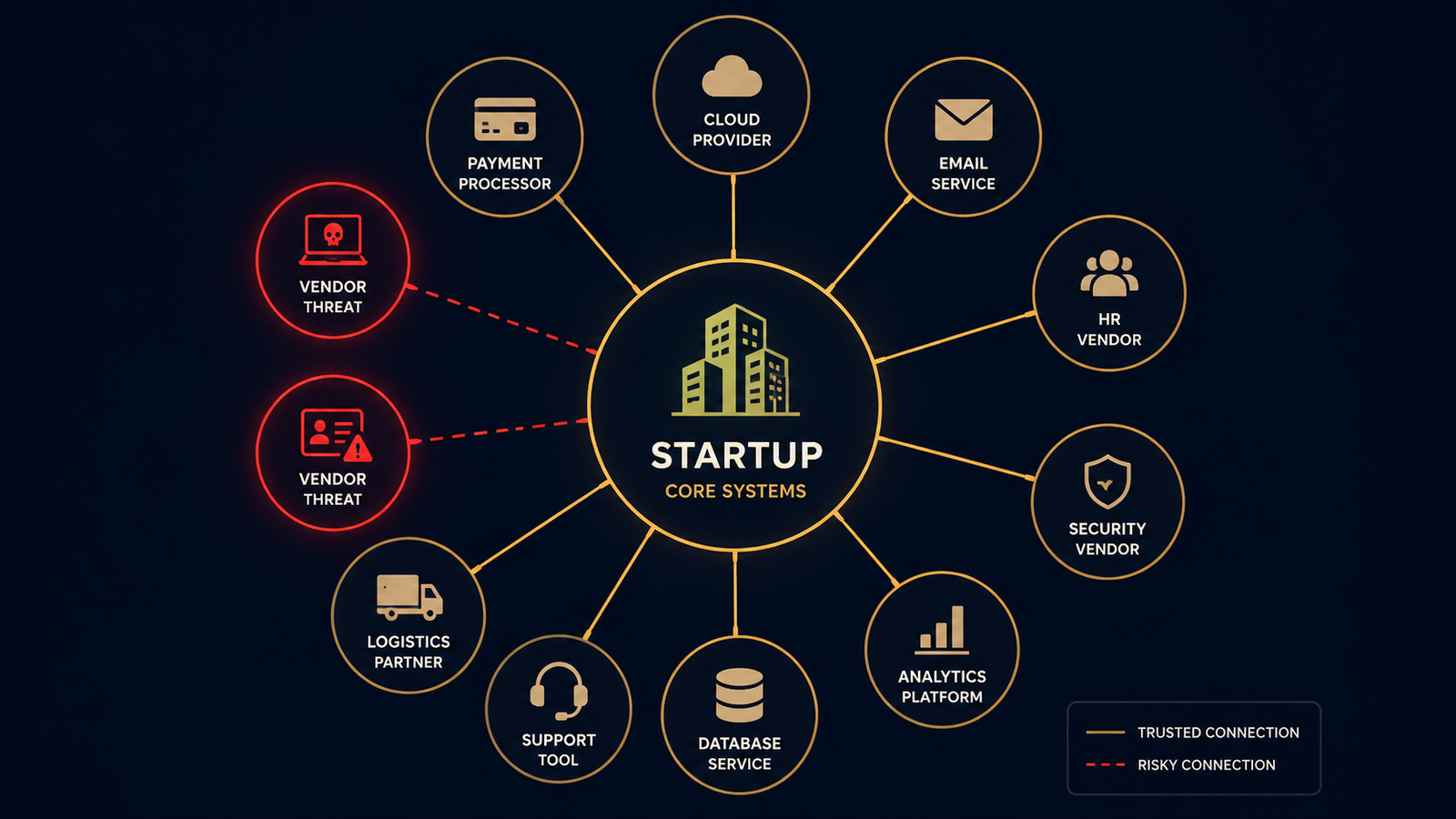
Most startup founders think vendor risk management is a problem for large enterprises — the kind of thing that Fortune 500 companies worry about when they have hundreds of suppliers, compliance teams, and dedicated risk officers.
That assumption is wrong, and in 2026, it is increasingly dangerous.
The vendor risk management market reached $15 billion in 2026, growing at 12% annually — not because large corporations suddenly discovered the problem, but because the scale of third-party risk has grown to the point where every company with more than a handful of vendors faces real exposure.
Supply chain cyber attacks surged 431% between 2021 and 2023. The average company now manages 286 vendors, up from 237 in 2024. And 63% of third-party risk management programs run on just one or two dedicated employees — while managing 300 or more vendor relationships simultaneously.
For startups, the stakes are uniquely high. A data breach through a vendor can destroy customer trust before you have had time to build it. A regulatory failure in your supply chain can trigger compliance problems that your small legal team is not equipped to handle. A critical vendor going dark can take your product offline.
This guide explains what vendor risk management actually means for startups in 2026, how to build a lightweight but effective program, and what the data says about where the real risks are.
Why Vendor Risk Is a Startup Problem in 2026
The Vendor Ecosystem Has Exploded
A typical early-stage startup in 2026 uses more third-party services than a mid-sized company did ten years ago. Cloud infrastructure, payment processing, customer support software, marketing automation, sales tooling, HR platforms, legal software, accounting tools, data analytics — each of these is a vendor relationship that carries risk.
The average company manages 286 vendors. For a 10-person startup, that number is likely lower, but the concentration of dependency is often higher: a single critical vendor failure — your cloud provider, your payment processor, your data warehouse — can be more damaging to a startup than to a large enterprise that has redundancy built in.
Cyber Risk Through Vendors Is Now the Top Concern
Vendor cybersecurity risk is the top concern entering 2026, ahead of financial and operational risk. This is not theoretical. Crunchyroll confirmed a data breach at its business process outsourcing partner Telus in early 2026 — an attacker gained access to millions of customer support ticket records after infecting a Telus agent’s workstation with malware. The breach happened at a vendor, but the damage landed on Crunchyroll’s customers and reputation.
For startups handling customer data — which is almost every B2B and B2C startup — a vendor breach is your breach in the eyes of your customers, regardless of where the failure originated.
Regulation Is Tightening — Fast
DORA (Digital Operational Resilience Act) is now fully enforced in the EU, requiring financial services companies and their technology vendors to demonstrate operational resilience and third-party oversight. GDPR enforcement on vendor data processing continues to intensify. In the US, SEC cybersecurity disclosure rules now require public companies to disclose material third-party breaches within four business days.
None of these regulations apply exclusively to large companies. If you are selling to enterprise customers in regulated industries — financial services, healthcare, legal — your vendor risk program will increasingly be a procurement requirement, not just a best practice.
AI Is Creating New Vendor Risk Categories
AI vendors represent an entirely new risk category that most startup founders have not yet systematically addressed. 23% of organizations do not monitor vendor AI usage — down from 37% in 2024, but still a significant gap. As startups integrate AI tools into their core workflows — customer support, sales outreach, data analysis, product development — the risk surface expands.
The specific risks: data leakage through AI vendor training processes, algorithmic bias affecting customer outcomes, and regulatory non-compliance when AI tools process personal data without appropriate governance.
The Four Categories of Vendor Risk Startups Face
1. Cybersecurity Risk
The most acute and immediate risk for most startups. A vendor that has access to your systems, your customer data, or your infrastructure is a potential attack vector.
What to assess: Does the vendor have SOC 2 Type II certification? Do they have a published security policy? Have they experienced a breach in the past 24 months? What data do they actually have access to — and do they need all of it?
Red flags: Vendors who cannot produce a security questionnaire response, who resist providing audit reports, or who request broader data access than their service requires.
2. Operational Risk
The risk that a vendor failure disrupts your operations — they go offline, they change their pricing dramatically, they get acquired and sunseted, or they simply stop supporting the features you depend on.
What to assess: How critical is this vendor to your core product? What happens if they go dark tomorrow? Do you have contractual protections — SLAs, data portability clauses, exit provisions?
Red flags: Single-vendor dependency for any critical function, vendors without enterprise SLAs at your tier, services where your data is locked in proprietary formats.
3. Compliance and Regulatory Risk
The risk that your vendor’s practices create regulatory exposure for your company — particularly in data processing, financial services, healthcare, and AI.
What to assess: Does this vendor’s data processing comply with GDPR, CCPA, HIPAA (if applicable)? Do they have a Data Processing Agreement (DPA) in place? Are they compliant with any industry-specific regulations your customers operate under?
Red flags: Vendors who resist signing a DPA, vendors headquartered in jurisdictions with inadequate data protection laws, vendors using customer data for training AI models without explicit consent.
4. Financial and Business Risk
The risk that a vendor’s financial instability creates problems for your business — they raise prices dramatically, go bankrupt, or get acquired by a competitor.
What to assess: Is the vendor venture-backed and potentially burning cash unsustainably? Are they a single-product company with no diversified revenue? What are your contractual protections if they change pricing or terms?
Red flags: Vendors offering unusually low prices (unsustainable unit economics), vendors with no published funding or revenue information, vendors with no exit/data portability provisions in their contracts.
Building a Vendor Risk Program: The Startup Framework
Most vendor risk management frameworks are built for enterprise organizations with dedicated risk teams, six-figure software budgets, and annual assessment cycles. Startups need something different: a lightweight, founder-executable program that identifies the real risks without creating bureaucratic overhead.
Here is a four-step framework that a two-person team can implement in a week.
Step 1: Build Your Vendor Inventory
Start with a complete list of every third-party service your company uses. This is more extensive than most founders realize. Include:
- Infrastructure and cloud (AWS, GCP, Azure, Vercel, etc.)
- Payment processing (Stripe, Braintree, etc.)
- Customer data tools (CRM, support software, analytics)
- Marketing and sales tools (email platforms, ad networks)
- HR and payroll (especially critical — payroll vendors have access to highly sensitive employee data)
- Legal and financial software
- AI tools (this category is growing rapidly)
- Any contractors or freelancers with system access
For each vendor, record: what data they can access, what systems they integrate with, and how critical they are to your core product.
Step 2: Classify by Risk Tier
Not every vendor needs the same level of scrutiny. Classify each vendor into one of three tiers:
Tier 1 — Critical: Vendors whose failure or breach would immediately impact your product, your customers, or your compliance posture. Examples: cloud infrastructure, payment processor, primary database, core API dependencies. These vendors get full security assessment, contractual review, and quarterly monitoring.
Tier 2 — Important: Vendors whose failure would create significant operational disruption but not immediate customer impact. Examples: email platform, CRM, analytics. These vendors get a security questionnaire and annual review.
Tier 3 — Standard: Vendors whose failure would be inconvenient but manageable. Examples: project management software, design tools, scheduling software. These vendors get basic due diligence — check for SOC 2, confirm DPA, review terms.
Step 3: Assess Your Tier 1 and Tier 2 Vendors
For Tier 1 vendors, request:
- SOC 2 Type II report (or ISO 27001 certification)
- Security questionnaire response (standardized questionnaires like CAIQ or SIG are free to download)
- Completed Data Processing Agreement
- Evidence of penetration testing in the last 12 months
- Incident response policy
For Tier 2 vendors, at minimum:
- Confirm SOC 2 or equivalent certification
- Sign a Data Processing Agreement
- Review breach notification terms in the contract
Step 4: Put Contractual Protections in Place
The most common vendor risk failure for startups is not the security assessment — it is the contract. Specifically:
Data portability: Can you export all your data in a usable format if you need to leave? Many SaaS vendors make this deliberately difficult. Ensure your contract includes explicit data export rights.
Breach notification: How quickly will the vendor notify you of a breach? GDPR requires notification within 72 hours — your vendor contract should match or exceed this.
Uptime SLA: What is the vendor’s committed uptime, and what are the remedies if they miss it? For Tier 1 vendors, a 99.9% SLA with meaningful financial remedies is the minimum bar.
Price protection: Does the vendor have the right to change pricing unilaterally with minimal notice? Negotiate for price protection periods, especially for annual contracts.
The AI Vendor Risk Problem Founders Are Ignoring
The most underaddressed vendor risk in 2026 is AI tool usage. Startups are integrating AI tools into every function — and most are not systematically assessing the risk.
The specific issues:
Training data risk. Some AI vendors use customer inputs to train their models. If your employees are inputting customer data, proprietary business information, or sensitive financial data into AI tools, that data may be used for model training — potentially exposing it to other users.
Data residency. AI processing often happens in data centers that may not comply with your customers’ data residency requirements. An EU customer who requires data to stay in the EU is affected by an AI vendor that processes in the US.
Vendor lock-in. AI tools that become embedded in workflows create significant switching costs. The more deeply an AI vendor is integrated into your operations, the harder it becomes to migrate if their pricing changes or their quality deteriorates.
Practical steps for AI vendor risk:
- Check each AI vendor’s data processing terms explicitly for training data usage
- Opt out of model training where the option exists (many enterprise tiers include this)
- Confirm data residency for any AI tools processing customer data
- Document which AI tools have access to what data — and review quarterly
What Good Looks Like: Benchmarks from 2026
Based on the most recent third-party risk management data:
96% of organizations report that their vendor risk program delivers measurable ROI — the cost of vendor risk incidents consistently exceeds the cost of prevention.
87% of organizations say their primary objective is reducing risk exposure — but only 22% have fully defined metrics to measure their program’s effectiveness. For startups, this means you can get significant risk reduction benefit from a basic, well-executed program that most organizations are not running.
13% of organizations have fully mature automation capabilities in vendor risk management. This is the opportunity: AI-enabled vendor risk tools are becoming accessible to startups, allowing small teams to monitor vendor risk at a scale previously requiring dedicated teams.
49% of programs have the authority to block new vendors due to risk. This is a governance maturity milestone worth targeting: the ability to say “we cannot use this vendor until they meet our security requirements” is a meaningful signal that your program is operational, not theoretical.
Practical Tools for Startup Vendor Risk Management
You do not need expensive enterprise GRC software to run an effective vendor risk program. Here are the tools that work for startups:
Free / Low Cost:
- Google Sheets / Notion: Vendor inventory and tier classification — free, good enough for sub-50 vendor portfolios
- CAIQ (Consensus Assessments Initiative Questionnaire): Free standardized security questionnaire from the Cloud Security Alliance
- SecurityScorecard Free Tier: Continuous security monitoring for your Tier 1 vendors
- Standard DPA templates: Available free from IAPP and various law firm resources
Mid-Market (as you scale):
- Venminder: Purpose-built vendor risk management platform, widely used in financial services
- OneTrust Vendor Risk: Integrated with broader privacy and compliance tooling
- Panorays: AI-powered vendor security assessment, faster than manual questionnaires
Also Read: Business Plan for a Startup Business: 3 Real Samples That Raised Funding in 2026
Conclusion
Vendor risk management is not a compliance checkbox. It is a fundamental operational discipline for any startup that processes customer data, depends on third-party infrastructure, or sells into regulated industries.
In 2026, the risk surface has expanded significantly: more vendors per company, more sophisticated cyber threats through supply chains, more regulatory requirements around data processing, and a new category of AI vendor risk that most founders have not yet systematically addressed.
The good news is that a lightweight, systematic program — vendor inventory, tier classification, focused assessment of critical vendors, and basic contractual protections — provides the majority of the risk reduction benefit at a fraction of the cost and complexity of enterprise-grade programs.
Build the program before you need it. Vendor risk failures are almost always preventable in retrospect — and almost always more expensive than prevention would have been.
