

Key Takeaways
- Deep tech now commands 20% of all global VC funding — double its share from a decade ago (Joltoo 2026)
- The global deep tech investment market will grow from $36.2 billion in 2023 to $127.8 billion by 2032 (CAGR 15.2%)
- Goldman Sachs estimates AI companies’ capital spending will exceed $500 billion in 2026
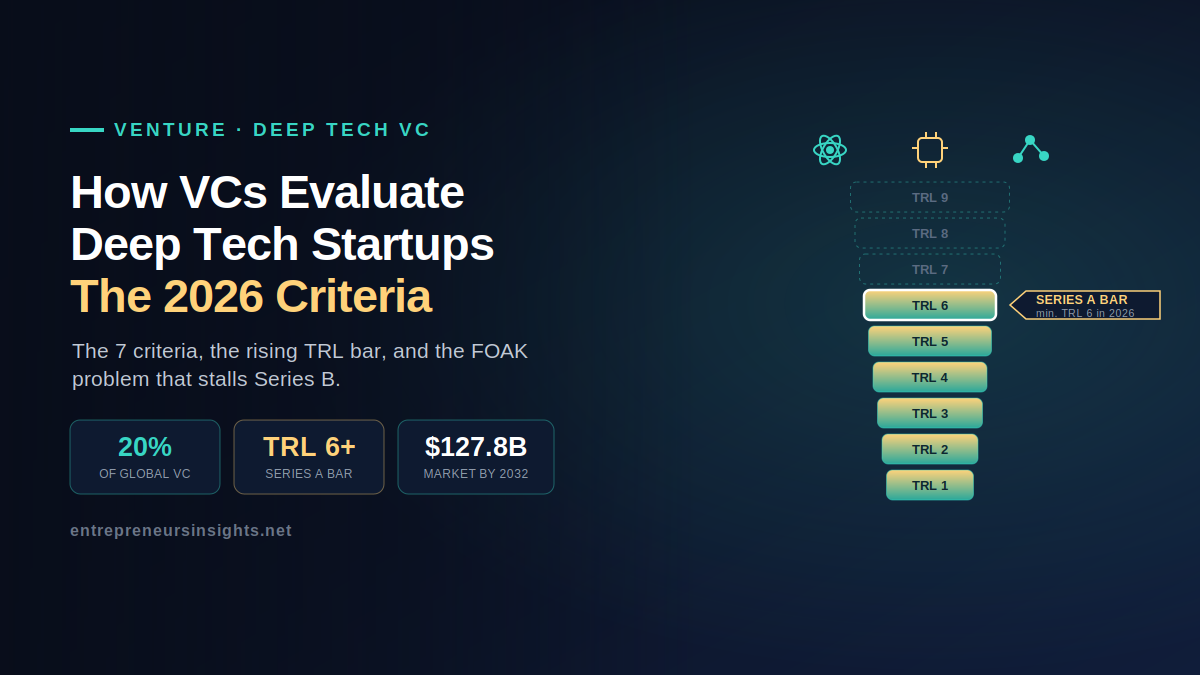
- The TRL (Technology Readiness Level) bar has risen dramatically: most Deep Tech VCs won’t consider Series A without TRL 6+ in 2026 — up from TRL 3-4 acceptable in 2024
- 47% of AI pilots convert to enterprise contracts vs 25% for traditional software — execution speed matters
- The First-of-a-Kind (FOAK) facility problem is the primary Series B barrier — VCs avoid using equity to fund heavy CapEx
- Top Deep Tech VC firms: Breakthrough Energy Ventures, Lux Capital, Andreessen Horowitz Bio Fund, 1517 Fund, Prelude Ventures
- Non-dilutive capital (SBIR grants, DoE loans, ARPA-E awards) has become essential for deep tech capital structure — not just optional funding
Introduction: The Hard Tech Renaissance
It is 2:14 AM, and a founder is staring at a thermal simulation of a modular fusion injector. The physics work. The math is elegant. But the inbox contains three polite rejections from Tier-1 firms, all saying some version of the same thing: “The tech is impressive, but we need to see more de-risking before we can commit.”
This scenario plays out hundreds of times a year in deep tech. And in 2026, the bar for what constitutes “sufficient de-risking” has moved substantially upward from where it was just two years ago.
Deep tech — startups built on fundamental scientific and engineering breakthroughs in quantum computing, advanced AI, synthetic biology, robotics, clean energy, and advanced materials — has quietly become the dominant force in venture capital. What was once a niche category for patient, specialized investors now commands 20% of all global VC funding. The thesis is no longer controversial: the world’s hardest problems will be solved not by software applications, but by companies built on fundamental scientific and engineering breakthroughs.
Capital is flowing. Talent is migrating from big tech to hard tech. Governments are treating deep tech as strategic infrastructure.
But the evaluation criteria have evolved dramatically. This guide explains exactly how VCs evaluate deep tech startups in 2026 — and what founders need to demonstrate to successfully raise at each stage.
What Is Deep Tech?
Deep tech refers to startups grounded in high-impact scientific research and engineering innovation, whose core products are based on significant scientific breakthroughs — not software user experience or business model innovation.
Unlike consumer tech or B2B SaaS, deep tech companies:
- Often originate from academic research or advanced laboratory work
- Have products based on significant scientific or engineering advances
- Face longer development timelines before commercial viability
- Require specialized technical expertise to evaluate
- May need to educate customers about technology categories that do not yet exist
Core deep tech categories:
Artificial Intelligence and Machine Learning: Not AI wrappers or AI-powered software, but fundamental AI research — new model architectures, training methodologies, hardware-software co-optimization. Companies like Anthropic, Mistral, and Cohere sit in this category.
Quantum Computing: Quantum hardware (trapped ions, superconducting qubits, photonic systems), quantum software, and quantum error correction. Involves physics-level engineering that is categorically different from classical computing.
Synthetic Biology: Gene editing (CRISPR and beyond), synthetic genomics, cell engineering, protein design. The combination of biology and engineering at the molecular level.
Advanced Robotics: Autonomous systems beyond software — companies building the hardware, actuation, sensing, and embodied intelligence required for robots to operate in unstructured environments.
Clean Energy Technology: Fusion energy (Commonwealth Fusion Systems, TAE Technologies), advanced fission, grid-scale storage, green hydrogen production, carbon capture. Technology-level innovation, not solar panel installation.
Advanced Materials: New materials with properties not found in nature — metamaterials, 2D materials (graphene, MXenes), high-temperature superconductors, and advanced composites.
Photonics and Semiconductors: Photonic integrated circuits, new semiconductor processes and materials, neuromorphic computing, and optical computing.
How Deep Tech VC Differs From Software VC
Understanding how deep tech VC differs from traditional software investing is essential context for understanding the evaluation criteria.
| Dimension | Software VC | Deep Tech VC |
|---|---|---|
| Primary value driver | Market + execution | Technology + execution |
| Time to revenue | 6-18 months | 3-10 years |
| Capital required | $1-10M to revenue | $10-500M+ to commercial scale |
| Primary risk | Market risk (do customers want this?) | Technology risk (can this be built?) |
| Evaluation expertise | Business model + traction | Technical depth + science |
| Exit timeline | 5-7 years | 8-15 years |
| Investor involvement | Board + network | Technical advisory + government partnerships |
| Key metrics (early) | ARR, NRR, CAC | TRL, IP, technical milestones |
The most important difference: software VCs evaluate market risk (will customers buy this?), while deep tech VCs evaluate technology risk (can this actually be built at commercial scale?). These require fundamentally different evaluation frameworks.
The Technology Readiness Level (TRL) Framework
The most important technical evaluation framework in deep tech investing is the Technology Readiness Level (TRL) scale — originally developed by NASA and now used across defense, energy, and industrial sectors to describe the maturity of a technology.
| TRL | Description | What it means |
|---|---|---|
| TRL 1 | Basic principles observed | Scientific theory, early research |
| TRL 2 | Technology concept formulated | Applied research, no experimental proof |
| TRL 3 | Experimental proof of concept | Lab demonstration of basic principles |
| TRL 4 | Validated in lab environment | Technology components validated in isolation |
| TRL 5 | Validated in relevant environment | Technology integrated into system, tested |
| TRL 6 | Demonstrated in relevant environment | Prototype demonstrated in operational conditions |
| TRL 7 | System prototype in operational environment | Near-commercial system demonstrated |
| TRL 8 | System complete and qualified | Commercial system completed and tested |
| TRL 9 | System proven in operational environment | Commercial deployment |
The 2026 TRL shift:
In 2024, seed rounds were possible at TRL 3-4. Series A was achievable at TRL 4-5. In 2026, the bar has moved dramatically:
- Seed: TRL 3-4 (still feasible, particularly with strong team credentials and non-dilutive co-funding)
- Series A: TRL 6 minimum (most Deep Tech VCs will not seriously consider Series A without a fully functional prototype demonstrated in relevant operational conditions)
- Series B: TRL 7+ with evidence of manufacturing pathway
The practical implication for founders: you need to show a working prototype, not a working theory. “Don’t show me a CAD drawing — show me a video of the hardware failing, being fixed, and then succeeding under stress.” Investors call this “engineering grit” and it has become a primary evaluation signal at Series A.
The 7 Core Evaluation Criteria for Deep Tech VCs in 2026
Criterion 1: Team Technical Depth and Pedigree
In deep tech, the team evaluation is more intensive than in software investing — because the primary risk is technical, and the ability to assess team quality requires genuine technical depth.
What VCs look for:
Scientific credentials: PhDs from top programs in the relevant field, postdoctoral research at leading labs, publications in top-tier journals. This matters more in deep tech than in any other venture category — not because of prestige, but because it signals that the founders understand the scientific state of the art.
Prior deep tech experience: Founders who have previously built deep tech companies — even if the companies did not succeed — have a significant advantage. They have navigated the specific challenges of translating laboratory results to commercial scale.
Domain-specific expertise that is not widely available: The best deep tech founders know things that most people with similar credentials do not know. They have been working on the specific problem for years and have accumulated insights, techniques, and understanding that cannot be replicated quickly.
The team-technology fit question: Is this the team that will solve this specific problem? A stellar quantum computing team does not make a stellar synthetic biology investment — the scientific domains are too different. VCs are looking for teams whose specific expertise is directly relevant to the specific technical challenge they are pursuing.
Criterion 2: Technology Differentiation and IP Position
Deep tech companies live and die by their intellectual property position. Unlike software companies where IP is relatively easy to work around, deep tech IP (patents, trade secrets, proprietary processes) can create genuinely durable moats.
IP portfolio: Does the company have filed patents covering the core technology? Are these patents broad enough to protect the commercial application? Are they in jurisdiction-appropriate markets?
Freedom to operate: Can the company build and sell its product without infringing existing patents? This requires a formal freedom-to-operate (FTO) analysis that VCs will request as part of diligence.
Trade secrets and know-how: Some of the most valuable IP in deep tech is not patentable — it is the accumulated operational knowledge of how to reliably produce a result. Proprietary manufacturing processes, specialized synthesis techniques, and optimized protocols are often more valuable than formal patents.
Reproducibility: Can the core technical result be reproduced reliably? A single experimental result means much less than 100 reproducible results. VCs in deep tech now specifically ask: “What is your reproducibility rate, and how does it vary across experimental runs?”
Criterion 3: Technical Milestone Achievement
Deep tech investors do not primarily evaluate traction the way software investors do — because pre-revenue deep tech companies often have no traction in the commercial sense. Instead, they evaluate technical milestone achievement.
The milestones that matter depend on the specific technology, but the principle is consistent: what technical claims did you make previously, and have you achieved them on the timeline you predicted?
Founders who consistently achieve technical milestones on schedule are demonstrating two things: that the technology is progressing as expected, and that the team can plan and execute against technical goals. Both matter enormously in deep tech investing, where timelines are long and milestone achievement is the primary signal of execution quality.
The technical milestone framework:
Past milestones: What did you say you would achieve and when? What did you actually achieve and when? Any variance from predicted timelines is an opportunity to explain — honest explanations (resources, unexpected technical challenges) are much better than unexplained variance.
Current milestone: What specific technical result are you targeting with the current funding round? What evidence will demonstrate that you have achieved it?
Next milestone: What will you need to demonstrate to raise the next round? Investors want to see that founders understand their own technology development roadmap clearly enough to define specific, measurable milestones two to three stages ahead.
Criterion 4: Manufacturing Pathway and Scale Economics
This is the criterion where the most deep tech companies get stuck — and the one that has become most important in 2026 as investors have accumulated experience with companies that achieved technical success but failed to achieve commercial scale.
The manufacturing pathway question: how does your technology go from laboratory demonstration to commercially competitive product at scale?
Cost reduction roadmap: What is the current cost of production? What is the target production cost required for commercial viability? What specific manufacturing improvements or scale economics will drive the cost from current to target? Deep tech investors want to see a clear, technically grounded pathway — not a projected learning curve.
The FOAK problem: The First-of-a-Kind (FOAK) facility — the first commercial-scale manufacturing plant for a novel technology — is the most common Series B barrier for deep tech companies. Building a FOAK facility requires massive CapEx (often $100M-$1B+) at a stage where the technology has been demonstrated but not commercially proven. VCs are increasingly reluctant to use equity to fund FOAK CapEx. Successful deep tech companies address this through:
- Loan Guarantee Programs (DoE, Ex-Im Bank)
- Strategic partner co-investment (a major corporation with aligned interests)
- Government offtake agreements that de-risk the first commercial facility
- Modular manufacturing approaches that reduce the FOAK investment required
Manufacturing partner relationships: Does the company have existing relationships with manufacturing partners, contract manufacturers, or equipment suppliers? Early relationships in the manufacturing ecosystem signal that the team understands the path from lab to factory.
Criterion 5: Regulatory and Compliance Pathway
Deep tech companies in healthcare, energy, food, agriculture, and defense face regulatory requirements that can take years to navigate and can represent significant capital risk.
Regulatory strategy: Does the company have a clear, realistic regulatory pathway? Have they engaged with the relevant regulatory body (FDA, FAA, EPA, CFTC, NRC)? Do they have regulatory affairs expertise — either in-house or through advisors?
Regulatory timeline and capital requirements: How long will regulatory approval take, and how much capital will be consumed during the regulatory process? This is a key driver of total capital requirements and dilution.
Precedent analysis: Has any company achieved regulatory approval for a similar technology? The presence of regulatory precedent dramatically de-risks the regulatory pathway — the absence of precedent creates both risk and first-mover advantage.
Criterion 6: Market Timing and Adoption Pathway
Deep tech companies often create new markets rather than disrupting existing ones — which means the market adoption challenge is different from software.
Customer education requirement: How much does the target customer need to understand about the technology before they will adopt it? Technologies that require extensive customer education have slower adoption curves and higher CAC than those that can demonstrate clear value with minimal education.
Incumbent transition cost: Will existing incumbent players transition to your technology, or will your technology create new categories? Technologies that require incumbents to abandon existing infrastructure face much slower adoption than those that can be integrated incrementally.
Early adopter profile: Who is the first customer — the customer who will adopt before the technology is fully proven? In deep tech, early adopters are often large organizations (government agencies, major industrial companies) with the risk tolerance and procurement processes to adopt novel technology.
The government offtake strategy: Many successful deep tech companies de-risk early commercial adoption through government contracts — particularly DoD, DoE, and NASA contracts that provide revenue before the commercial market is fully developed. This has become an increasingly important part of deep tech fundraising narratives.
Criterion 7: Capital Efficiency Pathway
Deep tech is inherently capital-intensive — but the investors who fund it still want evidence that capital is being deployed efficiently toward the milestones that matter.
Non-dilutive capital strategy: The best deep tech companies combine VC equity with non-dilutive funding — SBIR grants, DoE loan guarantees, ARPA-E awards, NSF grants, defense contracts — to extend runway and validate technology credibility without additional dilution.
The SBIR program alone provides up to $2M in non-dilutive funding across Phase I and Phase II — significant capital for early-stage deep tech companies. ARPA-E awards average $3M+. DoE loan guarantees can de-risk hundreds of millions in CapEx.
Non-dilutive funding signals three things to VCs: the technology has been independently evaluated and validated (government technical reviewers are genuinely rigorous); the company has the grant-writing and proposal capability that scales to large government contracts; and the founders are building with capital discipline rather than assuming unlimited equity funding.
Capital allocation clarity: Where specifically will the VC funding be deployed? Deep tech investors want a clear allocation of capital to specific technical milestones, not a general operating budget. “We will use $8M to achieve TRL 7 by demonstrating the system at commercial scale in an operational environment, at which point we expect to raise Series B at $50-80M” is much more compelling than “we will use $8M to continue R&D and build the team.”
Deep Tech Fundraising by Stage: What to Expect
Pre-Seed / Seed ($500K-$5M)
What you need:
- Strong founding team with relevant PhD or research credentials
- Clear articulation of the scientific breakthrough and why it is defensible
- TRL 3-4: experimental proof of concept demonstrating the basic principles work
- Non-dilutive funding applications in process (SBIR Phase I at minimum)
- Clear articulation of the technical milestone that this round will achieve
Who invests at seed:
- University tech transfer funds
- Deep tech accelerators (Y Combinator, IndieBio, Cyclotron Road, The Engine)
- Family offices comfortable with long timelines
- Government innovation programs (SBIR, NSF I-Corps)
- Early deep tech specialists (1517 Fund, Countdown Capital)
What to expect: A process focused heavily on team credentials and scientific validity. Investors at this stage often have technical backgrounds themselves — former scientists, engineers, or founders of deep tech companies. The conversation is more technical than a software seed round.
Series A ($5M-$30M)
What you need:
- TRL 6: Fully functional prototype demonstrated in relevant operational conditions
- Evidence that the technology performs as predicted (reproducibility data)
- Manufacturing pathway identified (even if not yet implemented)
- Early customer/partner relationships (LOIs, pilot agreements, DoD contracts)
- Regulatory strategy clear for regulated technology categories
- Non-dilutive capital track record (SBIR Phase II, ARPA-E, or equivalent)
Who invests at Series A:
- Dedicated deep tech VCs (Breakthrough Energy Ventures, Lux Capital, Prelude Ventures, Fifty Years)
- Generalist tier-1 VCs with deep tech focus (a16z Bio Fund, GV, Playground Global)
- Corporate venture arms of relevant industry incumbents (Shell Ventures, BMW i Ventures, Honeywell Ventures)
- Strategic government-adjacent investors (In-Q-Tel for defense/intelligence tech)
What to expect: Intensive technical diligence, potentially including independent technical experts hired by the VC to validate the core scientific claims. Due diligence timelines are longer than software — 3-6 months is common for Series A deep tech.
Series B ($30M-$150M)
What you need:
- TRL 7+: System-level prototype demonstrated in operational environment
- Pilot customer paying (even if at below-commercial scale)
- Manufacturing pathway defined with cost reduction roadmap
- FOAK facility strategy (government loan guarantee, strategic partner, or modular approach)
- Clear path to commercial-scale unit economics
Who invests at Series B:
- Growth-stage deep tech specialists (Lux Capital, NEA, General Catalyst)
- Crossover investors with deep tech mandates (Tiger Global, Coatue — for companies demonstrating commercial traction)
- Sovereign wealth funds and institutional investors (ADIA, Temasek — particularly for climate tech)
- Large corporate strategics (for companies that represent potential acquisition targets)
The Top Deep Tech VC Firms in 2026
Specialized Deep Tech VCs
Breakthrough Energy Ventures: Bill Gates-backed, focused exclusively on climate and energy technology. Portfolio includes Commonwealth Fusion Systems, Form Energy, and Verdagy.
Lux Capital: Long-term deep tech investor with portfolio across defense tech, health tech, and materials. Known for backing companies before they were obvious.
Prelude Ventures: Climate and energy focus, early-stage. Strong government contract network.
1517 Fund: Focused on technical founders without traditional credentials (Thiel Fellowship model). Early stage, high risk tolerance.
Fifty Years: Deep tech with particular focus on biotech and climate. Known for patient capital and mission alignment.
Countdown Capital: Industrial deep tech focus — companies building in physical infrastructure, manufacturing, and industrial operations.
Generalist Firms With Deep Tech Practices
Andreessen Horowitz (a16z): Bio Fund for biotech, American Dynamism for defense and national security tech. Two dedicated deep tech practices with specialized investment teams.
GV (Google Ventures): Strong in biotech, life sciences, and hardware. Google’s technical depth creates unique diligence advantages.
Playground Global: Founded by ex-Google hardware veterans. Focus on the “full stack” of hard tech — hardware, software, and manufacturing.
In-Q-Tel: Government-adjacent investor backing companies with defense and intelligence applications. Not a traditional VC — investment is strategic, but commercial companies regularly receive In-Q-Tel backing.
How to Prepare for Deep Tech VC Diligence
The deep tech due diligence process is more intensive and more technical than any other VC category. Founders who are well-prepared move through diligence faster and with less friction.
Technical documentation package:
- Comprehensive IP portfolio overview (patents filed, trade secrets documented)
- Reproducibility data (not just best-case results — average and variance)
- Independent technical validation (third-party lab testing, academic collaboration results)
- TRL assessment with specific evidence for each claim
- Manufacturing pathway analysis with cost reduction roadmap
Non-dilutive funding track record:
- SBIR awards received and milestone achievement
- ARPA-E, NSF, DoE grants received
- Defense contracts and government revenue
- These signals validate the technology independently and demonstrate capital efficiency
Technical milestone documentation:
- Historical milestones: what was predicted and what was achieved
- Current milestone: what the current round will achieve and on what timeline
- Next milestone: what will be needed to raise the subsequent round
Regulatory strategy documentation:
- Clear articulation of regulatory pathway for each target market
- Regulatory affairs advisor or in-house expertise identified
- Timeline and capital requirements for regulatory process
Frequently Asked Questions
Q: What is deep tech venture capital? A: Deep tech venture capital is a specialized category of investing that focuses on startups developing science and engineering-based technologies aimed at solving complex, fundamental problems. Unlike consumer tech or B2B SaaS, deep tech companies develop products based on significant scientific breakthroughs in areas like quantum computing, AI hardware, synthetic biology, advanced robotics, clean energy, and advanced materials. Deep tech VCs accept longer timelines, higher capital requirements, and more technical risk in exchange for exposure to potentially transformational technologies.
Q: What TRL level do deep tech startups need to raise Series A in 2026? A: Most deep tech VCs will not seriously consider Series A without TRL 6 — a fully functional prototype demonstrated in relevant operational conditions. This bar has risen dramatically from 2024, when TRL 3-4 was often sufficient for Series A. The shift reflects investor learning from companies that demonstrated promising laboratory results but failed to achieve commercial scale.
Q: What is the First-of-a-Kind (FOAK) problem in deep tech? A: The FOAK problem refers to the challenge of funding the first commercial-scale manufacturing facility for a novel technology. Building a FOAK facility typically requires $100M-$1B+ in capital at a stage where the technology has been demonstrated but not commercially proven. VCs are reluctant to use equity for this CapEx-intensive phase. Successful deep tech companies address FOAK through DoE Loan Guarantee Programs, strategic partner co-investment, government offtake agreements, or modular manufacturing approaches that reduce initial CapEx requirements.
Q: How important is non-dilutive funding for deep tech startups? A: Extremely important — in 2026, non-dilutive funding (SBIR grants, ARPA-E awards, DoE loans, defense contracts) has become essentially expected as part of a deep tech company’s capital structure, not just an optional supplement. Non-dilutive funding signals to VCs that the technology has been independently validated, demonstrates capital discipline, and extends runway without additional dilution. Deep tech startups that have built a track record of non-dilutive funding are materially more fundable than those relying entirely on equity.
Q: What is the global deep tech VC market size? A: The global deep tech investment market is expected to grow from $36.2 billion in 2023 to $127.8 billion by 2032, reflecting a CAGR of 15.2% (Dataintelo). Deep tech now commands approximately 20% of all global VC funding — double its share from a decade ago. Goldman Sachs estimates that AI companies’ capital spending alone will exceed $500 billion in 2026.
Q: Which firms are the top deep tech VCs in 2026? A: Leading dedicated deep tech VCs include Breakthrough Energy Ventures (climate/energy focus), Lux Capital (broad deep tech), Prelude Ventures (climate tech), 1517 Fund (early-stage technical founders), and Fifty Years (biotech and climate). Major generalist firms with strong deep tech practices include a16z (Bio Fund, American Dynamism), GV (Google Ventures), Playground Global, and In-Q-Tel (government-aligned). Sovereign wealth funds including ADIA, Temasek, and Saudi PIF are becoming increasingly significant capital sources for late-stage deep tech.
Q: How long does deep tech due diligence typically take? A: Deep tech due diligence is significantly longer than software VC diligence. Seed rounds may close in 4-8 weeks. Series A typically takes 3-6 months and often includes independent technical experts hired by the VC to validate core scientific claims. Series B and beyond can take 6-12 months given the complexity of manufacturing pathway validation, regulatory analysis, and strategic fit assessment.
