
Key Takeaways
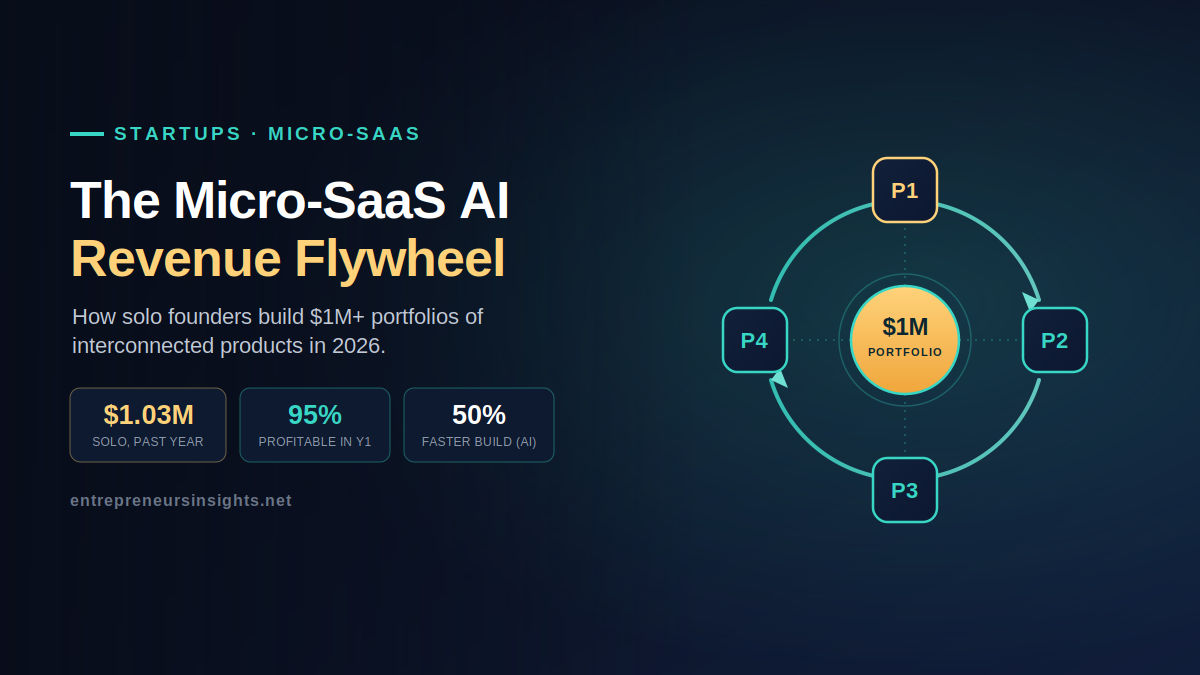
- Marc Lou made $1.03M in the past 12 months from a portfolio of micro-SaaS products built solo — ShipFast ($20K/mo), DataFast ($15.8K MRR), ByeByeAI ($4K MRR in three weeks)
- Pieter Levels runs Photo AI at $132K MRR by himself — and built Nomad List ($1.5M ARR) from a spreadsheet
- 95% of micro-SaaS businesses reach profitability in their first year (Freemius 2025)
- The median profitable micro-SaaS sits at $4.2K MRR; top 1% exceed $50K MRR
- AI coding assistants cut development time by 50% — a solo founder can now ship what took a team of 5 in 2019
- The interconnected portfolio model: products that share a customer base, data layer, or distribution channel compound faster than isolated products
- 90% of AI wrapper startups fail — vertical specificity with proprietary data is the only durable model in 2026
- Vertical SaaS is growing 18-22% CAGR — 2-3x faster than horizontal SaaS
Introduction: The Portfolio Model That Is Reshaping Solo Founder Economics
Something unusual happened in the micro-SaaS world over the past two years. The founders who are generating the most impressive revenue are not the ones who built one great product — they are the ones who built interconnected portfolios of small, focused products that compound on each other.
Marc Lou did not make $1.03M from one product. He made it from ShipFast, DataFast, ByeByeAI, and several other micro-products that share an audience, a brand, and a distribution strategy. Each new product launches to an existing customer base that already trusts the brand. The marginal cost of customer acquisition for product three is dramatically lower than it was for product one. That is the flywheel.
This model — what we call the interconnected micro-SaaS AI revenue flywheel — is becoming the dominant strategy for independent software founders in 2026. And it is being accelerated by AI in ways that were not possible even two years ago.
What Is a Micro-SaaS?
Micro-SaaS is a small, focused software product that solves one problem for a specific niche — built and run by one person or a tiny team, without venture capital, without enterprise sales, and without ambitions for a billion-dollar exit.
The defining characteristics:
- Narrow scope: One core workflow, not a platform
- Specific audience: One industry, one role, or one use case
- Small team: Solo to 3-4 people maximum
- Bootstrapped: No VC funding, profitable from early months
- Recurring revenue: Subscription model, $19-$299/month per customer
In 2026, the tools to build micro-SaaS are better than ever. AI coding assistants (Cursor, GitHub Copilot) cut development time by 50%. Supabase and Vercel handle infrastructure without DevOps. Stripe makes billing trivial. A solo founder with solid engineering skills can build and ship a functional SaaS product in 2-4 weeks — versus 3-6 months in 2019.
The result: the economics of micro-SaaS have shifted dramatically. Lower build cost + AI-assisted development + better no-code infrastructure = more products shipped by smaller teams at lower capital cost.
The Revenue Flywheel: Why Portfolios Compound Faster Than Single Products
The most important insight about the successful micro-SaaS founders of 2026 is not what they built — it is how they built it.
The naive micro-SaaS strategy: build one product, scale it to $10K MRR, then build another unrelated product and repeat.
The flywheel strategy: build interconnected products that share a customer base, a distribution channel, a brand, or a data layer — so that each new product benefits from everything the previous products have built.
How the Flywheel Works
Stage 1 — Anchor Product: Build the first product for a specific audience. Focus on one painful, specific workflow. Charge enough to be profitable quickly ($49-$199/month). Build in public to generate an audience.
Stage 2 — Audience Asset: As the anchor product grows, you accumulate email subscribers, Twitter/X followers, community members, and customers who trust your brand. This audience is an asset — it becomes the distribution channel for everything you build next.
Stage 3 — Adjacent Product: Build a second product that serves the same audience but solves a different problem. Launch to your existing audience first. CAC for product 2 is dramatically lower than CAC for product 1 — you are selling to people who already know and trust you.
Stage 4 — Data Layer: As multiple products share a customer base, you begin accumulating cross-product behavioral data. Which customers use both products? What workflows connect them? This data reveals integration opportunities and product extension ideas that competitors without the portfolio cannot see.
Stage 5 — Integration Value: Connect the products at the data or workflow level. A customer who uses two integrated products has switching costs that are exponentially higher than a customer of a single product. Integration creates lock-in that pure feature competition cannot.
Stage 6 — Portfolio Network Effect: Each new product adds value to existing products (through cross-sell and data sharing) and benefits from the distribution of existing products (through the audience asset). The portfolio accelerates with each addition.
Marc Lou’s Portfolio: The Flywheel in Practice
Marc Lou’s $1.03M annual portfolio is the clearest public example of the flywheel strategy in action:
ShipFast ($20K/month): A Next.js boilerplate for quickly shipping SaaS products. Serves technical founders who want to launch fast. Built an audience of engineers and indie hackers.
DataFast ($15.8K MRR): Analytics specifically for ShipFast users and similar solo founders — the exact audience that ShipFast built. Launched to an existing audience that already trusted the brand.
ByeByeAI ($4K MRR in three weeks): An AI content detector. Launched to the same technical founder audience. The speed of monetization (three weeks to $4K MRR) was possible because the audience already existed.
The key observation: each product serves the same audience (technical founders building indie products). The audience Marc built with ShipFast became the primary distribution channel for every subsequent product. The marginal cost of acquiring a new customer for DataFast was a fraction of the cost it was for ShipFast, because the audience already existed.
The AI Advantage: Why 2026 Is the Best Year to Build Micro-SaaS
AI has changed the economics of micro-SaaS in three specific ways:
1. Development Speed
AI coding assistants have cut development time for experienced developers by approximately 50% — and enabled non-developers to build functional software for the first time. A feature that took two weeks in 2022 takes one week in 2026. A product that took three months to MVP takes six weeks.
For portfolio builders, this is transformative: the time between idea and launch has compressed dramatically. A founder who previously could ship two products per year can now ship four or five — compressing the timeline from initial product to flywheel.
Specific tools driving this:
- Cursor: AI-native code editor that writes, reviews, and refactors code from natural language descriptions
- GitHub Copilot: AI pair programmer embedded in VS Code
- v0 by Vercel: UI generation from text descriptions
- Claude Code / ChatGPT: Architecture planning, debugging, code generation
2. AI as Product Core
In 2026, AI is not just building micro-SaaS — it is the core value proposition of the best-performing micro-SaaS products.
The specific AI capabilities that are most monetizable in micro-SaaS:
- Document and text processing: Extracting structured data from unstructured documents (contracts, invoices, reports, emails)
- Industry-specific content generation: Writing specific to a role, industry, or format that general-purpose tools handle poorly
- Workflow automation with judgment: Tasks that require contextual understanding that rule-based automation cannot handle
- Vertical-specific analysis: AI models fine-tuned on domain data that outperform general models for specific industry tasks
3. Vertical Specificity as Moat
The AI wrapper era is over. Products that simply put a UI on top of GPT-4 with no differentiation are failing: 90% of AI wrapper startups will fail, with 60-70% generating zero revenue (Market Clarity 2025). Margins for AI wrappers are just 25-35% versus 70-85% for traditional SaaS.
The products that are succeeding are vertically specific — built for one industry, one role, or one workflow, with proprietary data that makes the AI meaningfully better than a general model.
Vertical SaaS is growing at 18-22% CAGR — 2-3x faster than horizontal SaaS. The reason: vertical products are harder for AI to replicate because they are built on domain expertise, proprietary data, and workflow integration that general models cannot match.
The Interconnected Portfolio: 5 Models That Work
Not all portfolio structures generate flywheel compounding. The ones that do share a specific architecture — products that are genuinely interconnected, not just built by the same person for different audiences.
Model 1: Same Audience, Different Problems
The Marc Lou model. Build multiple products for the same specific audience — in his case, technical founders building indie products. Each product solves a different problem for the same people.
Why it works: The audience is the asset. Distribution costs collapse after the first product. Trust transfers across products. Cross-sell opportunities are natural.
Example portfolio:
- Product 1: Scheduling tool for freelance designers
- Product 2: Invoice and contract templates for freelance designers
- Product 3: Portfolio website builder for freelance designers
All three products serve the same freelance designer audience. Customers of Product 1 are natural buyers of Products 2 and 3.
Model 2: Same Workflow, Adjacent Steps
Build products that address different steps in the same core workflow. When products address sequential steps in a workflow, customers who do step 1 naturally need step 2.
Example portfolio:
- Product 1: AI tool that researches and profiles prospect companies
- Product 2: AI tool that drafts personalized outreach emails for those prospects
- Product 3: Follow-up sequence automation for the outreach started in Product 2
The workflow is sales prospecting. Each product serves the same salesperson and addresses a sequential step in their workflow.
Model 3: Vertical Depth Portfolio
Build one product per industry vertical, each addressing the same type of problem in different industries. Share the technology layer across products while specializing the data layer for each vertical.
Example portfolio:
- Product 1: AI contract review for real estate transactions
- Product 2: AI contract review for freelance/consulting agreements
- Product 3: AI contract review for SaaS subscription agreements
The underlying AI capability is similar across all three products. The domain data (real estate contract patterns, freelance agreement norms, SaaS terms) is vertical-specific and proprietary. Each product builds data that makes the AI better for that vertical.
Model 4: Data Aggregation Flywheel
Build products where each user contributes data that makes the product more valuable for all users. G2’s model: users write reviews, vendors pay to access them. The review data makes G2 more valuable as more users contribute.
For micro-SaaS, this model is accessible in niches where users generate benchmarks, pricing data, performance data, or market intelligence that is valuable to others in the same industry.
Example portfolio:
- Product 1: Analytics tool for newsletter creators (each subscriber contributes anonymized benchmark data)
- Product 2: Newsletter benchmark report tool (powered by the aggregate data from Product 1)
- Product 3: Newsletter monetization optimization (recommendation engine powered by cross-creator performance data)
Each product generates data that makes the others more valuable.
Model 5: Infrastructure + Applications
Build one infrastructure product that serves a specific audience, then build application-layer products on top of that infrastructure.
Example portfolio:
- Product 1: API for parsing and extracting data from legal documents (infrastructure)
- Product 2: Contract review app for small law firms (application layer using Product 1’s API)
- Product 3: Due diligence checklist automation for M&A attorneys (application layer using Product 1’s API)
The infrastructure product (Product 1) generates revenue from direct API customers and from powering the application products. The application products have lower development cost because they build on the infrastructure layer.
Building the Flywheel: A 12-Month Framework
Months 1-3: Anchor Product
Week 1-2: Validate the problem. Find 10 people in the target audience and ask if they would pay for a solution. Pre-sell if possible.
Week 3-8: Build the MVP. Use AI coding tools to accelerate development. Ship when it solves the core problem, not when it is perfect.
Week 9-12: Iterate and convert. Get to 10 paying customers. This is the signal that the product works.
Distribution: Build in public from day one. Tweet about your build process, your customer conversations, your revenue milestones. The audience you build here is the most valuable asset for future products.
Months 4-6: Audience Building
Primary goal: Build the distribution asset — email list, social following, community — before you need it for your next product.
Tactics:
- Weekly newsletter documenting learnings and revenue milestones
- Twitter/X build-in-public updates
- Niche community participation (relevant subreddits, Slack groups, Discord servers)
- Content marketing targeting the audience’s search queries
A founder with 5,000 engaged email subscribers has a significant distribution advantage for their next product launch over a founder with 500.
Months 7-9: Second Product
How to choose: Listen to your existing customers. What is the next problem they hit after solving the first one? This is the natural adjacent product.
Launch strategy: Email your existing audience first. Offer early-access pricing to existing customers. Their feedback shapes the product faster than any other source.
What changes: CAC for Product 2 should be 50-80% lower than CAC for Product 1, because you are launching to an existing warm audience. If it is not, you have chosen an adjacent product that does not naturally appeal to your existing audience — a signal to reconsider the product choice.
Months 10-12: Integration and Data Layer
Connect the products: Build integrations between Product 1 and Product 2. Customers who use both should get a demonstrably better experience than customers who use either alone.
Build the data layer: What data does the cross-product customer generate? How can you use this data to improve both products? What patterns across your customer base do you now have access to that competitors do not?
The flywheel signal: If revenue for Product 1 increases after you launch Product 2 (because the products refer customers to each other), the flywheel is working. If NRR for customers who use both products is higher than for single-product customers, the integration moat is building.
The 10 Best Niches for Micro-SaaS AI Portfolios in 2026
Based on the criteria that produce durable micro-SaaS businesses — specific audience, painful workflow, willingness to pay, and AI monetizability — these are the most promising niches in 2026:
1. Healthcare administration: Intake forms, prior authorization documentation, clinical notes — painful, manual, high willingness to pay.
2. Legal operations: Contract review, due diligence, compliance documentation — high value per document, clear ROI.
3. Construction and real estate: Permit applications, inspection reports, project documentation — highly manual, AI-amenable.
4. Recruiting and HR: Job description optimization, candidate screening, offer letter generation — high frequency, clear value.
5. Accounting and bookkeeping: Invoice processing, expense categorization, audit preparation — high accuracy requirements, proprietary client data.
6. E-commerce operations: Product description generation, inventory management automation, return processing — high volume, clear ROI.
7. Property management: Lease management, maintenance request routing, tenant communication — recurring workflows, specific niche.
8. Logistics back office: Freight documentation, customs forms, carrier communication — manual, high error cost.
9. Independent creator tools: Newsletter analytics, content repurposing, audience analytics — growing market, specific workflows.
10. Vertical-specific CRM: CRM systems designed for one specific industry (tattoo studios, music teachers, pet groomers) — high loyalty, low competition from generalist tools.
The Metrics That Predict Flywheel Success
Cross-product adoption rate: What percentage of your customers use more than one product? Above 20% signals flywheel momentum. Above 40% signals strong flywheel dynamics.
NRR differential: Do multi-product customers have higher NRR than single-product customers? They should — the integration moat should reduce churn and increase expansion.
CAC trajectory: Is CAC declining for each successive product launch? If yes, the audience asset is working. If CAC for Product 3 is the same as for Product 1, you are not building on the audience asset effectively.
Organic traffic compounding: Is organic traffic growing faster than paid channels? Content built for one product often drives discovery for adjacent products — a compounding SEO effect that single-product founders cannot generate.
Frequently Asked Questions
What is the Micro-SaaS AI revenue flywheel?
The Micro-SaaS AI revenue flywheel is a portfolio strategy where solo founders build multiple interconnected software products that share a customer base, distribution channel, data layer, or workflow integration. Each product amplifies the others — reducing CAC for new products, increasing retention for existing products, and building data moats that compound over time. Marc Lou’s $1.03M annual portfolio is the most prominent public example.
How much can a solo founder make from a micro-SaaS portfolio in 2026?
The range is wide. The median profitable micro-SaaS sits at $4.2K MRR. The top 1% exceed $50K MRR. Portfolio builders like Marc Lou ($1.03M/year) and Pieter Levels ($1.5M+ ARR from multiple products) demonstrate that $500K-$2M+ annual revenue is achievable for solo founders with the right portfolio strategy. 95% of micro-SaaS businesses reach profitability in their first year.
How has AI changed micro-SaaS in 2026?
Three ways: (1) AI coding assistants have cut development time by 50%, allowing solo founders to ship more products faster; (2) AI capabilities (document processing, content generation, workflow automation) have become the core value proposition of the best-performing micro-SaaS products; (3) Vertical specificity has become essential — AI wrappers without proprietary data are failing, while vertically specific products with domain data are growing at 18-22% CAGR.
What makes a micro-SaaS portfolio “interconnected”?
An interconnected portfolio shares at least one of: the same customer base (products serve the same audience), sequential workflow steps (products address different steps in the same customer journey), a shared data layer (products generate data that improves each other), or technical integration (products work better when used together). Unconnected portfolios — different products for different audiences — do not generate flywheel compounding.
What niches work best for micro-SaaS AI portfolios in 2026?
[The best niches combine a specific, reachable audience with painful manual workflows that AI can automate with high accuracy. Top niches in 2026: healthcare administration, legal operations, construction documentation, recruiting and HR, accounting and bookkeeping, e-commerce operations, property management, logistics back office, creator tools, and vertical-specific CRM.
How long does it take to build a micro-SaaS to profitability?
95% of micro-SaaS businesses reach profitability in their first year. With AI coding tools accelerating development, MVPs can be shipped in 2-6 weeks. Most founders reach their first 10 paying customers within 1-3 months of launch with targeted distribution to the right niche community.
