

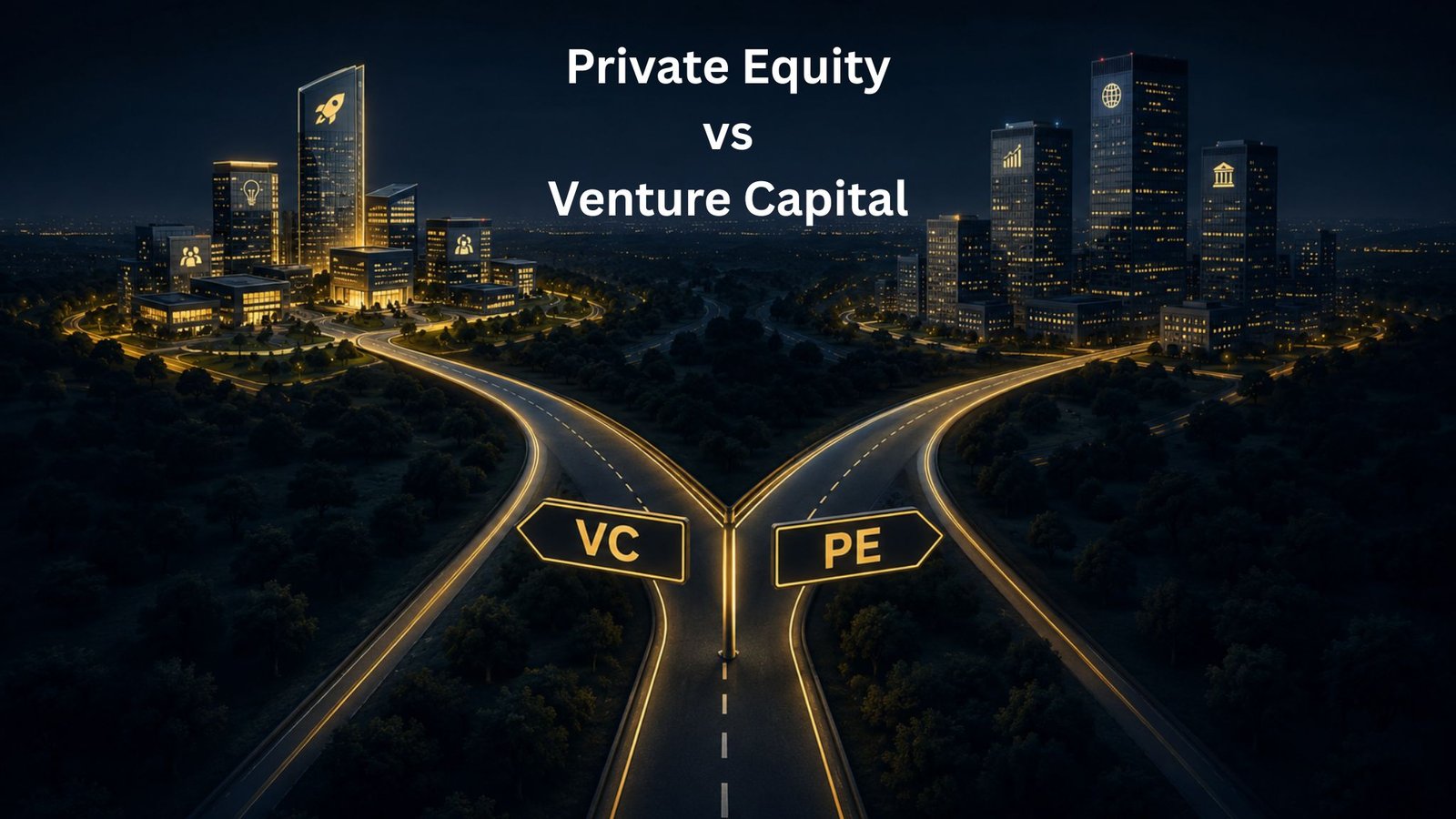
Key Takeaways
- Venture capital funds early-stage startups with minority stakes (10-30%); private equity acquires mature companies with majority or full ownership (50-100%)
- PE pays 20-40% more in cash at junior levels: PE associates earn $250-400K vs $130-300K in VC
- VC targets 10-100x returns from a few winners; PE targets consistent 2-4x returns across a stable portfolio
- 75% of VC-backed startups fail to return investor capital; PE failure rates are dramatically lower
- The right choice depends entirely on your company’s stage, not which model sounds better
What Is Private Equity?
Private equity (PE) refers to investment firms that acquire established, mature companies — typically taking majority or full ownership — and work to improve their operations, profitability, and strategic position before selling them at a profit.
PE firms raise money from institutional investors — pension funds, university endowments, sovereign wealth funds, and family offices — pool it into funds, and deploy it into established businesses using a combination of equity and debt.
The dominant PE deal structure is the Leveraged Buyout (LBO): the firm uses 30-40% equity and 60-70% debt to finance the acquisition. The debt sits on the acquired company’s balance sheet — not the PE firm’s — which amplifies returns when operations improve and creates serious risk when they do not.
What PE firms look for:
- Proven, profitable business model with stable cash flows
- EBITDA that can service acquisition debt
- Fragmented market with consolidation opportunity
- Management team capable of executing under PE ownership
- Clear path to exit at a premium valuation in 4-7 years
PE deal types:
- Leveraged Buyout (LBO): Majority acquisition using debt — the classic PE deal
- Growth Equity: Minority investment in profitable, fast-growing companies
- Distressed/Turnaround: Acquiring struggling companies at discount and restructuring
- Secondaries: Buying existing PE fund stakes from LPs seeking liquidity
Famous PE firms: Blackstone ($1T AUM), KKR, Apollo, Carlyle, Bain Capital, TPG, Warburg Pincus
Famous PE outcomes: Dell Technologies (taken private by Silver Lake), Hilton Hotels (Blackstone 2x return on IPO), PetSmart (BC Partners), Refinitiv (Blackstone → LSEG acquisition)
What Is Venture Capital?
Venture capital (VC) is a form of private equity investment focused exclusively on early-stage and high-growth startups. VC firms raise money from institutional investors, pool it into a fund, and deploy it into startups in exchange for minority equity stakes — betting that a small number of companies will generate returns large enough to compensate for the majority that fail.
The fundamental VC bet: invest in 20-30 companies knowing that 15-20 will fail or return minimal capital, 5-8 will return 2-5x, and 1-3 will return 10-100x — and that those 1-3 winners generate the fund’s returns.
VC funding stages:
- Pre-Seed: $250K-$2M — idea or MVP stage, often angels or micro-VC firms
- Seed: $1M-$5M — early product, first customers, initial team
- Series A: $5M-$20M — product-market fit demonstrated, scaling begins
- Series B: $20M-$75M — proven model, aggressive growth
- Series C+: $75M+ — scaling toward market leadership or IPO
What VC firms look for:
- Large addressable market ($1B+)
- Scalable business model with high gross margins
- Strong founding team with relevant expertise
- Evidence of product-market fit or strong early traction
- Clear path to market leadership
Famous VC firms: Sequoia Capital, Andreessen Horowitz (a16z), Benchmark, Founders Fund, General Catalyst, Accel
Famous VC-backed companies: Google, Facebook, Amazon, Stripe ($159B), Airbnb, Uber, OpenAI, Anthropic
Private Equity vs. Venture Capital: Why the Lines Have Blurred in 2026
The classical distinction between PE and VC — PE buys mature companies, VC bets on startups — remains largely accurate. But in 2026, the boundaries have blurred in several meaningful ways.
VC firms doing late-stage deals: Tiger Global, SoftBank, and growth-oriented VC firms like General Atlantic write $100M+ checks into established companies — check sizes that overlap with PE. The OpenAI round at $122B involved investors from both VC and sovereign wealth — categories that did not traditionally coexist at a single cap table.
PE firms moving earlier: Some PE firms, particularly in software, are deploying growth equity into companies with $10-30M ARR — earlier than traditional PE but later than traditional VC. The playbook is the same (operational improvement, financial engineering) but applied at smaller scale.
The rise of crossover funds: Hedge funds like Coatue Management, D1 Capital, and Tiger Global operate across public and private markets — investing in both VC-stage startups and public companies. These crossover funds blur the distinction further.
AI has created new category questions: An AI infrastructure company like Anthropic is simultaneously: a startup (VC-backed, early in its commercial history), an enterprise (with major corporate customers and substantial revenue), and a potential acquisition target (for major tech companies). Which capital type is appropriate? In practice, all of them — its $30B fundraise in Q1 2026 included VC firms, sovereign wealth funds, and strategic corporate investors.
Understanding the classical distinction remains essential. The blurring at the edges simply adds complexity — it does not eliminate the core differences.
10 Key Differences: Private Equity vs. Venture Capital
Difference 1: Company Stage and Type
Venture Capital: Targets startups — companies that may have no revenue, no proven business model, and significant execution risk. The prototypical VC target is a 2-year-old software company with strong early growth but no clear path to profitability.
Private Equity: Targets established businesses with stable revenues, proven business models, and in most cases, profitability. The prototypical PE target is a 15-year-old industrial services company with $50M revenue, 20% EBITDA margins, and a fragmented competitive landscape ripe for consolidation.
Difference 2: Ownership Stake and Deal Size
Venture Capital: Takes minority stakes — typically 10-30% per round. Multiple VC rounds progressively dilute founders, but they retain majority ownership and operational control through most of the growth phase. Check sizes: $500K (seed) to $50M (Series C+) per round.
Private Equity: Takes majority or full ownership — typically 50-100%. Founders either exit completely or retain a minority stake alongside the PE firm. Check sizes: $50M minimum, multi-billion for large buyouts. US buyout funds raised $325 billion in 2024 alone.
Difference 3: Deal Structure and Use of Debt
Venture Capital: Pure equity. VC firms do not use debt in their investments. They buy preferred stock with protective provisions — liquidation preferences, anti-dilution rights, board seats, and veto rights on major decisions.
Private Equity: Heavy use of debt. The typical PE buyout uses 60-70% debt financing, creating an LBO structure that amplifies returns. This debt sits on the portfolio company’s balance sheet and must be serviced from operating cash flows — creating real financial risk if performance disappoints.
Difference 4: Risk Level
Venture Capital: Extremely high risk. By most estimates, 75% or more of VC-backed companies fail to return investor capital. The power law governs VC — most investments fail, a few succeed moderately, and one or two generate the fund’s entire return.
Private Equity: Moderate risk. PE firms invest in established businesses with proven cash flows, which significantly reduces the probability of complete loss. However, leveraged buyouts create financial risk — if the portfolio company cannot service its debt, restructuring or bankruptcy can follow.
Difference 5: Value Creation Strategy
Venture Capital: Value is created through growth — building the company from early stage to market leadership. VCs add value through their network (introductions to customers, investors, and talent), advice, and follow-on capital in subsequent rounds. They do not improve operations — they help companies grow fast enough that operational efficiency becomes a later problem.
Private Equity: Value is created through operational improvement, financial engineering, and strategic repositioning. PE firms bring in experienced operating partners, implement rigorous financial controls, pursue bolt-on acquisitions, and optimize the capital structure. The PE playbook is about making a good company significantly more efficient and valuable — not building from scratch.
Difference 6: Operational Involvement
Venture Capital: Typically hands-off. VCs take board seats and provide strategic advice, but they do not manage day-to-day operations. Founders retain operational authority.
Private Equity: Deeply hands-on. PE firms often install new management teams, operational partners, and CFOs. They implement reporting cadences, KPI dashboards, and operational improvement programs. Founders who want to retain operational independence post-PE deal should negotiate this explicitly — it is not the default.
Difference 7: Return Expectations and Timeline
Venture Capital: Targets 10-100x on individual winners, with an overall fund target of 3x+ returns over 10 years. The power law dominates: one investment like Google or Facebook generates returns that dwarf everything else in the portfolio combined.
Private Equity: Targets consistent 2-4x returns across the portfolio with a 20-25% IRR, over a 4-7 year hold period. Returns are driven by a combination of: EBITDA growth (30-40% of returns), multiple expansion (30-40%), and debt paydown (20-30%).
Difference 8: Founder Liquidity
Venture Capital: Founders receive no liquidity at the time of investment. They must wait for an IPO or acquisition — typically 7-12 years from initial funding — to realize any financial return on their equity.
Private Equity: Founders receive immediate liquidity at closing, either through a partial or complete buyout. A founder selling 70% of their company to a PE firm at a $100M valuation walks away with $70M at closing — regardless of what happens afterward.
Difference 9: Exit Strategy
Venture Capital: IPO or strategic acquisition. VC firms need exits that value companies at large multiples of invested capital — which requires either a public offering or acquisition by a company with the balance sheet to write a large check.
Private Equity: More diverse exit options — sale to another PE firm (secondary buyout), strategic acquisition, or IPO. PE exits are more varied because established, profitable businesses attract a wider range of potential buyers.
Difference 10: Recruiting, Work, and Culture
Venture Capital: Recruiting is relationship-driven and often opaque. There is no structured “recruiting season” like banking. Getting into VC typically requires a combination of startup operating experience, investment banking background, MBA from a top program, and — most importantly — warm introductions through the VC network. The work is more qualitative: meeting founders, evaluating markets, supporting portfolio companies. Hours are demanding but generally more reasonable than PE.
Private Equity: Recruiting is more structured — most PE firms hire former investment banking analysts in a formal on-cycle recruiting process. The work is heavily quantitative: financial modeling, LBO analysis, due diligence, and portfolio company monitoring. Hours are demanding and often brutal during deal execution. The culture is more similar to investment banking than to startups.
Complete Comparison Table
| Factor | Venture Capital | Private Equity |
|---|---|---|
| Company Stage | Early / Growth-stage startup | Mature / Established business |
| Revenue Requirement | None to early | Profitable with stable cash flows |
| Ownership Stake | 10-30% minority | 50-100% majority |
| Check Size | $500K – $50M | $50M – $10B+ |
| Debt Used | No | Yes (60-70% of deal) |
| Founder Control | Retained | Reduced or eliminated |
| Founder Liquidity at Close | None | Significant (partial or full buyout) |
| Operational Role | Advisory / Board | Hands-on control |
| Return Target | 10-100x on winners | 2-4x across portfolio (20-25% IRR) |
| Hold Period | 7-12 years | 4-7 years |
| Risk Profile | Very high (75% failure rate) | Moderate |
| Primary Exit | IPO or M&A | Secondary buyout, M&A, or IPO |
| Work Culture | Relationship / qualitative | Deal-driven / quantitative |
What Pays More: Venture Capital vs Private Equity Compensation in 2026
This is one of the most searched questions about VC vs PE — and the answer is clear: private equity pays more in cash at almost every level.
Analyst Level
- VC Analyst: $80-135K base, $100-150K total (2026 data — VC Beast, Wall Street Careers)
- PE Analyst: $80-150K base, $100-200K total (primarily at mega-funds and upper-middle-market firms)
- Verdict: Roughly comparable at analyst level
Associate Level
- VC Associate: $110-210K base, $130-320K total cash (2026 median ~$210K)
- PE Associate: $180-350K base, $250-428K total cash (Glassdoor Feb 2026 average: $246K; top earners at 90th percentile: $428K; mega-fund Year 2: ~$500K)
- Verdict: PE pays 20-40% more in cash. PE associates at mega-funds can out-earn VC associates by $100-200K per year.
VP / Principal Level
- VC VP: $200-400K base, $250-600K total
- PE VP: $300-500K base, $400-620K total
- Verdict: PE consistently higher in cash
Partner Level
- VC Partner: $400-600K base, total cash $400K-$1.4M (median ~$800K) — plus significant carried interest
- PE Partner/MD: $500K-$1M+ base, total cash $900K-$2M+ — plus substantial carried interest
The Carry Factor
Cash compensation is only part of the picture. Both PE and VC professionals earn carried interest — 20% of fund profits — which can be life-changing at senior levels.
A VC partner at Sequoia or a16z whose fund generates a 5x return on $2B might personally earn $50-100M+ in carry over the fund’s life. A PE partner at a mega-fund on a successful 3x buyout of $5B might earn comparable amounts. At the associate and VP level, carry allocations are small and vest over the fund’s lifetime — meaning the real wealth from carry takes 10-15 years to materialize.
The bottom line: If you are primarily motivated by near-term cash compensation, PE is the better choice. If you are comfortable with lower near-term cash for the optionality of startup exposure, carry upside, and a more varied work environment, VC may fit better.
Trends in the Private Equity and Venture Capital Markets in 2026
1. AI Concentration in VC
The defining trend in VC in 2026 is the extreme concentration of capital into AI. In Q1 2026, AI startups captured 80% of all global VC deployed — with four deals (OpenAI $122B, Anthropic $30B, xAI $20B, Waymo $16B) representing 65% of the quarter’s total. Non-AI startups face materially tighter capital markets.
2. ESG and Impact Investing
Both PE and VC are under increasing pressure from LPs — particularly pension funds and sovereign wealth funds — to demonstrate ESG (Environmental, Social, Governance) credentials. In PE, this has translated into ESG due diligence requirements and reporting frameworks for portfolio companies. In VC, climate tech captured $120 billion in private capital in 2025, up 22% year-over-year. Firms like Acrew Capital have made climate tech software a core investment thesis.
3. The Secondary Market Explosion
Global secondary transaction volume hit $240 billion in 2025 — a record. The secondary market allows PE investors to buy existing fund stakes, providing liquidity to LPs who cannot wait for primary fund exits. This trend is democratizing PE liquidity and creating new opportunities for investors who want PE exposure without a 10-year lock-up.
4. Sovereign Wealth Funds as Mega-Capital
The emergence of sovereign wealth funds (SoftBank Vision Fund, Saudi PIF, Abu Dhabi’s Mubadala, Singapore’s GIC and Temasek) as the dominant capital source for mega-round VC deals is reshaping the top end of venture investing. These funds can write $10-30B checks — sizes that no traditional VC fund can match — and are treating frontier AI infrastructure as strategic national investment, not financial speculation.
5. The Blurring of Public and Private Markets
With companies like Stripe ($159B) and SpaceX ($350B+) remaining private at valuations that would have guaranteed IPOs in any previous decade, the distinction between “private” and “public” company is becoming less meaningful at the top of the market.
PE vs VC vs Hedge Fund vs Angel Investors vs Investment Banking
Private Equity vs Venture Capital vs Hedge Fund
| Factor | PE | VC | Hedge Fund |
|---|---|---|---|
| Companies targeted | Mature, private | Early-stage, private | Public + private |
| Liquidity | Illiquid (4-7 years) | Illiquid (7-12 years) | Liquid (daily/monthly) |
| Return strategy | Operational improvement + leverage | Growth + power law | Trading, arbitrage, long/short |
| Risk | Moderate | Very high | Moderate to very high |
| Typical investor | Institutional | Institutional | Institutional + HNWI |
Hedge funds are fundamentally different from PE and VC: they invest primarily in public markets, provide liquidity to investors, and generate returns through active trading strategies rather than long-term ownership of private companies.
Angel Investors vs Venture Capital vs Private Equity
| Factor | Angel | VC | PE |
|---|---|---|---|
| Capital source | Personal funds | LP pooled funds | LP pooled funds |
| Stage | Pre-seed / seed | Seed to Series C | Growth to buyout |
| Check size | $10K – $2M | $500K – $50M | $50M – $10B+ |
| Operational involvement | Minimal | Advisory | Hands-on |
| Typical investor | Individual operator/founder | Institutional | Institutional |
Angel investors provide the earliest funding — often the first institutional check a startup ever receives. They invest their own money, unlike VC and PE firms which invest pooled capital from LPs. Y Combinator, the most famous early-stage program, typically invests $125K for 7% ownership.
Investment Banking vs Private Equity vs Venture Capital
| Factor | IB | PE | VC |
|---|---|---|---|
| Primary activity | Advisory (M&A, IPO, debt) | Buy and improve companies | Invest in startups |
| Revenue model | Transaction fees | Management fees + carry | Management fees + carry |
| Ownership of companies | No | Yes (majority) | Yes (minority) |
| Work hours | Very long (80-100+ hrs/week) | Long (60-80 hrs), brutal in deals | Moderate (50-70 hrs) |
| Entry path | Analyst program from university | Post-banking (on-cycle recruiting) | Relationship-based, varied |
Investment banking does not invest in companies — it advises them on transactions and earns fees for that advice. PE and VC both own stakes in companies. The key difference: IB generates revenue from one-time transaction fees; PE and VC generate returns from the long-term performance of their portfolio companies.
The Top Firms in Private Equity and Venture Capital in 2026
Top PE Firms by AUM
- Blackstone — $1 trillion+ AUM, largest PE firm in the world
- KKR — $600B+ AUM, pioneer of the LBO
- Apollo Global — $600B+ AUM, credit and equity
- Carlyle Group — $400B+ AUM, global buyout focus
- Bain Capital — $185B+ AUM, Boston-based
Top VC Firms by Returns/Reputation
- Sequoia Capital — backed Google, Apple, WhatsApp, Stripe
- Andreessen Horowitz (a16z) — $35B+ AUM, tech-focused
- Benchmark — concentrated fund model, WhatsApp, Twitter, Snap
- Founders Fund — Peter Thiel’s firm, Stripe, SpaceX, Facebook
- General Catalyst — $25B+ AUM, health and climate focus
What Is Better: Private Equity or Venture Capital?
Neither is objectively better — the right answer depends entirely on your situation.
PE is better if: You run a profitable, established business and want immediate liquidity, operational partnership, and a defined exit timeline.
VC is better if: You are building a high-growth startup, want to retain operational control, can wait 7-12 years for liquidity, and are targeting a large market where exponential growth is possible.
For investors and career professionals: PE pays more in near-term cash, offers more structured career paths, and targets more predictable returns. VC offers more intellectual variety, proximity to innovation, and the possibility of extraordinary carry upside from a breakout fund.
The most important advice: understand which world your company or career belongs in, and pursue the right type of capital or firm accordingly. The worst outcomes happen when founders take VC from firms that expect PE-style returns, or when PE firms invest in startups that need VC-style patient capital.
Also Read: Q1 2026’s $297B Venture Record Tells a Story — But Not the One You Think
Frequently Asked Questions
Q: What is the difference between venture capital and private equity?
A: Venture capital invests in early-stage startups with minority stakes, betting on high-growth potential. Private equity acquires majority or full ownership of mature, profitable companies and uses operational improvement and leverage to generate returns. VC is high-risk, high-variance; PE is moderate-risk, more consistent.
Q: What pays more, venture capital or private equity?
A: Private equity pays 20-40% more in cash at junior and mid-levels. PE associates earn $250-400K total cash versus $130-300K in VC. At the partner level, both can generate life-changing returns through carried interest, though PE mega-fund partners often out-earn VC partners in cash compensation.
Q: Is it harder to get into venture capital or private equity?
A: Both are extremely competitive, but in different ways. PE recruiting is more structured — most firms hire through on-cycle banking recruiting with defined processes and timelines. VC recruiting is more relationship-driven and opaque — there is no set recruiting season, and getting in typically requires warm introductions, startup operating experience, or an MBA from a top program.
Q: Is Shark Tank an example of venture capital or private equity?
A: Shark Tank is closest to angel investing or early-stage venture capital. The “Sharks” invest their own personal capital (like angels) in early-stage consumer companies in exchange for equity stakes. They are not managing a formal fund structure (like institutional VC) or acquiring mature companies (like PE).
Q: How do venture capital and private equity compare in size?
A: Both are enormous. US private equity buyout funds raised $325 billion in 2024. Global VC assets under management doubled between 2019 and 2024. In Q1 2026, global VC investment hit a record $297 billion — though 86% went to mega-rounds. PE is larger in aggregate capital deployed; VC is larger in number of deals.
Q: What is the highest position in private equity?
A: The highest position is Managing Director (MD) or Partner, with some mega-firms having titles like Senior Managing Director or Co-CEO. At this level, all-in cash compensation (base + bonus) ranges from $900K to $2M+, plus carried interest that can generate tens or hundreds of millions over a fund’s life.
Q: How does operational involvement compare between VC and PE investors?
A: VC investors take board seats and provide strategic advice, introductions, and follow-on capital — but they do not manage operations. PE investors are hands-on: they often install new management teams, implement financial controls, and actively direct operational strategy. The depth of PE operational involvement is one of the most important things founders should understand before taking PE capital.
Q: What are the key legal differences between VC and PE transactions?
A: VC investments use preferred stock with protective provisions — liquidation preferences, anti-dilution rights, pro-rata rights, and information rights. PE buyouts use a more complex legal structure involving purchase agreements, debt financing agreements, management equity plans, and often new holding company structures. PE transactions are significantly more legally complex and expensive to execute than VC rounds.
Q: Can a startup take both VC and PE funding?
A: Yes — and it is common. Many companies raise VC from seed through Series C to build and scale their business, then take growth equity (the hybrid between VC and PE) once they are profitable and growing. A full PE buyout after VC is less common but does happen — typically when founders want liquidity and are ready for new operational partners.
Q: Is private equity good or bad for companies?
A: PE has a genuinely mixed track record. In the best cases, PE firms bring operational expertise, capital for strategic acquisitions, and management discipline that makes companies meaningfully better. In the worst cases — particularly in consumer brands, healthcare, and retail — excessive leverage, aggressive cost-cutting, and short-term return optimization have damaged companies, jobs, and customer experience. The outcome depends heavily on the specific firm, the deal structure, and whether the operational strategy is genuinely value-creating or purely extractive.
