

Key Takeaways
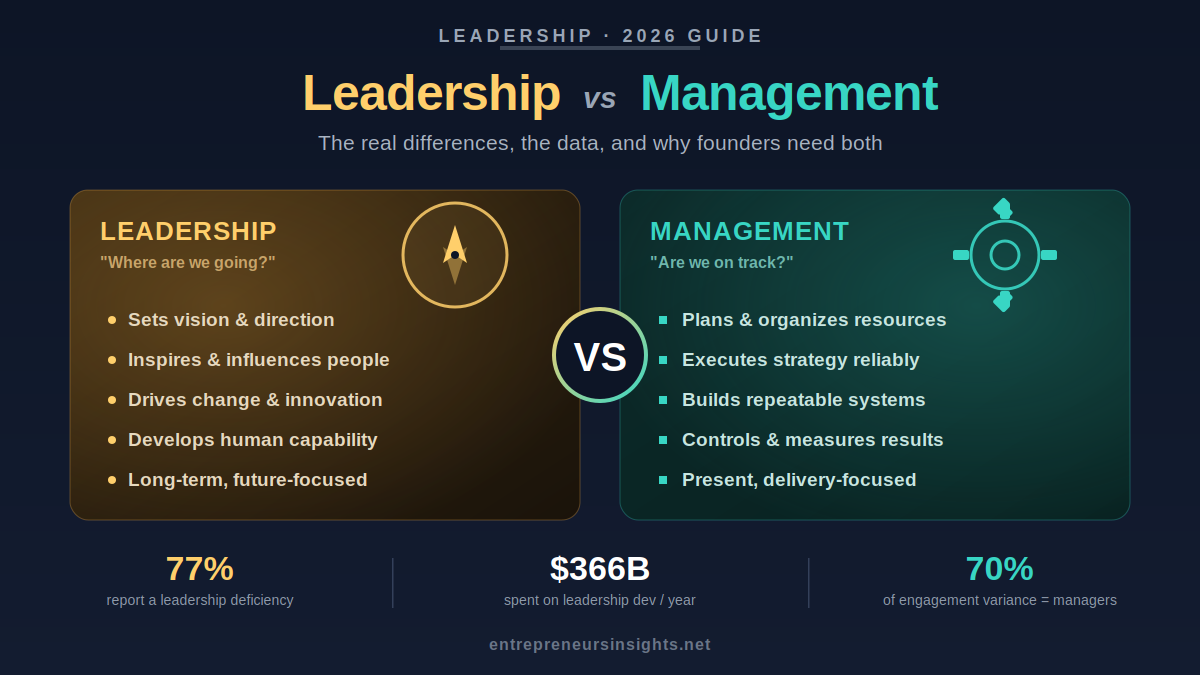
- 77% of businesses report a deficiency in leadership — despite $366 billion spent globally on leadership development annually
- Managers account for 70% of the variance in employee engagement (Gallup) — making management quality the single largest driver of team performance
- Only 10% of individuals are considered natural leaders; 20% exhibit basic managerial traits that can be developed
- Digital-first leaders are 1.8x more likely to lead industry disruptors (MIT Sloan, 2026)
- 90% of the difference between top-performing and average senior leaders is attributable to emotional intelligence, not cognitive ability
- In 2026, leadership is shifting from authority to capability — from directing people to enabling systems
- Leaders create vision and inspire change; managers execute strategy and maintain systems — both are essential, and the best founders must develop both capabilities
Introduction: Why the Distinction Matters More Than Ever
“Are you a leader or a manager?” is one of the most common questions in business education — and one of the most misleading. The framing implies a hierarchy: that leadership is superior to management, that managers are just lower-level leaders, or that the two are mutually exclusive.
All of these implications are wrong.
Leadership and management are distinct capabilities that organizations need simultaneously. Leaders create vision, inspire change, and set direction. Managers execute strategy, build systems, and maintain performance. The most effective executives in any organization — including founders and operators of startups — develop both capabilities deliberately, deploying each where it is most needed.
In 2026, the stakes are higher than ever. With 77% of businesses reporting a deficiency in leadership, $366 billion invested globally in developing leaders, and a documented shift toward more autonomous, distributed organizational models, understanding the genuine differences between leadership and management has become one of the most practically important questions in business.
This guide breaks down everything founders and operators need to know — backed by 2026 data throughout.
What Is Leadership?
Leadership is the ability to influence people toward a common goal — through vision, inspiration, trust, and the cultivation of capability in others. Leaders set direction, create alignment, and motivate action in environments where the path forward is uncertain.
The essence of leadership: changing what people believe is possible, and then helping them achieve it.
Leadership is not a position or a title. A junior employee who rallies their team around a new approach is exercising leadership. A CEO who simply issues directives from the top without inspiring genuine commitment is managing, not leading.
Core characteristics of effective leaders:
- Vision: The ability to see where the organization needs to go — before others can see it clearly — and communicate that vision compellingly
- Inspiration: The ability to motivate people intrinsically, not just through authority or financial incentives
- Influence: Creating change through persuasion, example, and earned trust rather than positional authority
- Emotional intelligence: Understanding and managing their own emotions, and recognizing and responding to the emotions of others
- Change orientation: Comfortable with ambiguity, willing to challenge the status quo, focused on transformation rather than preservation
- People development: Investing in the growth of individuals, not just the completion of tasks
- Long-term thinking: Focused on sustainable results over time, not just immediate output
Famous examples of leadership in action:
- Steve Jobs returning to Apple in 1997 and creating a vision of “1,000 songs in your pocket” that became the iPod — leadership is defining a future others cannot yet see
- Reed Hastings pivoting Netflix from DVDs to streaming when DVDs were still the profitable business — leadership is making decisions that are correct but uncomfortable
- Yvon Chouinard building Patagonia around environmental sustainability as a core business principle, not a marketing strategy — leadership is defining organizational values that outlast any individual decision
What Is Management?
Management is the process of organizing, planning, directing, and controlling resources — people, budget, time, and systems — to achieve defined organizational goals. Managers execute strategy within defined parameters, ensure that processes work reliably, and deliver consistent results.
The essence of management: making sure the right things happen, consistently, at scale.
Management is also not merely about hierarchy or administration. A founder managing her first two employees is a manager — allocating tasks, setting expectations, giving feedback, and monitoring results. A department head running a 200-person organization is also a manager — at higher complexity, but performing the same fundamental functions.
Core characteristics of effective managers:
- Planning: Translating strategic goals into specific plans, timelines, and resource allocations
- Organization: Structuring teams, processes, and workflows for reliable execution
- Direction: Assigning tasks clearly, setting expectations, and providing the information people need to succeed
- Control: Monitoring performance against plans and making adjustments when results deviate from targets
- Process orientation: Building repeatable systems that produce consistent results without depending on heroic individual effort
- Problem-solving: Identifying and resolving operational problems before they escalate
- Measurement: Tracking the right metrics to understand whether the organization is on track
Famous examples of management in action:
- Tim Cook building Apple’s supply chain into the most efficient in consumer electronics history — management is creating systems that reliably deliver at scale
- Andy Grove’s OKR system at Intel, later adopted by Google and thousands of other companies — management is creating planning frameworks that align large organizations
- Amazon’s “working backwards” product development process — management is building systems that consistently produce the right outcomes regardless of which specific people are involved
Leadership vs Management: The Key Differences
1. Orientation: Future vs Present
Leadership is oriented toward the future — toward what the organization needs to become. Leaders ask “Where should we be going, and why?” They are comfortable operating in ambiguity and uncertainty because the future is always uncertain.
Management is oriented toward the present — toward what the organization needs to deliver today, this week, this quarter. Managers ask “How do we execute what we have committed to?” They thrive on clarity, defined processes, and measurable outcomes.
Neither orientation is superior. Organizations need both simultaneously: leadership to set the right direction, management to execute it reliably.
2. Change vs Stability
Leaders are change agents. Their value comes from disrupting the status quo — challenging existing assumptions, introducing new ideas, and mobilizing people to pursue different futures. Leadership is inherently uncomfortable for the organization because it requires people to operate outside their established patterns.
Managers are stability agents. Their value comes from creating reliable systems and processes that deliver consistent results. Management is inherently reassuring for the organization because it creates predictability and reduces variance.
In a startup context: leadership is needed to define the product vision and go-to-market strategy; management is needed to ensure that engineering delivers on time, customer success retains customers, and finance tracks the cash position accurately.
3. People vs Processes
Leaders focus on people — their motivation, their development, their alignment with organizational purpose. The leadership question is always “Do these people believe in what we are doing, and are they growing?”
Managers focus on processes — the systems through which people’s work is organized, directed, and measured. The management question is always “Are these processes reliably producing the results we need?”
Research confirms this distinction in how each role affects organizational outcomes. Managers account for 70% of the variance in employee engagement (Gallup) — through the daily decisions about task assignment, feedback, recognition, and relationship quality that make work motivating or demotivating. Leaders, by contrast, drive the strategic alignment and purpose that determines whether engagement translates into organizational performance.
4. Authority vs Influence
Managers typically derive their authority from their organizational position. A manager’s right to direct people’s work comes from the formal structure — the org chart, the job descriptions, the employment relationship.
Leaders derive their authority from influence — earned through expertise, integrity, track record, and the quality of their ideas. A leader without positional authority can still move an organization because people choose to follow them.
This distinction matters practically: you can be appointed to a management position, but you cannot be appointed to a leadership position. Leadership is conferred by followers, not by org charts.
5. Vision vs Execution
Leadership is about creating and communicating vision — a compelling picture of a desired future state that motivates people to change their behavior. The leader’s job is to answer “Why are we doing this, and what does success look like?”
Management is about translating vision into execution — breaking down strategic goals into specific plans, assigning work, monitoring progress, and solving problems. The manager’s job is to answer “How do we actually get there, and are we on track?”
6. Risk and Innovation
Leaders are typically more comfortable with risk and more oriented toward innovation. Leadership requires making bets on uncertain futures — which requires tolerance for ambiguity and willingness to be wrong.
Managers are typically more focused on risk reduction and operational reliability. Management requires delivering against commitments — which requires discipline, planning, and the ability to anticipate and mitigate problems before they become crises.
This difference in risk orientation is one of the most practically important: organizations that over-index on management will be operationally reliable but strategically stagnant. Organizations that over-index on leadership will be strategically ambitious but operationally chaotic. The best organizations balance both.
Complete Comparison Table
| Dimension | Leadership | Management |
|---|---|---|
| Primary focus | Vision and direction | Execution and delivery |
| Orientation | Future | Present |
| Change vs stability | Drives change | Creates stability |
| People vs processes | People | Processes |
| Authority source | Influence (earned) | Position (conferred) |
| Risk orientation | Tolerates ambiguity | Reduces variance |
| Key question | “Where are we going?” | “Are we on track?” |
| Motivation approach | Inspires intrinsically | Directs and incentivizes |
| Time horizon | Long-term | Short-to-medium term |
| Success metric | Vision realized | Goals achieved |
| Development focus | Growing capability | Executing tasks |
| Culture contribution | Sets values and purpose | Reinforces standards |
2026 Data: What the Research Actually Shows
The Leadership Deficiency Crisis
77% of businesses report a deficiency in leadership — the most commonly cited organizational challenge in executive surveys. This deficiency is expensive: organizations with strong leadership outperform peers by up to 20% in profitability and 19% in revenue growth.
Despite this, US companies invest approximately $166 billion annually in leadership development — nearly half of the $366 billion spent globally. The gap between investment and outcome suggests that traditional leadership development approaches are not working as intended.
Emotional Intelligence Dominates Leadership Effectiveness
Research from Goleman’s foundational studies — validated and extended in a 2023 hybrid literature review examining 104 studies — confirms that almost 90% of the difference between top-performing and average senior leaders is attributable to emotional intelligence factors over cognitive abilities.
In 2026, 47% of organizations report that emotional intelligence is even more critical for leadership effectiveness than in 2024 (HBR Global Leadership Development Survey). The five components of emotional intelligence — self-awareness, self-regulation, motivation, empathy, and social skill — are more predictive of leadership effectiveness than IQ, technical expertise, or educational credentials.
Practical implication: developing emotional intelligence should be the primary focus of any founder or operator investing in their own leadership capability.
Management Quality Drives Engagement
While leadership drives strategic alignment, management quality drives the daily experience of work. Managers account for 70% of the variance in employee engagement — making the quality of front-line management the single largest organizational lever for improving team performance, retention, and productivity.
69% of employees say they would work harder if they felt their efforts were better recognized — a management behavior, not a leadership behavior. And 71% of employees say their leaders and managers do not communicate goals clearly — a gap that directly undermines both engagement and performance.
Digital-First Leadership in 2026
MIT Sloan Management Review’s 2026 data shows that digital-first leaders are 1.8x more likely to lead industry disruptors. The shift toward AI, automation, and data-driven decision-making is creating a new category of leadership requirement: the ability to understand, deploy, and create organizational culture around digital technologies.
In 2026, MTD Training’s research identifies five key leadership trends:
- Psychological safety as a foundation for team performance — not just a “nice to have” but a measurable driver of innovation and problem-solving
- Self-managed teams replacing traditional hierarchical oversight — especially in high-growth software and AI companies
- Coaching-style management replacing directive management — with 42% of organizations increasing emphasis on coaching behaviors
- Data-driven leadership — using real-time performance data, not intuition or proximity, to make management decisions
- Micro-behaviors — the small, everyday interactions (recognition, check-ins, clear communication) that create or destroy psychological safety and engagement
10 Key Leadership Skills That Drive Results
1. Emotional Intelligence
The foundational leadership capability. Self-awareness, empathy, and social skill determine how effectively a leader builds trust, navigates conflict, and develops the people around them.
2. Strategic Vision
The ability to see where the market is going, where the organization needs to be, and how to bridge the gap — clearly enough to communicate it compellingly to others.
3. Communication
69% of managers report feeling uncomfortable communicating with employees. Yet communication quality is the primary driver of organizational clarity, trust, and alignment. Developing communication skill — specifically the ability to communicate complex ideas simply and clearly — is one of the highest-leverage leadership investments.
4. Decision-Making Under Uncertainty
Leaders routinely make consequential decisions with incomplete information. The ability to synthesize available data, acknowledge uncertainty honestly, make a call, and commit to it — while remaining open to revision as new information arrives — is a core leadership capability.
5. Coaching and Development
Research shows that managers who delegate effectively generate 33% more revenue than those who do not. The broader finding: leaders who invest in developing the capability of their teams create exponential returns. Developing others is not just a “nice” leadership behavior — it is a high-ROI operational choice.
6. Adaptability
In 2026, the pace of change — technological, regulatory, competitive — requires leaders who can pivot without losing their teams. Adaptability includes both personal comfort with change and the ability to manage organizational change without creating destabilizing uncertainty.
7. Accountability
Leaders who hold themselves and their teams accountable — acknowledging failure honestly, demanding genuine performance, and accepting personal responsibility for outcomes — create cultures of high performance. Leaders who avoid accountability create cultures of excuse-making.
8. Psychological Safety
Research from Amy Edmondson and Google’s Project Aristotle confirms that psychological safety — the belief that team members can speak up without fear of punishment — is the strongest predictor of team performance. Leaders who create psychological safety unlock the full cognitive contribution of their teams; those who do not systematically suppress it.
9. Long-Term Thinking
The ability to make decisions that are right for the long term even when they are costly or unpopular in the short term. Leadership requires the conviction to take actions whose benefits are realized months or years later.
10. Inclusive Leadership
Research consistently shows that diverse teams with inclusive leaders outperform homogeneous teams. Inclusive leadership — the ability to create genuine belonging and leverage the perspectives of all team members — is increasingly a competitive advantage, not just a social responsibility.
10 Key Management Skills That Drive Results
1. Planning and Goal-Setting
Translating vision into specific, measurable goals with clear timelines and resource allocations. The OKR (Objectives and Key Results) framework, popularized by Intel and Google, is one of the most effective planning systems for high-growth organizations.
2. Delegation
Managers who delegate effectively generate 33% more revenue than those who do not (Harvard Business Review). Delegation — assigning outcomes rather than tasks, using RACI frameworks to clarify roles, and trusting people with genuine responsibility — is among the highest-leverage management behaviors.
3. Performance Management
Setting clear expectations, providing timely feedback, recognizing strong performance, and addressing underperformance directly. 69% of employees say they would work harder with better recognition — making performance management one of the most under-invested management capabilities.
4. Problem-Solving
Identifying root causes of operational problems (not just symptoms), generating and evaluating solutions, and implementing fixes before problems become crises. The most effective problem-solving managers combine analytical rigor with practical pragmatism.
5. Process Design
Building repeatable systems that produce consistent results without depending on individual heroics. The best managers create processes that make good outcomes the default — reducing variance and enabling scale.
6. Communication (Downward and Upward)
71% of employees say their managers do not communicate goals clearly. Effective managers communicate expectations explicitly (not just once, but repeatedly and through multiple channels), surface information upward to decision-makers accurately, and create clarity at every level of the team.
7. Conflict Resolution
Teams with genuine diversity of perspective — which are the highest-performing teams — also generate more conflict. Managers who can surface and resolve conflict constructively, rather than avoiding or suppressing it, build healthier and more productive team dynamics.
8. Budget and Resource Management
Allocating limited resources — budget, headcount, time — against organizational priorities. Effective resource management requires both analytical capability (understanding where resources generate the highest returns) and political skill (navigating competing claims on scarce resources).
9. Meeting and Workflow Management
Research consistently identifies poorly-run meetings as one of the largest productivity drains in organizations. Managers who run efficient, outcome-oriented meetings — and who build workflows that minimize unnecessary coordination overhead — create significant organizational leverage.
10. Hiring and Talent Management
The most consequential management decisions are hiring decisions. Managers who hire well — rigorously defining the role, sourcing broadly, evaluating candidates against genuine job requirements rather than pattern-matching — build the talent foundations that enable everything else.
Leadership vs Management in Startups: The Founder Challenge
Founders face a unique version of the leadership vs management challenge: they must develop and deploy both capabilities simultaneously, often without the organizational infrastructure that helps large-company executives develop each separately.
The Early Stage: Leadership Dominates
In a startup’s first 1-3 years, leadership is the dominant requirement. The founding team needs to create a compelling vision, recruit early employees who believe in that vision, pivot rapidly as market feedback arrives, and maintain morale through the inevitable setbacks of early-stage company building.
Management at this stage is often informal and improvised — and that is appropriate. A 5-person team does not need a performance management system or a delegation framework. They need a compelling reason to come to work every day and a clear sense of what success looks like.
The Growth Stage: Management Becomes Critical
As a startup scales from 10 to 50 to 200 employees, the management gap typically becomes the primary performance constraint. The informal coordination mechanisms that worked at 10 people break down. Information stops flowing accurately. Accountability gaps emerge. People stop understanding how their work connects to company goals.
This is the stage where many founder-led companies stall — not because the vision is wrong, but because the management infrastructure to execute the vision has not been built.
The most common failure mode: founders who are exceptional leaders continue leading when what the organization needs is management. They set inspiring vision but do not build the systems to execute it. The result is strategic clarity with operational chaos.
The Scaling Stage: Both at Full Capacity
In a mature, scaling company, leadership and management must both operate at full capacity simultaneously. The CEO leads — setting strategic direction, creating culture, inspiring the organization. The leadership team manages — building and running the systems through which the organization delivers.
The founders who navigate this transition most successfully are those who either: develop genuine management capability themselves, or hire exceptional managers who can build the operational infrastructure while the founder continues leading.
Common Myths About Leadership and Management
Myth 1: Great leaders are born, not made Wrong. Leadership is a capability built through experience, feedback, and deliberate development. Just 10% of individuals are considered natural leaders — but another 20% exhibit managerial traits that can be developed into effective leadership. The remaining 70% can improve their leadership effectiveness significantly through intentional development.
Myth 2: Only senior people are leaders Wrong. Leadership happens at every level of an organization. The most impactful leadership often comes from individual contributors who influence their peers without positional authority — through expertise, initiative, and the quality of their ideas.
Myth 3: Management is just lower-level leadership Wrong. Management and leadership are distinct capabilities that organizations need simultaneously. A company staffed entirely with leaders and no managers would have inspiring vision and chaotic execution. A company with excellent managers and no leaders would be operationally reliable but strategically stagnant.
Myth 4: Strong leaders do not need management skills Wrong. The most effective executives develop both leadership and management capabilities — deploying each where the situation demands. Leadership without management discipline produces visionary companies that cannot execute. Management without leadership produces efficient machines heading in the wrong direction.
Myth 5: Leadership is about charisma Wrong. Research consistently shows that the most effective leaders are not the most charismatic — they are the most emotionally intelligent, the most focused on developing others, and the most consistent in their values and behavior. Charismatic leaders often generate short-term enthusiasm without building durable organizational capability.
Also Read:
Frequently Asked Questions
What is the main difference between leadership and management?
Leadership focuses on setting vision and inspiring people toward a desired future — through influence, inspiration, and the development of human capability. Management focuses on organizing, planning, and controlling resources to achieve defined goals — through systems, processes, and reliable execution. Leaders ask “Where are we going?”; managers ask “Are we on track to get there?”
Can someone be both a leader and a manager?
Yes — and the most effective executives at every level develop both capabilities. Leadership and management are distinct but complementary. A startup founder must lead (setting vision, inspiring the team, making strategic calls under uncertainty) and manage (allocating resources, building processes, monitoring performance) simultaneously. As organizations scale, these roles often separate into distinct positions, but the best senior leaders retain meaningful management capability.
Is leadership more important than management?
Neither is more important — both are essential. Organizations without strong leadership drift strategically, fail to adapt to market change, and cannot attract and retain exceptional talent. Organizations without strong management execute inconsistently, scale poorly, and cannot translate vision into reliable results. The question is not which matters more but which is the current constraint in your specific organization.
What makes a great leader in 2026?
In 2026, the research points consistently to emotional intelligence as the foundation of great leadership — specifically, self-awareness, empathy, and the ability to build genuine trust. Digital fluency (understanding and leveraging technology, particularly AI) is an increasingly important differentiator. The ability to create psychological safety — enabling teams to speak up, take risks, and learn from failure — is strongly correlated with team performance. And the ability to develop others — coaching, delegating genuine responsibility, investing in the growth of people — is both a leadership skill and a high-ROI organizational investment.
What is the hardest part of the transition from manager to leader?
The hardest shift is from doing to enabling — from being the most capable individual on the team to creating conditions where others can perform at their best. Managers who have built their identity and credibility around personal contribution often struggle to invest in the success of others rather than demonstrating their own expertise. The second hardest shift is from short-term to long-term orientation — accepting that the most important leadership decisions often have costs in the near term and benefits that are realized years later.
How do leadership and management skills develop?
Both develop most effectively through deliberate practice in high-stakes situations with quality feedback. Research supports three development mechanisms: (1) challenging assignments that require the application of new skills, (2) developmental relationships (mentors, coaches, role models), and (3) coursework and frameworks that provide conceptual tools for making sense of experience. The most common mistake in leadership development is over-investing in classroom learning and under-investing in on-the-job challenge and quality feedback.
What percentage of managers are effective leaders?
Research suggests that only about 10% of individuals are natural leaders, and another 20% exhibit basic managerial traits that can be developed into leadership. This means roughly 30% of the workforce has clear leadership potential — while the remaining 70% can develop meaningful leadership capability through deliberate investment, even if they will not be exceptional leaders.
