
Key Takeaways
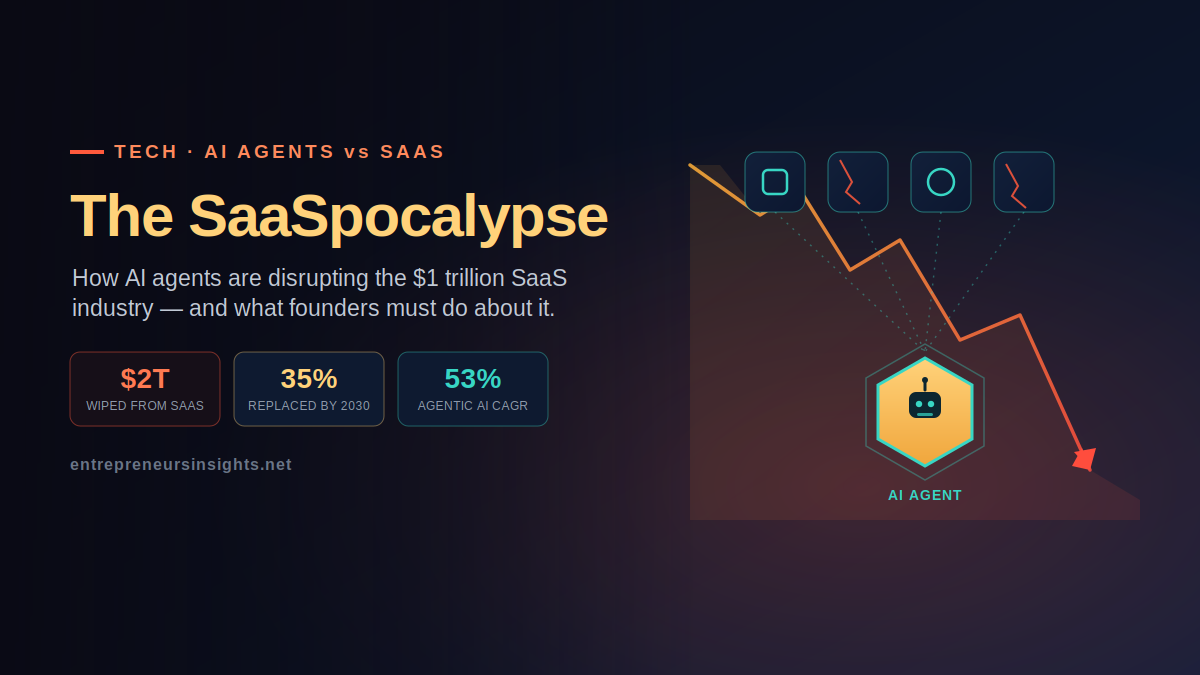
- Between January 15 and February 14, 2026, approximately $2 trillion in market capitalization evaporated from the software sector — the “SaaSpocalypse”
- The IGV software ETF fell roughly 30% from its September 2025 peak
- Gartner predicts 35% of point-product SaaS tools will be replaced by AI agents by 2030
- Agentic AI market will grow at 53% CAGR — from $8.5 billion in 2026 to $45 billion by 2030 (Deloitte)
- IDC forecasts a 40x increase in actively deployed AI agents over 2025 levels
- Only 6% of companies fully trust agents to autonomously execute core business processes — the trust gap is the primary adoption brake
- Enterprise SaaS M&A hit $83.7 billion across 245 deals in Q4 2025 — consolidation is accelerating
- The per-seat pricing model that powered SaaS growth is breaking — consumption-based and outcome-based pricing are replacing it
- Winners: vertical SaaS with deep data moats, systems of record, AI-native platforms
- Losers: horizontal point solutions, feature-thin tools, anything an AI agent can replace with an API call
Introduction: The $2 Trillion Reckoning
February 2026 will be remembered as the month the SaaS industry’s assumptions broke.
Between January 15 and February 14, 2026, approximately $2 trillion in market capitalization evaporated from the software sector. The trigger was Anthropic’s Claude Cowork announcement — a product demonstrating that a single AI tool could replace functions spread across multiple enterprise software platforms: legal document management, compliance automation, financial analysis, and workflow orchestration. In what European tech publication Trending Topics called “The Anthropic Effect,” $285 billion in market value vanished overnight from public software stocks.
The term “SaaSpocalypse” entered the technology vocabulary.
But unlike previous market corrections, this one was not driven by macroeconomic fears or sector rotation. It was driven by a specific structural insight that investors, CIOs, and enterprise buyers all reached simultaneously: AI agents are eroding the moats that SaaS companies spent two decades building — user habits, data lock-in, and workflow integration — simultaneously and at accelerating speed.
This article explains what is actually happening, who wins, who loses, and what founders need to understand to build in this environment.
What Are AI Agents and Why Do They Threaten SaaS?
An AI agent is a system that can perceive its environment, make decisions, and take actions autonomously to achieve goals — without requiring human intervention at each step.
The critical distinction from previous AI features: agents do not just assist humans in using software. They use software themselves. An AI agent can log into your CRM, update contact records, draft follow-up emails, schedule meetings, and analyze pipeline health — replacing the human user that the CRM’s per-seat licensing assumed would be there.
This is the structural threat to the SaaS business model. The per-seat model — “pay for each human who uses the software” — assumed that software value was delivered through human users. When AI agents become the primary users of software, the economics of per-seat licensing collapse.
The replacement logic:
Traditional SaaS workflow: Human → Software → Output. Agentic AI workflow: Human defines goal → AI Agent → Multiple Software APIs → Output
In the agentic model, the software becomes a backend service called by an AI orchestration layer. The user experience — the UI, the workflow, the “seat” — becomes irrelevant. What matters is the API, the data, and the underlying capability.
SaaS companies that have built their moat primarily around user experience and workflow friction now face agents that bypass both.
The SaaSpocalypse: What Happened and Why
The Catalytic Event: Anthropic Claude Cowork (February 2026)
Anthropic’s Claude Cowork announcement in February 2026 was the catalytic event. The product demonstrated agentic AI working across enterprise systems — completing multi-step workflows that previously required multiple software products and human coordination.
The market’s immediate reaction — $285 billion overnight — was not irrational. Investors who understood what was being demonstrated recognized that horizontal point-solution SaaS (tools that do one thing for human users) faced an existential threat from AI orchestration layers that could accomplish the same outcome without requiring the user-facing software.
The Earnings Call Signal
Mentions of “agentic AI” and “AI agent risk” on Q4 2025 and Q1 2026 earnings calls doubled compared to the prior quarter. This is a meaningful signal: when risk language doubles in earnings disclosures, it reflects genuine management concern that analysts are asking pointed questions about AI-driven disruption.
Multiple SaaS companies reported slowing growth in Q4 2025 earnings — not because AI failed to boost productivity, but because enterprise customers were beginning to consolidate their software spending, eliminating point solutions that AI agents could replicate.
The Market Correction
The IGV software ETF — the benchmark for the SaaS sector — fell roughly 30% from its September 2025 peak. The correction erased approximately $2 trillion in aggregate SaaS market capitalization.
Analyst reactions were split: Dan Ives called it a “generational buy,” citing enterprise switching costs and data lock-in. Goldman Sachs maintained Buy ratings on select names. But UBS cut ServiceNow to Neutral, reflecting concern about competition from AI agents in IT workflow automation — one of ServiceNow’s core markets.
The $83.7 billion in enterprise SaaS M&A across 245 deals in Q4 2025 tells a parallel story: larger companies are acquiring AI capabilities to defend pricing power and transition to hybrid models before the market forces their hand.
The Structural Shift: From Seats to Outcomes
The SaaS business model is built on per-seat pricing. You pay for each user who accesses the software. This model works when humans are the primary users.
AI agents break this model in two ways:
Demand substitution: AI agents replace human users for routine tasks — meaning fewer human seats are needed for the same output. A customer success team of 10 humans using a $100/seat CRM might be replaced by 3 humans and AI agents — reducing seat count by 70% while maintaining output.
Direct replacement: AI agents can accomplish specific software functions directly through APIs, without requiring the user-facing software at all. An AI agent that drafts and sends follow-up emails via the email API directly does not need a sales engagement platform like Outreach or SalesLoft.
The emerging model: consumption-based and outcome-based pricing
Deloitte’s 2026 analysis identifies the pricing transition clearly: “Subscriptions and seat-based licensing could give way to hybrid approaches that blend usage- and outcome-based pricing.”
The companies adapting fastest are moving to pricing models that capture value from AI-driven outcomes rather than human seat counts:
- Usage-based: Price per API call, per transaction processed, per document analyzed
- Outcome-based: Price per deal closed, per customer retained, per issue resolved
- Hybrid: Fixed platform fee + variable consumption component
This pricing evolution is not optional — it is forced by the competitive environment. SaaS companies that maintain per-seat pricing while AI agents erode the human user base will face both demand reduction and competitive pressure from AI-native alternatives that price on outcomes from day one.
Who Wins: SaaS Categories That Survive and Thrive
Not all SaaS is equally threatened. The disruption is highly selective — concentrated in specific product categories while leaving others largely intact or making them more valuable.
Winners: Systems of Record
Systems of record — software products where the data is the moat, not the user experience — are significantly more defensible than pure workflow tools.
Salesforce’s advantage is not its UI. It is the decade of customer relationship data, deal history, contact enrichment, and sales process documentation that lives in it. An AI agent can use Salesforce more effectively than a human user — but it still needs Salesforce’s data. This actually makes systems of record more valuable in an agentic world, not less.
The same logic applies to: ERPs (SAP, Oracle), data warehouses (Snowflake, Databricks), customer data platforms (Segment), and financial systems (QuickBooks, NetSuite). These products hold data that AI agents need — making them infrastructure, not tools.
Winners: Vertical SaaS with Deep Domain Data
Vertical SaaS companies with proprietary domain data — legal contract databases, medical records systems, construction project management platforms — are more defensible than horizontal tools.
An AI agent built on a general-purpose LLM cannot replicate the 10 years of industry-specific training data and workflow integration that a vertical SaaS company has accumulated. The moat is the data, not the UI.
This is why vertical AI (discussed in our separate article) is growing 2-3x faster than horizontal SaaS. The vertical data moat survives the agent disruption — and potentially strengthens it, as AI agents trained on domain-specific data outperform general models.
Winners: AI-Native Platforms
Companies that have rebuilt their core product around AI orchestration — not just added AI features — are capturing the transition rather than being disrupted by it.
Salesforce’s Agentforce, ServiceNow’s AI platform, and HubSpot’s AI integration are all attempts by incumbents to become the orchestration layer rather than the replaced component. The companies succeeding at this transition are commanding premium valuations; those adding superficial AI features while maintaining legacy architectures are not.
Winners: Developer and Infrastructure Tools
AI agents need infrastructure to run: compute (AWS, Azure, GCP), databases (PostgreSQL, MongoDB), APIs (Stripe, Twilio), and development tools (GitHub, Cursor). These infrastructure providers benefit from the AI agent explosion — more agents means more API calls, more compute, more infrastructure spend.
Developer tools specifically are seeing accelerating adoption: GitHub Copilot has over 1.8 million paid subscribers; Cursor (AI-native code editor) has grown from zero to significant revenue in 18 months.
Losers: Horizontal Point Solutions
The category facing the most immediate threat is horizontal point solutions — tools that do one thing for human users, without proprietary data or network effects.
Examples: generic project management tools that do not have network effects, standalone email automation tools that an AI agent can replicate with the email API directly, basic reporting tools that AI can reproduce from raw data, and workflow automation tools whose value was manual configuration that AI can now auto-generate.
Gartner’s prediction — 35% of point-product SaaS tools replaced by AI agents by 2030 — is concentrated in this category.
The Trust Gap: Why Full Replacement Is Slower Than Headlines Suggest
The most important corrective to SaaSpocalypse narratives: the trust gap is real and it is braking agentic AI adoption significantly.
84% of IT leaders trust AI agents as much as or more than humans for effective performance.
31% of employees are enthusiastic about autonomous AI execution.
6% of companies fully trust agents to autonomously execute core business processes.
The gap between IT leader confidence (84%) and employee enthusiasm (31%) and organizational trust for full autonomy (6%) reflects a fundamental reality: AI agents can technically perform many SaaS-replaced functions, but organizations are not yet comfortable with the accountability gaps, error recovery requirements, and governance complexity that full autonomy creates.
This trust gap means that:
- The replacement of human SaaS users by AI agents will be gradual, not sudden
- Human oversight remains in most workflows — reducing seat counts, not eliminating them
- The SaaS tools that survive will be those that facilitate human-AI collaboration, not just pure AI execution
- Governance and compliance requirements specifically require human review in regulated industries — limiting agent autonomy in healthcare, financial services, and legal
What This Means for Founders Building in 2026
If You Are Building a New SaaS Company
Build for AI-native from day one. The companies that will dominate in 2030 are being built in 2025-2026 with the assumption that AI agents are users of the product, not just helpers for human users. This means API-first architecture, consumption-based pricing, and data moats that AI agents need to function effectively.
Choose vertical depth over horizontal breadth. The disruption is most severe in horizontal point solutions. Vertical SaaS with genuine domain data and workflow depth is significantly more defensible. Pick an industry you understand deeply and build the system of record for that industry’s AI-augmented workflows.
Price on outcomes, not seats. Build pricing models from day one that capture value from AI-driven outcomes. Outcome-based pricing aligns your revenue model with the value you actually create — and positions you favorably relative to incumbent seat-based competitors when AI agents start reducing enterprise seat counts.
Own the data layer. The most defensible position in an agentic world is owning the data that AI agents need to function. If your product generates, aggregates, or structures proprietary data that makes AI agents better at your domain, you have a moat that general-purpose AI companies cannot easily replicate.
If You Are Running an Existing SaaS Company
Audit your moat honestly. Is your moat primarily around user experience and workflow friction — or around proprietary data and genuine switching costs? If the former, you are more exposed than the latter. Most SaaS companies over-estimate how much of their retention comes from product quality versus data lock-in.
Transition pricing before customers force you. The companies that will emerge from the SaaSpocalypse strongest are those that proactively transition to hybrid pricing — adding consumption components alongside seat fees — before customers demand reductions in seat counts. Waiting until enterprise buyers start canceling seats and demanding renegotiation puts you in a weak negotiating position.
Build the agent interface. Your product needs an agent-friendly API layer that AI orchestration platforms can call directly. Companies that build this proactively become infrastructure; companies that do not become obstacles that agents route around.
The Agentic Market: Size and Growth
The agentic AI market is growing at a pace that validates the SaaSpocalypse thesis:
Market size: $8.5 billion in 2026 (Deloitte) Growth rate: 53% CAGR 2030 projection: $45 billion (Deloitte)
IDC forecasts a 40x increase in actively deployed AI agents over 2025 levels — a number that, if accurate, represents one of the fastest technology adoption curves in enterprise software history.
The companies building the infrastructure for AI agents — orchestration platforms (Anthropic, OpenAI, Google), agent frameworks (LangChain, CrewAI), and agent management platforms (BetterCloud, Okta) — are capturing significant venture capital. Startups building AI agent orchestration platforms raised over $3 billion in venture funding in H1 2026.
Frequently Asked Questions
What is the SaaSpocalypse?
The SaaSpocalypse is the term coined in February 2026 to describe the rapid decline in traditional SaaS company valuations as AI agents began replacing entire product categories. Between January 15 and February 14, 2026, approximately $2 trillion in software sector market capitalization was erased. The term reflects a structural shift in how businesses think about software — from per-seat licensed tools for human users to AI-orchestrated workflows that bypass user interfaces entirely.
Will AI agents replace SaaS tools?
AI agents will replace some SaaS tools — specifically horizontal point solutions that do not have proprietary data moats or network effects. Gartner predicts 35% of point-product SaaS tools will be replaced by AI agents by 2030. However, 65% will survive — systems of record with deep data moats, vertical SaaS with domain-specific training data, and infrastructure tools that AI agents depend on will be more valuable in an agentic world, not less.
What SaaS tools are most at risk from AI agents?
The highest-risk categories are: horizontal workflow automation tools (that agents can replicate through direct API integration), standalone reporting and analytics tools (that AI can reproduce from raw data), basic project management tools (without network effects), and generic content creation tools (replaced by LLM capabilities).
What SaaS tools are safest from AI agent disruption?
The safest categories are: systems of record (CRM, ERP, financial systems) where the data moat is the value; vertical SaaS with proprietary domain data; infrastructure tools (databases, compute, APIs) that AI agents need to function; and developer tools (GitHub, Cursor) that AI augments rather than replaces.
How should SaaS founders respond to AI agent disruption?
Four priorities: build API-first so AI agents can use your product directly; develop consumption or outcome-based pricing that captures value from AI-driven workflows; focus on building and protecting proprietary data assets that make AI agents better in your domain; and audit your moat honestly to determine whether your retention comes from product quality or from data lock-in.
What is the agentic AI market size?
The agentic AI market reached $8.5 billion in 2026 and is projected to grow at 53% CAGR to $45 billion by 2030 (Deloitte). IDC forecasts a 40x increase in actively deployed AI agents over 2025 levels — one of the fastest enterprise technology adoption curves on record.
