

Key Takeaways
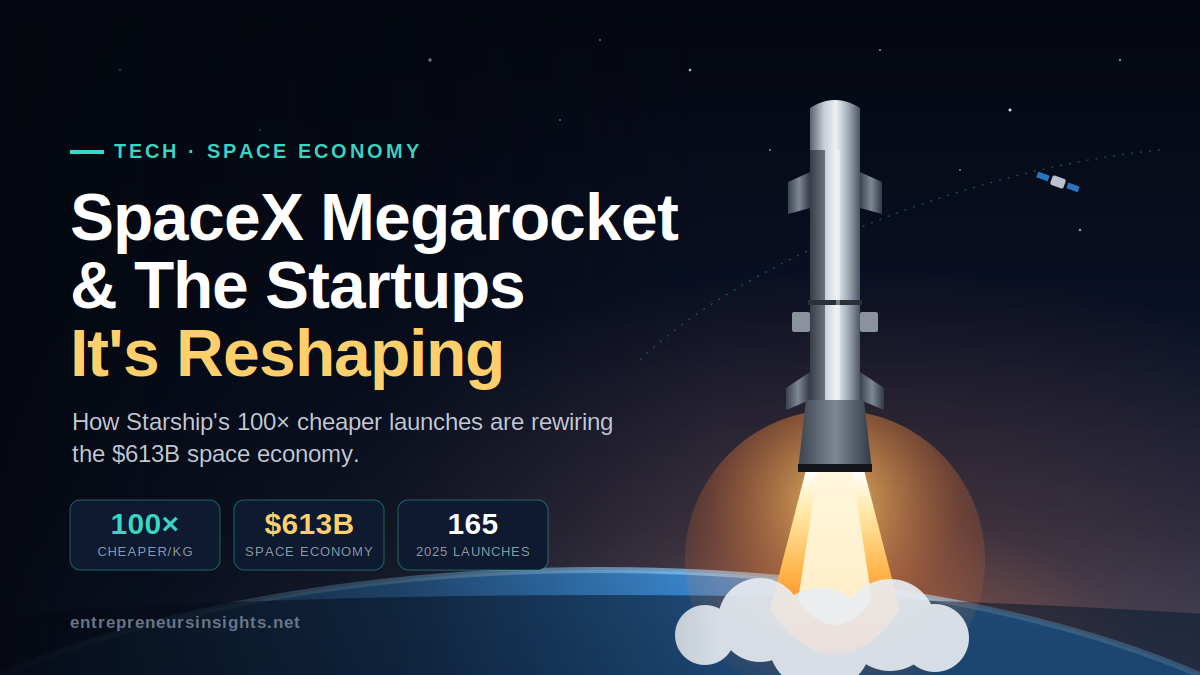
- SpaceX launched 165 Falcon 9 flights in 2025 — a world record — and completed Starship V3’s 12th test flight on May 22, 2026
- Starship could reduce launch costs by 100x — from $10,000/kg to $100/kg — fundamentally changing who can afford to operate in space
- The commercial space economy reached $613 billion in 2024, with private companies capturing 78% of growth
- SpaceX merged with Elon Musk’s xAI in early 2026, creating a combined entity valued at $1.25 trillion targeting a $1.5 trillion IPO
- Space startups raised $7.8 billion in venture capital in 2023; the figure has grown significantly in 2025-2026
- 25 companies are now building specifically for a “post-Starship world” — cheaper access to orbit changes everything from satellite design to in-space manufacturing
- The Aerospace Center for Space Policy warns: bigger isn’t always better — super heavy-lift vehicles face real commercial challenges
Introduction: The Most Important Rocket in History
On May 22, 2026, SpaceX launched Starship V3 — the biggest rocket ever built by any entity in human history — for its 12th test flight. The vehicle performed a landing burn over the Indian Ocean before splashing down, completing the most successful Starship mission to date.
The technical achievement was extraordinary. But for founders, investors, and operators watching the space economy, the more important question is not whether Starship can fly — it clearly can. The question is: what does a world with operational Starship mean for startups, for the economics of space, and for the kinds of companies that should be built in the next decade?
The short answer: it changes almost everything. And the founders who understand this now will have a structural advantage over those who discover it later.
SpaceX in 2026: The Numbers
SpaceX is no longer a startup. It is the cornerstone of America’s aerospace and defense infrastructure — and one of the most valuable private companies ever created.
- Launch dominance: SpaceX broke its own record with 165 Falcon 9 orbital flights in 2025, accounting for the vast majority of US launches. The company holds approximately 60%+ of the global commercial launch market.
- Financial scale: SpaceX generated an estimated $15-16 billion in annual revenue in 2025, with approximately $8 billion in EBITDA. These are extraordinary margins for a launch company — enabled by the reusability economics of Falcon 9, which has now reflown boosters more than 20 times.
- Starlink backbone: Starlink, SpaceX’s satellite internet constellation, is the financial engine behind the aerospace operations. Starlink’s 2025 revenue reached approximately $11.8 billion — $7.5 billion in consumer services, $1.3 billion in hardware sales, and $3.0 billion from US government and military contracts. Starlink added 4.6 million new active customers in 2025, expanding to 35+ countries.
- The xAI merger: In early 2026, SpaceX completed a merger with Elon Musk’s AI company xAI in an all-stock deal, creating a combined entity valued at $1.25 trillion. The combined company is targeting a public listing at a valuation exceeding $1.5 trillion — which would make it the most valuable IPO in history, surpassing Saudi Aramco’s $2 trillion listing in 2019.
- Starship development: Starship is now through 12 full-stack test flights. Starship V3 — unveiled on Flight 12 on May 22, 2026 — features a significantly larger 80-meter booster. SpaceX is building multiple launch sites and production “Giga Bays” to support Block 4 vehicles. Flight tests in 2026 are focusing on orbital refueling — the critical capability needed for deep space missions and the Artemis lunar architecture.
What Is Starship and Why Does It Matter for Startups?
Starship is SpaceX’s fully reusable super heavy-lift vehicle — designed to carry a staggering amount of mass to low Earth orbit (LEO) and beyond. To understand why it matters for startups, you need to understand what it changes about the economics of space.
The Launch Cost Revolution
The cost of getting mass to orbit has been the fundamental constraint on the space economy for 60 years. In the early Space Shuttle era, launch costs ran approximately $54,000 per kilogram. Falcon 9 drove that down to approximately $2,700/kg. Falcon Heavy brought it to approximately $1,400/kg.
Starship’s theoretical cost at full operational scale is approximately $100/kg — a 100x reduction from Falcon 9 and a 540x reduction from the Space Shuttle.
This is not just a cost reduction. It is a category change. At $100/kg, activities that were previously economically impossible become viable. At $2,700/kg, building a space-based solar power station was fantasy. At $100/kg, it is a credible engineering project. At $2,700/kg, manufacturing in space was a laboratory curiosity. At $100/kg, it is a business.
The Payload Capacity Revolution
Starship is designed to carry up to 100-150 metric tons to LEO in expendable mode, or approximately 20-40 tons in fully reusable mode. For context: Falcon 9 carries approximately 22.8 tons to LEO. Falcon Heavy carries approximately 63.8 tons to LEO in expendable mode.
This massive payload capacity changes what satellites can look like. When launch mass is expensive, satellites must be small, light, and efficient. When launch mass is cheap, satellites can be larger, carry more sophisticated instrumentation, and be designed for repairability and longevity rather than miniaturization.
The founders specifically building for this shift — designing satellites for a world where launch mass is cheap — are among the most interesting companies in the space economy right now.
How Starship Changes the Startup Landscape
1. In-Space Manufacturing Becomes Real
The most striking example of Starship-enabled startup activity in 2026 is Space Forge — a British startup that successfully generated plasma aboard its ForgeStar-1 spacecraft in LEO on December 31, 2025. The manufacturing furnace reached temperatures north of 1,000°C in orbit — an essential milestone for orbital semiconductor manufacturing.
“Generating plasma on orbit represents a fundamental shift,” CEO Joshua Western said.
Space Forge’s bet: in microgravity and vacuum, certain materials — semiconductors, pharmaceuticals, fiber optic cables — can be produced with properties impossible to achieve in Earth’s gravity. Until Starship drives down launch costs, the economics of returning manufactured products from orbit to Earth do not work. With Starship, they potentially do.
This is one of the clearest examples of a startup category that does not exist without Starship — and that could be worth tens of billions of dollars with it.
2. New Satellite Design Paradigms
SpaceX itself is already building what observers call “very large, low-cost satellite buses enabled by Starship’s payload capacity” — satellites designed with the assumption that launch mass is cheap. These are satellites rethinking design from first principles for a world where the mass constraint has been substantially relaxed.
Several startups founded by former SpaceX engineers are pursuing the same thesis in different orbital niches. When you can put 100 tons into orbit on a single launch, the satellite design assumptions change completely.
3. Orbital Debris Removal
SpaceX President Gwynne Shotwell suggested as early as 2020 that Starship could be used to clean up used rocket bodies and dead satellites cluttering LEO. Starship’s massive cargo bay could retrieve multiple defunct satellites per mission — a task that requires both the payload volume and the economics that only Starship provides.
Startups working on orbital debris removal have been funding-constrained for years because the business model requires cheap, frequent access to orbit. Starship’s operational development changes that calculus.
4. Space Tourism at Scale
Blue Origin and Virgin Galactic have been selling space tourism tickets at $250,000-$450,000 per seat — prices that limit the market to the ultra-wealthy. Starship’s economics could reduce the cost of a seat to orbit to tens of thousands of dollars within a decade — opening space tourism to a dramatically larger addressable market.
Axiom Space, currently building the first commercial space station, is developing this market with a view toward Starship-enabled access. Startups building experiences, services, and infrastructure for space tourists are positioning for a market that does not yet exist at scale but could within a decade.
5. Point-to-Point Earth Transportation
SpaceX has publicly described using Starship for ultra-fast point-to-point transportation on Earth — New York to London in under 30 minutes. This application is early and speculative, but the technical capability exists with Starship. Startups building the ground infrastructure, booking systems, and passenger experience for hypersonic point-to-point travel are small and early — but potentially positioned for an extraordinary market if the use case develops.
The Warning: Bigger Isn’t Always Better
The Aerospace Center for Space Policy and Strategy published a report in June 2026 that offers a valuable corrective to unqualified Starship optimism.
The report argues that while super heavy-lift rockets offer maximum payload capacity, they face real commercial challenges compared to smaller, more agile launch vehicles. Specifically: increased rocket capacity demands greater cost, time, and operational complexity — and may face challenges in the commercial launch sector where most payloads are not large enough to justify a Starship launch.
Most commercial satellites are not 100-ton payloads. Most commercial launches carry small or medium payloads that fit comfortably on a Falcon 9 or a Rocket Lab Electron. Starship’s economics work best when the full payload capacity can be utilized — which requires aggregating many small payloads or building satellites large enough to fill the vehicle.
This creates a genuine strategic question for startups: are you building for a world where Starship’s capacity is consistently filled? Or are you building a business that works regardless of whether Starship achieves operational scale?
The most robust space startups are building businesses that benefit from Starship’s cost reduction but do not depend on it — companies that have a viable business at today’s launch costs and a dramatically better business at Starship-scale costs.
The Competitive Landscape: Who Else Is Building for This World?
Rocket Lab
Rocket Lab is SpaceX’s most credible small-launch competitor, with its Electron rocket serving the small satellite market and Neutron (a medium-lift vehicle) under development. Rocket Lab’s thesis is that there will always be a market for dedicated small-satellite launches that do not need to wait for Starship rideshare windows.
Blue Origin
Jeff Bezos’s Blue Origin is developing New Glenn — a heavy-lift reusable rocket — and working on orbital space stations through its contract with NASA’s Commercial Low Earth Orbit Destinations (CLD) program. Blue Origin is the only US company with the vertical integration to be a genuine long-term SpaceX competitor.
Relativity Space
Relativity Space is developing Terran R — a fully reusable medium-lift rocket — using 3D printing and AI-driven manufacturing to reduce production time to 60 days versus 2+ years using traditional methods. Former Google CEO Eric Schmidt joined as Executive Chairman. Relativity’s bet: the manufacturing process is the moat, not the rocket design.
Impulse Space
Founded by Tom Mueller — SpaceX’s founding CTO and former head of propulsion with 18+ years at SpaceX — Impulse Space is building orbital transfer vehicles that enable multi-orbit delivery from a single launch. Impulse is specifically building for the post-Starship world: when you can put enormous mass in orbit cheaply, the challenge becomes moving that mass to the right orbit efficiently.
What This Means for Founders and Investors
VC Advice from Space Investors
Three prominent space VCs — Chad Anderson (Space Capital), Jonathan Lacoste (Space.VC), and Raphael Roettgen (E2MC Ventures) — have all given similar advice to space startup founders: think now about how Starship could affect your operations, for better or worse.
Anderson’s framing is the most direct: “We don’t want to invest in something that’s going to be obsolete. We’re looking for people who are building for this post-Starship world.”
Questions Every Space Startup Founder Should Answer
Does your business model depend on launch costs that Starship could undermine? If you are building a launch vehicle that competes with Falcon 9 on cost, Starship’s $100/kg economics could make your business obsolete before it achieves scale. If you are building a payload or application that benefits from cheaper launch costs, Starship is your tailwind.
Are you designing for the mass constraints of today or the capacity of tomorrow? Satellites, space stations, and in-space manufacturing facilities designed for the mass constraints of Falcon 9 may not be optimally designed for a world where Starship makes mass cheap. The most forward-looking founders are designing for tomorrow’s economics.
What new markets become possible at $100/kg that are impossible at $2,700/kg? The most interesting space startups are building for markets that do not yet exist economically but will exist with Starship’s cost structure.
The Five Space Economy Sectors Being Transformed
1. Launch Services
The launch market is consolidating around reusable vehicles. Companies without a reusability roadmap face existential risk. SpaceX dominance is accelerating this consolidation.
2. Satellite Manufacturing
Designing satellites for cheap, abundant launch capacity rather than mass-constrained rideshare. New form factors, longer missions, repairability.
3. Earth Observation
Planet Labs, Maxar, and dozens of startups are building imaging constellations. Starship’s capacity enables larger, more capable imaging satellites at lower per-unit cost.
4. Space Stations
Axiom Space and Blue Origin are building commercial space stations for NASA’s CLD program. Starship is the only vehicle currently capable of delivering the large modules needed for these stations efficiently.
5. Deep Space and Lunar Economy
NASA’s Artemis program uses Starship as the Human Landing System for returning to the Moon. The lunar economy — resource extraction, habitation, transportation — is Starship-dependent at its core.
Also Read: Acrew Capital: The Complete Guide to the Climate Tech and Fintech VC Firm
Frequently Asked Questions
What is SpaceX’s Starship megarocket?
Starship is SpaceX’s fully reusable super heavy-lift vehicle — the most powerful rocket ever built. It consists of a Super Heavy booster and the Starship upper stage, together standing approximately 120 meters tall. Designed to carry 100+ metric tons to low Earth orbit, Starship is intended to reduce launch costs by up to 100x compared to current vehicles, enable Mars colonization, and serve as the backbone of NASA’s Artemis lunar program.
How many times has Starship launched?
As of July 2026, Starship has completed 12 full-stack test flights, including the debut of Starship V3 (an upgraded, larger version) on May 22, 2026. SpaceX completed 165 Falcon 9 orbital flights in 2025 — a world record — alongside 5 Starship test flights.
What is SpaceX worth in 2026?
Following SpaceX’s merger with Elon Musk’s AI company xAI in early 2026, the combined entity is valued at approximately $1.25 trillion, with a targeted IPO valuation exceeding $1.5 trillion. SpaceX’s standalone revenue was estimated at $15-16 billion in 2025, with approximately $8 billion in EBITDA.
How does Starship affect space startups?
Starship’s potential to reduce launch costs from ~$2,700/kg (Falcon 9) to ~$100/kg fundamentally changes what is economically viable in space. Businesses that could not justify the economics of getting mass to orbit — in-space manufacturing, orbital debris removal, large satellite constellations, space tourism at scale — become viable at Starship costs. Startups “building for a post-Starship world” are among the most interesting investment opportunities in the space economy.
What is the commercial space economy worth?
The commercial space economy reached $613 billion in 2024, with private companies capturing 78% of growth. Space startups raised $7.8 billion in venture capital in 2023, with the figure growing significantly in 2025-2026 as Starship development has progressed and the sector’s commercial potential has become more concrete.
Who are SpaceX’s main competitors?
SpaceX’s primary competitors include Blue Origin (New Glenn heavy-lift vehicle, lunar landers), Rocket Lab (Electron small-lift, Neutron medium-lift in development), Relativity Space (Terran R 3D-printed reusable rocket), and ULA (Atlas V, Vulcan Centaur). In satellite internet, SpaceX’s Starlink competes with Amazon’s Kuiper and OneWeb. No competitor currently matches SpaceX’s launch cadence, reusability track record, or vertical integration.
