

Key Takeaways
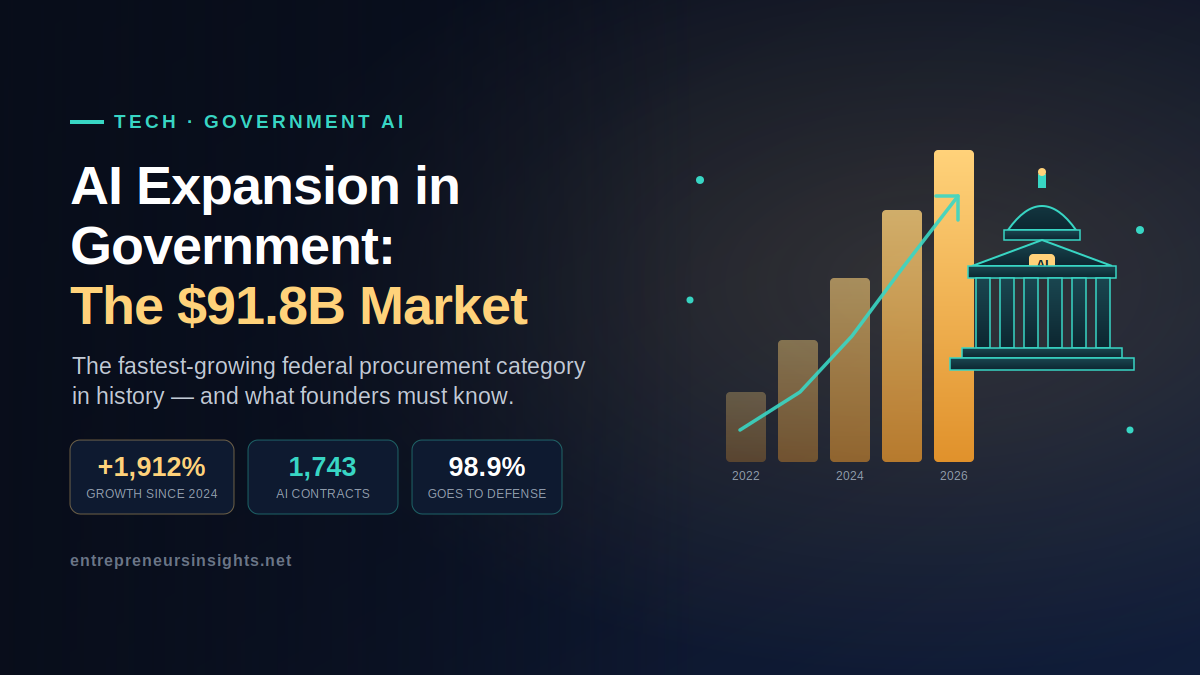
- Federal AI contract potential value reached $91.8 billion in 2026 — a 1,912% increase from $4.6 billion in 2024 (Brookings)
- Obligated AI spending hit $7.2 billion in 2026 — up 966% from $675 million in 2024
- Department of Defense dominates: $90.7 billion in potential AI contract value, 98.9% of all federal AI spending
- 1,743 AI contracts were awarded in 2026 — up from 472 in 2022 and 961 in 2024
- 28 federal agencies now have AI contracts — up from 17 in 2022
- The Trump administration’s “America’s AI Action Plan” removed regulatory barriers, dramatically accelerating federal AI investment
- Local government is the largely untapped frontier — 50,000+ agencies, most spending under $1M per AI contract
- Startups targeting government AI must achieve FedRAMP authorization, CMMC 2.0 certification (for DoD), and SBIR pathway eligibility
Introduction: The Largest Technology Market Shift in a Generation
When historians look back at 2026, they will note that the US federal government did something it has almost never done: it moved fast.
Federal AI spending obligated between 2024 and 2026 increased by 966% — from $675 million to $7.2 billion. The potential value of federal AI awards increased by 1,912% — from $4.6 billion to $91.8 billion. In four years, the federal AI market went from “chaotic, immature, and dominated by small experimental contracts” (IBM’s 2022 characterization) to the fastest-growing technology procurement category in government history.
For founders and operators, this is one of the most significant market shifts of the decade — and one of the most underappreciated. Government AI is not just a procurement category. It is a signal about where AI is being embedded into the foundational infrastructure of the world’s largest economy, and what that embedding means for the companies building AI products and services.
The Numbers: Federal AI Spending in 2026
The data comes from two primary sources: Brookings Institution’s May 2026 federal AI spending report, and IBM’s July 2026 analysis of Leadership Connect data. Both tell the same story, from slightly different angles.
Contract Volume
The number of federal AI contracts awarded has grown dramatically:
- 2022: 472 contracts
- 2024: 961 contracts
- 2026: 1,743 contracts
This tripling in contract count over four years reflects both the expansion of AI capabilities worth procuring and the increasing number of agencies developing the procurement knowledge to write AI contracts effectively.
Dollar Value
The dollar growth is even more striking than the contract count:
Obligated spending (money actually committed):
- 2024: $675 million
- 2026: $7.2 billion (+966%)
Potential award value (maximum value if all contract options are exercised):
- 2024: $4.6 billion
- 2026: $91.8 billion (+1,912%)
The gap between obligated ($7.2B) and potential ($91.8B) reflects the extensive use of IDIQ (Indefinite Delivery, Indefinite Quantity) contracts — vehicles where the government establishes a maximum contract ceiling without committing to a specific spending level. The $91.8 billion in potential value represents the ceiling of contracts currently in place; actual spending will depend on agency adoption and funding availability.
Agency Distribution
Out of 441 total federal agencies, 28 now have AI contracts — up from 17 in 2022. The distribution is dramatically skewed:
Department of Defense: 1,319 of 1,743 total AI contracts, $90.7 billion in potential contract value (98.9% of total). This represents a 1,605% increase from 2024.
Department of Commerce: $197 million in AI contracts Department of Health and Human Services: $138 million NASA: $45 million Department of Energy and others: Smaller but growing
The DoD dominance reflects both the scale of defense spending generally and the Pentagon’s explicit strategic priority of achieving “AI decision superiority” — the ability to process and act on information faster than adversaries.
The Policy Context: America’s AI Action Plan
The dramatic acceleration of federal AI spending in 2025-2026 is not an organic phenomenon — it is the direct consequence of deliberate policy choices by the Trump administration.
The America’s AI Action Plan, signed in early 2025, established three core priorities: removing regulatory barriers to AI development, expanding AI infrastructure, and achieving global AI dominance. The plan explicitly emphasized deregulation and removing what it called “ideological bias” from AI governance.
The practical effects have been substantial:
Deregulation: Several Biden-era AI safety requirements that applied to federal AI procurement were reversed or substantially weakened. This removed friction from the procurement process and accelerated agency adoption.
Defense prioritization: The administration’s explicit framing of AI as a national security priority — specifically around competition with China — channeled the majority of new AI spending through DoD channels.
Infrastructure investment: The administration’s support for AI data centers and computing infrastructure has created demand for both cloud services (AWS GovCloud, Microsoft Azure Government) and specialized government AI platforms.
The Anthropic controversy: In March 2026, the Pentagon labeled Anthropic a “supply-chain risk” after Anthropic refused to weaken safety guardrails for autonomous weapons systems. The episode illustrates the tension between commercial AI companies’ safety commitments and the military’s operational requirements — a tension that will shape the government AI market for years.
What the Government Is Actually Buying
Understanding what government agencies are purchasing is more useful than knowing the total dollar figures. The breakdown reveals both the current state of government AI adoption and the opportunity landscape for startups.
Defense and Intelligence AI ($90.7B potential value)
The DoD’s AI spending is concentrated in several priority areas:
Intelligence analysis: AI systems that process satellite imagery, signals intelligence, and open-source information faster than human analysts. Companies like Palantir (which has extensive DoD contracts) and Anduril (founded by Palmer Luckey with explicit defense focus) have built their businesses around this use case.
Logistics and supply chain: Predictive maintenance for military equipment, supply chain optimization, and inventory management. The DoD manages one of the world’s most complex logistics operations, and AI-driven efficiency improvements translate directly to operational readiness.
Cybersecurity: AI-powered threat detection, vulnerability assessment, and automated response. DoD cybersecurity spending has grown dramatically alongside the broader federal cybersecurity budget.
Autonomous systems: Drone warfare, autonomous vehicle navigation, and robotic systems. This is the most politically contested area — and where the tension between commercial AI companies’ safety commitments and military operational requirements is most acute.
Civilian Agency AI ($1.1B obligated)
Civilian agency AI spending is smaller in absolute terms but offers more accessible opportunities for startups without defense clearances:
Healthcare (HHS, VA): AI for clinical decision support, claims processing, and fraud detection. The VA in particular has been an active early adopter of AI for veteran healthcare management.
Scientific research (NASA, DOE, NIST): AI for climate modeling, scientific data analysis, and research acceleration. These agencies are buying AI capability to extend their research capacity, not replace researchers.
Regulatory and compliance (SEC, FDA, IRS): AI for document processing, compliance monitoring, and enforcement prioritization. These use cases are large in scale (millions of documents) and relatively lower in political sensitivity.
Customer service (SSA, USPS): AI chatbots and automated response systems for citizen-facing services. The most common AI-related agenda item in local government meetings in 2026 is “AI use policy” — and AI customer service tools are typically the first implementation that follows.
Local Government: The Untapped Market
The federal AI story dominates coverage — but the local government market may be the larger long-term opportunity for startups.
There are 50,000+ local government agencies in the United States. Most lack the budget for $10M+ contracts, but collectively they represent enormous aggregate procurement capacity — and the AI tools they adopt become the foundation for a generation of government technology infrastructure.
Based on analysis of 1,000+ city council meetings and county board sessions, the AI use cases generating real local government contract spending in 2026 include:
- AI use policies: The most common agenda item — nearly every local government is writing AI use policies that define what tools employees can use and for what purposes
- Public safety AI: Gunshot detection, traffic optimization, and predictive policing (the most politically contested category)
- Permitting and inspection: AI-assisted permit review, code compliance, and building inspection scheduling
- Customer service: Chatbots for common citizen inquiries (permit status, trash pickup schedules, utility payments)
- Financial management: AI for budget analysis, fraud detection, and grant management
Palantir and AWS GovCloud have dominated federal and defense AI — but local government remains largely untapped. The companies that build scalable AI platforms specifically for the local government market are entering a space where the competition is limited and the aggregate opportunity is substantial.
The Startup Opportunity in Government AI
Why Government AI Is Attractive for Startups
Sticky contracts: Government contracts typically run 3-5 years with renewal options. Once embedded in agency workflows, AI systems are very difficult to displace — creating revenue visibility that commercial software companies rarely achieve.
Large contract values: Even small agencies award contracts worth $500K-$5M for AI services. A startup with 10-20 agency customers can build a substantial recurring revenue base.
Mission alignment: Working on government AI often means building tools that affect millions of citizens — a mission that attracts talent who want their work to matter beyond commercial metrics.
Competitive moats: Security clearances, FedRAMP authorization, and CMMC certifications create genuine barriers to entry that protect early movers in the government market from commodity competition.
Why Government AI Is Hard for Startups
Procurement complexity: Federal procurement is governed by the Federal Acquisition Regulation (FAR) — a complex set of rules that requires specialized legal and compliance knowledge. The procurement cycle from first contact to awarded contract typically runs 12-24 months.
Security requirements: Accessing classified data requires personnel security clearances. Building software that handles classified data requires facilities clearances and compliance with NIST security standards. These are not trivial to obtain.
FedRAMP authorization: Software products that process federal data must achieve FedRAMP authorization — a rigorous security assessment process that typically costs $500K-$2M and takes 12-18 months. Without FedRAMP, most federal agencies cannot procure your software.
CMMC 2.0 compliance: The Cybersecurity Maturity Model Certification (CMMC) 2.0, which took effect November 2025, is now a prerequisite for many DoD bids. Phase 1 (November 2025-November 2026) covers Level 1 and Level 2 requirements. Startups targeting DoD must achieve appropriate CMMC certification.
Slow payment cycles: Government agencies typically pay on Net-30 or Net-45 terms — after invoicing. Complex contracts may have additional payment delays. Cash flow management is more challenging in government markets than in commercial SaaS.
The SBIR Pathway
The Small Business Innovation Research (SBIR) program is the most accessible entry point for startups into the government AI market. SBIR contracts are set aside specifically for small businesses, with Phase I awards of up to $300K and Phase II awards of up to $2M.
More importantly, SBIR contracts can serve as proof points that facilitate larger contract awards. A startup that has successfully delivered SBIR Phase I and II contracts has established a contract performance record — the most important credentialing factor in government procurement.
The DoD’s SBIR program specifically targets AI capabilities in the priority areas identified above: intelligence analysis, logistics, cybersecurity, and autonomous systems. Startups with relevant AI capabilities should actively track SBIR solicitations from relevant DoD components.
The Key Players: Who Is Winning Government AI Contracts
Established Leaders
Palantir Technologies ($200B+ market cap): Built its business on government intelligence analysis and has been the most visible commercial beneficiary of the government AI expansion. Its Gotham (government) and Foundry (commercial) platforms are embedded in major federal agency workflows.
Microsoft: Azure Government and Microsoft 365 Government are the dominant cloud infrastructure for civilian agencies. Microsoft’s $10B investment in OpenAI gives it a strategic advantage in bringing GPT capabilities to government customers through compliant cloud infrastructure.
Amazon Web Services: AWS GovCloud is the primary cloud infrastructure for the most sensitive government workloads. Amazon’s $4B investment in Anthropic positions it to deliver frontier AI capabilities through its government cloud infrastructure.
Booz Allen Hamilton: The largest government IT contractor by AI revenue, with extensive relationships across defense and intelligence agencies and the contract vehicles to capture a large share of new AI spending.
Leidos, SAIC, General Dynamics IT: Traditional defense contractors rapidly building AI practices to capture the AI spending surge.
Emerging Challengers
Anduril Industries: Palmer Luckey’s defense tech startup building autonomous systems and AI-powered defense platforms. Valued at $28B, Anduril is the most prominent defense-native AI startup and a model for startups building specifically for the defense market.
Shield AI: Autonomous aerial systems for defense, valued at $2.7B.
Rebellion Defense: AI for defense decision-making, acquired by Shield AI.
Scale AI: Government division providing AI data labeling and evaluation services for federal agencies.
What Founders Must Know Before Targeting Government AI
Start With Civilians Before DoD
The civilian agency market (HHS, NASA, Commerce, SSA) is significantly more accessible than DoD for most startups. Security requirements are lower, procurement cycles are somewhat faster, and the use cases are often closer to commercial AI applications. Build your government contracting capability in civilian agencies before attempting DoD.
FedRAMP Is Non-Negotiable for Scale
If you are building software for federal agencies that process federal data, FedRAMP authorization is required. Budget 12-18 months and $500K-$2M for the process. There is no shortcut. The good news: FedRAMP authorization is a durable competitive advantage that few startups achieve — and once achieved, it opens many agency doors simultaneously.
Partner Before You Prime
Most small AI startups enter the government market as subcontractors to larger prime contractors — Booz Allen, Leidos, SAIC — who provide the contract vehicles, security infrastructure, and customer relationships while the startup provides the AI technology. This is slower and involves sharing revenue, but it is dramatically lower-risk than pursuing direct prime contracts as a first government engagement.
Local Government First for Non-Defense AI
If your AI product serves a general business use case — document processing, customer service, data analysis — local government is a more accessible entry point than federal. Procurement cycles are shorter, security requirements are lower, and the 50,000+ agency addressable market is large enough to build a substantial business without engaging federal procurement complexity.
Frequently Asked Questions
How much does the federal government spend on AI in 2026?
Federal AI contract potential value reached $91.8 billion in 2026 — a 1,912% increase from $4.6 billion in 2024. Obligated spending (money actually committed) reached $7.2 billion, up 966% from $675 million in 2024. The Department of Defense accounts for 98.9% of potential contract value ($90.7 billion).
Which federal agencies are spending the most on AI?
The Department of Defense dominates, with $90.7 billion in potential AI contract value (98.9% of all federal AI spending). Other significant spenders include the Department of Commerce ($197 million), Department of Health and Human Services ($138 million), and NASA ($45 million). 28 of 441 federal agencies now have AI contracts.
What is FedRAMP and why do AI startups need it?
FedRAMP (Federal Risk and Authorization Management Program) is the US government’s security assessment framework for cloud software products. Software products that process federal data must achieve FedRAMP authorization before most federal agencies can procure them. The authorization process typically costs $500K-$2M and takes 12-18 months. Without FedRAMP, AI startups are effectively blocked from federal software contracts.
What is CMMC 2.0 and does it affect AI startups?
CMMC (Cybersecurity Maturity Model Certification) 2.0 is a DoD cybersecurity framework that took effect November 2025. It is now a prerequisite for many DoD contracts. AI startups pursuing DoD business must achieve appropriate CMMC certification for their level of target contracts. Phase 1 (November 2025-November 2026) covers Level 1 and Level 2 requirements.
What is the SBIR program and how can AI startups use it?
The Small Business Innovation Research (SBIR) program is a federal program that sets aside contracts specifically for small businesses. Phase I awards go up to $300K; Phase II awards up to $2M. SBIR contracts serve as proof points that facilitate larger contract awards. DoD’s SBIR program actively solicits AI capabilities across its priority areas, making it the most accessible entry point for AI startups into the defense market.
Why did the Pentagon label Anthropic a supply-chain risk?
In early March 2026, the Pentagon labeled Anthropic a supply-chain risk after Anthropic refused to weaken its safety guardrails for autonomous weapons systems. The episode illustrates the tension between commercial AI companies’ safety commitments and the military’s operational requirements for autonomous decision-making in weapons systems.
