

Key Takeaways
- Only 30% of organizations have highly prepared AI governance strategies — down from last year, despite 74% planning to adopt agentic AI within two years (Deloitte 2026)
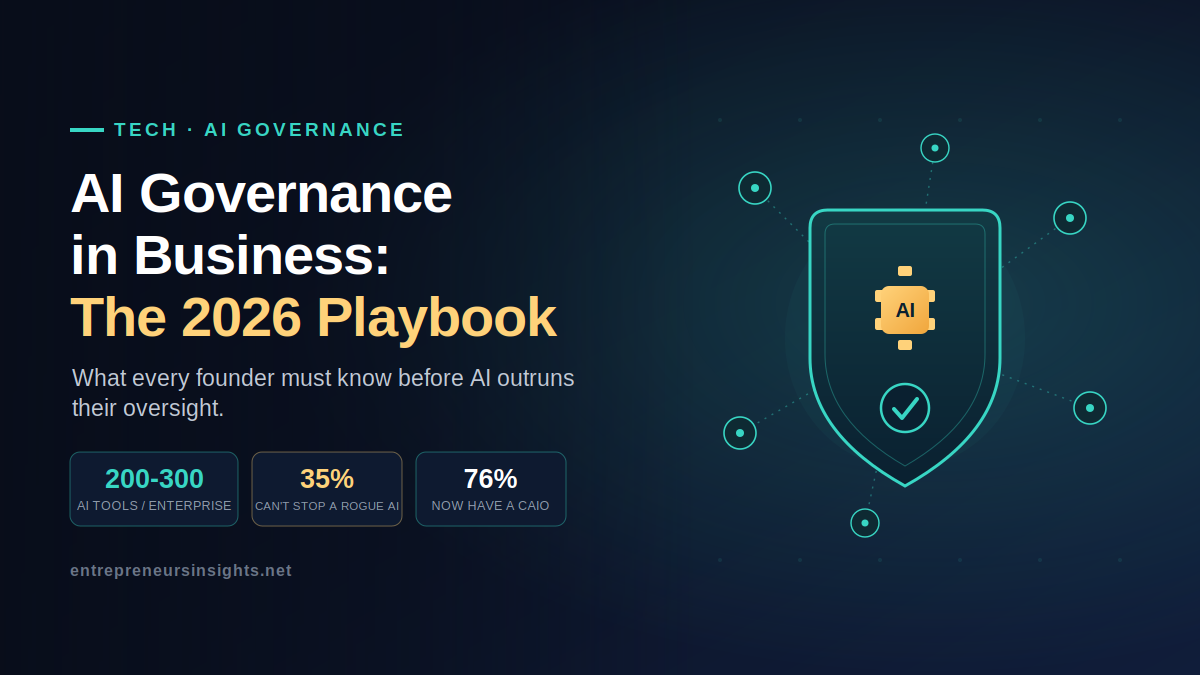
- The average enterprise has 200-300 AI tools in active use — versus the 60-70 that CIOs think they have deployed
- 76% of organizations now have a Chief AI Officer, up from just 26% in 2025 (IBM) — the governance function is being institutionalized at record speed
- 35% of organizations cannot shut down a rogue AI agent if one emerged — the most alarming single statistic in enterprise AI in 2026
- Spending on AI governance platforms will reach $492 million in 2026 (Gartner) — a market created almost entirely within the last 24 months
- 78% of enterprises are unprepared for EU AI Act obligations (Vision Compliance) — regulatory risk is the primary governance forcing function
- Governed organizations consistently outperform ungoverned ones — AI governance is a competitive advantage, not just a compliance cost
Introduction: The Governance Gap Is the AI Problem
Every founder in 2026 has heard the same AI promise: transform your operations, accelerate your product, reduce your headcount, 10x your output. The promise is real. The returns are documented. The adoption is accelerating.
What is less discussed — but equally consequential — is the governance gap: the distance between where AI is operating in organizations and where oversight can actually see it.
The average CIO believes their organization is using 60-70 AI tools. When monitoring is turned on, the real number is 200-300. Sometimes more. Every one of those tools is making decisions, processing data, generating outputs, and taking actions — often without clear accountability, audit trails, or shutdown mechanisms.
This is not a compliance problem. It is a business problem. Ungoverned AI creates operational liability, regulatory exposure, customer trust risk, and competitive vulnerability. The organizations winning with AI in 2026 are not the ones deploying AI fastest — they are the ones deploying AI most reliably.
This guide explains what AI governance actually means in a business context, why it matters for founders and operators at every stage, and how to build a governance framework that enables AI adoption rather than blocking it.
What Is AI Governance?
AI governance is the set of policies, processes, accountability structures, and technical controls that determine how AI systems are developed, deployed, monitored, and corrected within an organization.
The simplest definition: AI governance answers three questions:
- Who is responsible when an AI system makes a consequential decision?
- How do we know whether AI systems are performing as intended?
- What happens when an AI system behaves unexpectedly?
Organizations that cannot answer all three questions for their deployed AI systems — confidently and specifically — have a governance gap.
In 2026, AI governance has expanded dramatically in scope. It now covers:
Data governance for AI: What data can AI systems access, train on, and use in decision-making? Who controls data quality and lineage? How is sensitive data protected from AI-driven exposure?
Model governance: Which AI models are approved for enterprise deployment? How are models evaluated before deployment? How are performance degradations detected post-deployment?
Agentic AI governance: As AI systems gain the ability to take actions autonomously — browsing the web, writing code, sending emails, making purchases — governance must extend to controlling what actions agents can take, not just what outputs they can generate.
Regulatory compliance: EU AI Act (fully applicable August 2026), SEC AI disclosure requirements, GDPR AI processing requirements, and sector-specific regulations (HIPAA for healthcare AI, financial services AI regulations) all impose specific governance obligations.
Accountability structures: Who owns AI systems? Who is responsible for outcomes? Who has the authority to shut down an underperforming or misbehaving AI system?
Why AI Governance Is a Business Problem, Not Just a Compliance Problem
The most common mistake founders make about AI governance: treating it as a compliance function rather than a business function.
Compliance-driven governance asks: “What do we need to do to avoid regulatory penalties?” Business-driven governance asks: “How do we ensure our AI systems reliably serve our business objectives and protect our relationships with customers, employees, and partners?”
The business case for governance is clear and growing:
Governed organizations outperform ungoverned ones. The Larridin State of Enterprise AI 2026 report found that AI governance is not a barrier to adoption but a critical success factor — with governed organizations consistently outperforming ungoverned ones on AI ROI.
The exposure gap creates operational risk. When employees use AI tools outside the organization’s awareness (shadow AI), sensitive data moves through unvetted systems, decisions are made by unmonitored models, and the organization accumulates liability it cannot see.
Customer and partner trust is at stake. Governance frameworks are becoming a competitive signal. Customers — especially enterprise buyers — are beginning to ask not just whether AI is being used, but how AI decisions are made, monitored, and owned. Organizations without clear answers lose deals to those who have built governance credibility.
AI failures are public. Unlike a bad spreadsheet formula, AI system failures tend to be visible, consequential, and repeatable — affecting many customers in similar ways. A single AI governance failure can generate more reputational damage than a year of product quality improvements can recover.
The State of AI Governance in 2026: What the Data Shows
The Adoption-Governance Gap
The fundamental pattern of AI in 2026 is a widening gap between adoption speed and governance maturity:
- 74% of organizations plan to adopt agentic AI within two years (Deloitte)
- Only 21% currently have a mature governance model for AI agents (Deloitte)
- 36% have no formal plan for deploying AI agents at all (Writer)
- 35% could not shut down a rogue AI agent if one emerged (Writer)
This gap — planning AI autonomy without governance for that autonomy — is the defining risk of the current AI moment.
The Shadow AI Problem
When organizations implement AI monitoring, they consistently discover that actual AI tool usage dramatically exceeds sanctioned deployment:
- CIOs typically believe 60-70 AI tools are in use
- Monitoring reveals 200-300 tools actually in use
- The reaction is consistently: “surprise and concern, followed by grudging acknowledgment that it makes sense”
This shadow AI problem is not primarily a security failure — it reflects the reality that AI tools are increasingly accessible, immediately useful, and spreading through organizations at the speed of individual productivity improvement, not IT procurement cycles.
Effective governance acknowledges this reality rather than trying to prevent it. The appropriate response to discovering 300 AI tools in use is not to ban 240 of them — it is to build monitoring and evaluation infrastructure that can assess which tools are safe to use, under what conditions, for what purposes.
The Chief AI Officer Explosion
76% of organizations now have a Chief AI Officer — up from just 26% in 2025 (IBM). This 50-percentage-point jump in 12 months represents the fastest institutionalization of any C-suite role in corporate history.
The CAIO role reflects organizational recognition that AI governance requires dedicated leadership — someone whose full-time job is ensuring AI serves business objectives while managing the associated risks. For founders building organizations at scale, the question is not if you need dedicated AI governance leadership, but when — and what that role looks like at your current company size.
The EU AI Act Is the Primary Forcing Function
78% of enterprises are unprepared for EU AI Act obligations (Vision Compliance). The Act, fully applicable from August 2026, creates specific governance requirements for organizations deploying AI in “high-risk” applications — a category that includes many B2B AI use cases in healthcare, financial services, HR, education, and critical infrastructure.
The regulatory pressure is not limited to the EU. SEC cybersecurity disclosure rules, proposed FTC AI guidelines, and sector-specific regulations are creating a multi-jurisdictional compliance environment that makes ad-hoc AI governance untenable.
For US startups with European customers or operations: EU AI Act compliance is not optional. For US startups without European exposure: the US regulatory environment is moving toward similar requirements, and building governance infrastructure now is cheaper than retrofitting it after regulatory requirements crystallize.
The AI Governance Framework for Business Context
Effective AI governance for business context addresses four dimensions:
Dimension 1: Visibility — Know What AI You Have
You cannot govern what you cannot see. The first governance priority is establishing comprehensive visibility into your AI landscape:
AI tool inventory: What AI tools are in use across the organization? Who is using them, for what purposes, with access to what data? This inventory must be actively maintained — shadow AI means the landscape changes faster than quarterly audits can track.
Data flow mapping: What data flows through which AI systems? Which AI tools have access to customer data, financial data, personal data, or proprietary business information? The data flow map is the foundation for both governance and regulatory compliance.
Decision mapping: Where is AI influencing decisions that affect customers, employees, or operations? The most important governance interventions target consequential decisions — not AI-assisted content generation, but AI-driven credit decisions, hiring recommendations, or medical diagnoses.
Usage monitoring: Real-time visibility into how AI tools are being used — including attempts to use unsanctioned tools — is the operational foundation of governance. Without monitoring, governance is aspirational rather than effective.
Dimension 2: Accountability — Know Who Owns What
The most common AI governance failure is accountability ambiguity: when an AI system produces a bad outcome, no one is clearly responsible for addressing it.
Effective accountability structures specify:
System ownership: Every deployed AI system has a named owner — a person whose job includes ensuring the system performs as intended and addressing problems when it does not.
Decision accountability: When AI influences a consequential decision, a human is accountable for that decision. The human accountability does not disappear because AI was involved. Deloitte’s formulation: “Unclear accountability will not scale. Ownership should be explicit before autonomy expands further.”
Escalation paths: When an AI system produces unexpected or concerning output, who gets notified? What is the process for escalating AI system problems from the operator to the owner to leadership?
Shutdown authority: Who has the authority — and the technical capability — to shut down a misbehaving AI system? The 35% of organizations that cannot shut down a rogue AI agent represents an accountability failure, not just a technical one.
Dimension 3: Context — Make AI Business-Aware
This is the most underappreciated dimension of AI governance — and the one captured by the keyword “AI contextual governance” and “business-specific accuracy.”
AI systems that are accurate in general are often inaccurate in specific business contexts. A general-purpose LLM that correctly summarizes most documents may perform poorly on your specific regulatory filings, customer contracts, or technical documentation. The governance challenge is ensuring that AI systems have the business context they need to be accurate and appropriate for your specific use case.
Contextual accuracy: How well does the AI system understand your specific business, industry, terminology, and decision-making context? Generic AI models often need fine-tuning, RAG (Retrieval-Augmented Generation), or custom prompt engineering to achieve the accuracy required for business-critical applications.
Semantic alignment: Do your AI systems understand what your business terms mean? “Customer” may mean different things in your CRM, your support system, and your financial system. AI governance must address how semantic consistency is maintained across AI applications that may draw from multiple systems.
Business rule integration: Your organization has rules — regulatory, contractual, ethical — that AI systems must respect. Governance ensures these rules are encoded into AI system behavior, not just documented in policies that AI systems cannot read.
Cultural and regulatory context: AI systems deployed in different markets must be sensitive to local regulatory requirements, cultural norms, and language nuances. Governance frameworks must address how AI behavior is adapted for different contexts.
Dimension 4: Evolution — Build Governance That Adapts
AI governance that is static will always be behind. AI capabilities are evolving faster than governance frameworks can be written — which means effective governance must be designed to evolve.
Evidence-based evolution: Governance should change based on evidence of what is working and what is not, not based on policy calendar or annual review cycles. When monitoring reveals that a governance control is creating friction without reducing risk, it should be updated. When an AI failure exposes a governance gap, controls should be tightened within days, not at the next audit cycle.
Agentic AI readiness: The single most important governance evolution challenge in 2026 is preparing for agentic AI — systems that take actions autonomously, not just generate content. Governance frameworks designed for supervised AI (where a human reviews every output) are inadequate for agentic AI (where the AI acts without human review). The governance question evolves from “is this output appropriate?” to “is this action appropriate, and can we reverse it if it is not?”
Regulatory tracking: The regulatory environment for AI is changing faster than at any point in technology history. Governance teams must actively track regulatory developments across relevant jurisdictions — not just react to regulations after they take effect.
AI Governance for Startups: A Practical Framework
Most AI governance guidance is written for enterprises with hundreds of employees and dedicated compliance teams. Startups need a different approach: governance that is proportionate to current scale, builds the right habits early, and can scale as the company grows.
Stage 1: Early Startup (1-20 employees)
The governance priority: Know what AI you are using and what data it can access.
Practical steps:
- Create a simple AI tool inventory (a spreadsheet is fine) listing every AI tool in use, who uses it, and what data it can access
- Review the terms of service and data processing agreements for every AI tool that touches customer data
- Establish a default rule: no customer personal data in consumer AI tools (ChatGPT, Claude.ai, etc.) without explicit customer consent or enterprise agreements
- Designate someone (probably the CTO or founder) as responsible for AI tool decisions
What you do not need yet: A formal AI policy, a Chief AI Officer, or enterprise governance software.
Stage 2: Growth Stage (20-100 employees)
The governance priority: Formalize accountability and establish monitoring.
Practical steps:
- Write a simple AI use policy (1-2 pages) that specifies which tools are approved, what data they can process, and how to request approval for new tools
- Implement monitoring for at least your highest-risk AI applications (any AI touching customer data, financial decisions, or HR processes)
- Assign specific owners to each significant AI application
- Build AI-related questions into your vendor security questionnaire (see the vendor risk management article)
- Conduct a quarterly review of AI tool usage and emerging risks
What you probably need: AI use policy, basic monitoring, named ownership.
Stage 3: Scale Stage (100+ employees)
The governance priority: Systematic governance infrastructure that scales.
Practical steps:
- Implement an AI governance platform (Larridin, Retool, or comparable) that provides automatic AI tool detection and monitoring
- Create a formal AI risk classification framework (high/medium/low risk AI applications with different governance requirements for each tier)
- Establish an AI governance committee (not a dedicated team yet — representatives from legal, engineering, product, and operations)
- Develop an EU AI Act compliance program if you have European operations or customers
- Implement formal model documentation and performance monitoring for all production AI systems
- Consider hiring a dedicated AI governance or responsible AI role
The Strategic Visibility Angle: AI Governance as Competitive Advantage
The most sophisticated organizations in 2026 have realized that AI governance is not just risk management — it is strategic differentiation.
When enterprise customers evaluate AI-powered vendors, they increasingly ask governance questions: How do you ensure AI accuracy in our specific context? Who is accountable when AI produces wrong outputs? How do you protect our data in your AI systems? What is your EU AI Act compliance status?
Organizations with clear, confident answers to these questions win deals that organizations with vague, aspirational answers lose. Governance credibility is becoming a sales asset.
For founders building B2B companies: invest in governance infrastructure before your customers start asking for it. The organizations that built SOC 2 compliance before it was a procurement requirement now close enterprise deals faster than those scrambling to achieve it under customer pressure. AI governance is following the same adoption curve.
Frequently Asked Questions
What is AI governance in a business context?
AI governance in a business context is the set of policies, processes, accountability structures, and technical controls that ensure AI systems deployed within an organization operate reliably, safely, and in alignment with business objectives and regulatory requirements. It answers: who is responsible when AI makes a consequential decision, how do we know AI systems are performing as intended, and what happens when AI behaves unexpectedly.
Why is AI governance important in 2026?
Three converging forces make AI governance critical in 2026. First, AI is embedded across business operations — the average enterprise uses 200-300 AI tools, many without formal oversight. Second, agentic AI systems are beginning to take autonomous actions, not just generate content — raising the stakes of governance failures dramatically. Third, regulatory requirements (EU AI Act, SEC disclosure rules, sector-specific regulations) are creating legal obligations for AI governance that did not exist two years ago.
What is the EU AI Act and how does it affect businesses?
The EU AI Act, fully applicable from August 2026, is the world’s first comprehensive AI regulation. It classifies AI systems by risk level and imposes governance requirements proportionate to risk. High-risk AI applications — including AI in hiring, credit scoring, healthcare, education, and critical infrastructure — face the most stringent requirements: risk assessment, documentation, human oversight, accuracy monitoring, and regulatory registration. 78% of enterprises are currently unprepared for their EU AI Act obligations.
What is agentic AI governance?
Agentic AI governance addresses the specific challenges of AI systems that take autonomous actions — browsing the web, writing and executing code, sending communications, making purchases — rather than simply generating content for human review. The key governance questions for agentic AI are: what actions can the agent take without human approval? How do we monitor what actions agents are taking? What are the rollback mechanisms when an agent takes an inappropriate action? And who has the authority and technical capability to shut down a misbehaving agent? Only 21% of organizations currently have mature governance for AI agents.
How many AI tools does the average company use?
CIOs typically believe their organizations use 60-70 AI tools. When automatic monitoring is deployed, the real number is 200-300 tools — sometimes more. This “shadow AI” gap represents the distance between officially sanctioned AI deployment and the actual AI landscape created by individual employees using tools that are immediately accessible and productive.
What is a Chief AI Officer (CAIO)?
A Chief AI Officer is an executive responsible for an organization’s AI strategy, deployment, and governance. 76% of organizations now have a CAIO, up from just 26% in 2025 — a 50-percentage-point increase in 12 months, making it the fastest-growing C-suite role in history. The CAIO typically reports to the CEO or CTO and is responsible for ensuring AI initiatives deliver business value while managing associated risks.
What should a startup’s AI governance policy include?
A startup AI governance policy should cover: an approved AI tool list with data handling requirements for each tool, a classification of what data can and cannot be processed by AI tools without additional controls, a process for requesting approval of new AI tools, accountability assignments for significant AI applications, an incident response process for AI-related problems, and a review cadence for updating the policy as the AI landscape evolves. The document should be simple enough to be read and followed — 1-2 pages for early-stage startups, more comprehensive as complexity grows.
