
Key Takeaways
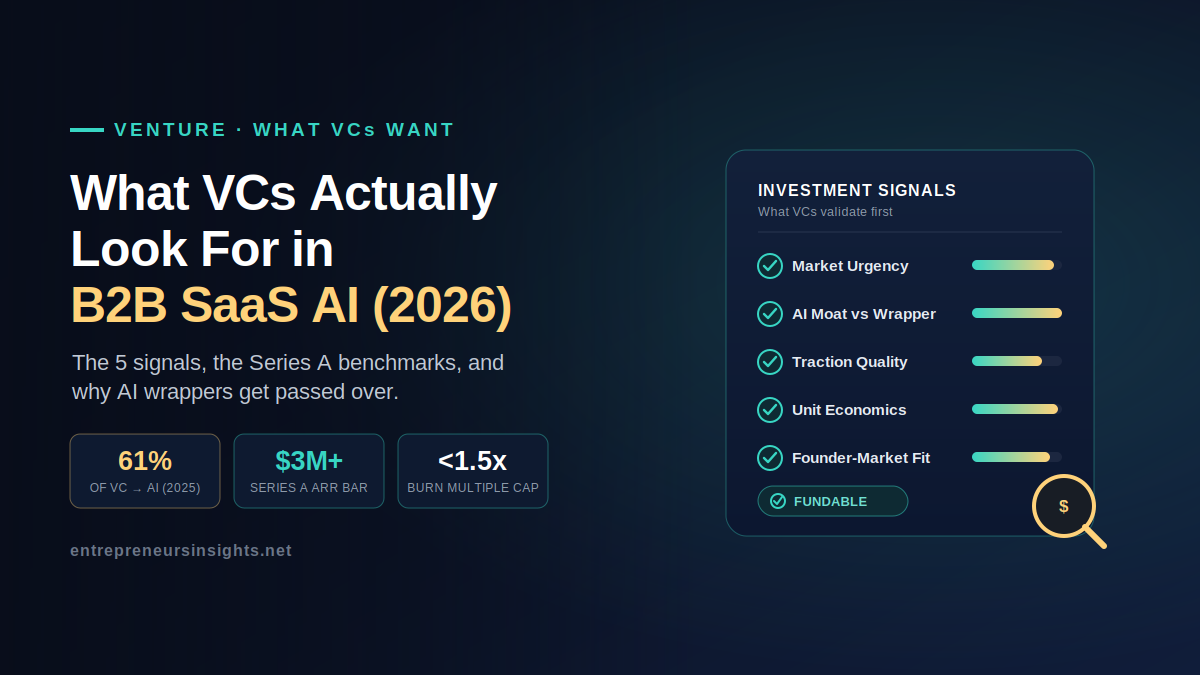
- AI companies captured 61% of all global VC in 2025 — $258.7 billion of a $427.1 billion total market (OECD)
- Series A bar has risen 40% since 2023 — investors now require $3M+ ARR, 15-20% MoM growth, and 120%+ NRR
- “AI wrapper” startups are being passed over — investors now demand proprietary data moats, not just GPT-4 wrappers
- 5 signals investors validate first: market urgency, AI differentiation, traction quality, unit economics, and execution strength
- Spending on AI-native apps rose 108% in the past year — large enterprises saw 393% growth (Zylo 2026)
- Burn multiple must be below 1.5x — above 3x is “lighting capital on fire” in current market
- Founder-market fit has become the primary early-stage signal — funds back founders who out-execute and out-learn
- Technical diligence has intensified — VCs now use dedicated technical review to validate model reliability and data pipelines
Introduction: The AI Wrapper Problem
In 2025, almost every B2B software company entering the market claimed to be “AI-powered,” “AI-driven,” or “AI-native.” The terminology became so pervasive that it ceased to function as a signal. Investors reviewing 500 decks a month, 490 of which described themselves as AI companies, needed a better framework for distinguishing genuine AI differentiation from marketing positioning.
In 2026, that framework has been built — through thousands of due diligence processes, hundreds of funded companies, and an increasing body of performance data comparing AI-native startups against their traditional SaaS predecessors.
The result is a dramatically more precise set of investment criteria for B2B SaaS AI startups. The bar has risen significantly — Series A requirements that would have qualified for Series B funding five years ago are now table stakes. And the specific signals investors look for have become more technical, more specific, and harder to fake.
This guide breaks down exactly what VCs are looking for in B2B SaaS AI startups in 2026 — covering every dimension from market sizing to team evaluation to the metrics that determine whether a deal gets done.
The Market Context: Why AI SaaS Investment Is Both Larger and Harder
The scale of AI investment in 2026 is extraordinary. AI companies captured 61% of all global venture capital in 2025 — $258.7 billion of a $427.1 billion total market. That share was 30% in 2022, meaning it has more than doubled in three years.
But the concentration of capital does not mean easy capital. The volume of companies claiming AI differentiation has grown faster than the volume of companies demonstrating it. The result: more capital flowing into the sector, with higher bars for receiving it.
Two structural shifts define the 2026 B2B SaaS AI investment landscape:
Shift 1: AI advantages are less durable. In traditional B2B SaaS, products became harder to replace once deeply embedded in workflows. With AI, many features are easier to copy because they rely on widely available models and tools. This has made investors more skeptical of AI features and more demanding about AI moats — the specific assets (proprietary data, fine-tuned models, network effects) that make an AI advantage genuinely defensible.
Shift 2: Pricing instability is real. The shift from fixed pricing to usage-based and hybrid models is creating budget uncertainty for enterprise buyers. 78% of IT leaders reported unexpected charges tied to AI features or consumption in the past year, and 61% had to cut projects as a direct result (Zylo 2026). Investors now scrutinize pricing model stability alongside revenue growth.
The 5 Investment Signals VCs Validate First
Before examining detailed metrics, understand the five signals that investors validate in the first 30 minutes of evaluating a B2B SaaS AI startup. If any of these five do not hold up, the deal rarely advances regardless of how strong the metrics are.
Signal 1: Market Urgency — Why Now?
The most important preliminary question: why is this the right moment for this product to exist? Market urgency in B2B SaaS AI requires demonstrating that something has changed — in regulation, in technology capability, in customer behavior, or in competitive dynamics — that makes the problem both solvable and necessary to solve right now.
AI-specific urgency signals that resonate in 2026:
- A specific regulatory change creating compliance requirements that AI can address
- A new AI capability (specific model release, new multimodal capability) that makes a previously impossible solution possible
- An enterprise buyer behavior shift (specific budget reallocation, new C-suite mandate) creating near-term demand
- A competitive dynamic change that makes the window for this company’s approach time-limited
Investors who cannot articulate the urgency signal after hearing a pitch typically pass without explicitly saying so. “The market is large and growing” is not urgency — it is background.
Signal 2: AI Differentiation — Real Moat or Marketing?
This is where the “AI wrapper” problem is most directly tested. Investors in 2026 use a specific framework for evaluating AI differentiation:
Tier 1 — Genuine AI moat (most fundable):
- Proprietary training data that competitors cannot replicate
- Fine-tuned domain-specific models that outperform general-purpose alternatives
- Network effects where the AI improves as more customers use it
- Deep workflow integration that makes the AI increasingly accurate with customer-specific context over time
Tier 2 — Defensible AI implementation (fundable with strong execution):
- Significantly better prompt engineering, RAG architecture, or model selection than competitors
- AI capabilities embedded in switching-cost workflows
- First-mover data advantage in a specific domain
Tier 3 — AI wrapper (very difficult to fund at premium valuation):
- Standard API calls to OpenAI or Anthropic with basic UI
- No proprietary training, no domain-specific fine-tuning
- Features that could be replicated in weeks by a competitor
The question investors ask to distinguish tiers: “If OpenAI added this feature tomorrow, would your core value proposition still exist?” Tier 1 companies answer yes confidently. Tier 3 companies cannot.
Signal 3: Traction Quality — How Revenue Behaves
Revenue quantity matters. Revenue quality matters more.
In 2026, “traction” means how revenue behaves — not just how much there is. Specifically:
Recurring and predictable: Is revenue genuinely recurring (annual contracts, subscription), or is it lumpy and project-based? Lumpy revenue creates valuation discounts in B2B AI because it signals uncertain product stickiness.
Expanding, not contracting: Is NRR above 100%? Best-in-class AI companies generate 40%+ of new ARR from expansion within existing accounts — a signal that customers find increasing value over time rather than just at the initial purchase.
Organically generated: Is growth coming from outbound sales efficiency or from inbound demand? Companies with strong inbound signals (customers finding them through word of mouth, content, or category creation) command premium valuations because they demonstrate genuine market pull rather than pushed demand.
From the right customers: 10 enterprise customers with $100K+ ACV generate more investor confidence than 100 SMB customers at $10K ACV — not because the revenue is larger, but because enterprise logos demonstrate enterprise-grade capability, longer contract cycles, and more sustainable unit economics.
Signal 4: Unit Economics — The Capital Efficiency Test
The bar for unit economics has risen dramatically since 2022. In the current environment:
Burn multiple below 1.5x: Net burn ÷ net new ARR. Below 1.5x signals efficient growth. Above 3x — in the current VC market — is very difficult to fund regardless of growth rate.
LTV: CAC above 3x, preferred above 5x: Minimum 3:1 ratio required for most investors. 5:1 is preferred for competitive deals at Series A.
CAC payback under 12 months: For B2B AI, CAC payback must be under 12 months. Under 6 months is best-in-class and commands premium valuations.
Gross margins above 70%: AI compute costs are a specific concern in 2026. Startups whose AI capabilities are expensive to run — large model inference, heavy API costs — face gross margin compression that undermines the SaaS premium valuation multiple. Demonstrating margins above 70% with a clear path to 80%+ at scale is increasingly a gating criterion.
NRR above 120%: The single most important retention metric for B2B SaaS AI. Below 100% signals churn that no acquisition rate can sustainably overcome. 120%+ signals that customers expand their usage over time — the most durable revenue characteristic.
Signal 5: Execution Strength — The Founder-Market Fit Test
The final preliminary signal is the one that is hardest to quantify and most consequential in early-stage investing: founder-market fit.
In 2026, with AI capabilities widely accessible and competitive moats harder to build than in traditional SaaS, the founder matters more than ever. The specific question investors are asking: does this founder have an unfair insight advantage in this specific market?
The signals that indicate genuine founder-market fit:
- Deep prior domain experience in the specific industry or problem the startup addresses
- Relationships with target customers that produce faster sales cycles and better product feedback
- Technical expertise that enables faster iteration on AI capabilities than competitors
- Network advantages in talent acquisition for the specific skills required
“We’re a strong team that can execute on any opportunity” is a red flag in 2026. “I spent 10 years in this industry and saw this problem costing companies millions — here’s what the solution looks like” is what investors want to hear.
The Complete Investment Criteria Framework by Stage
Pre-Seed / Seed Stage
What investors are evaluating:
- Founder-market fit and team quality
- Market size and urgency
- Early product signal (even if pre-revenue)
- AI differentiation thesis
Minimum thresholds (2026):
- No ARR required, but proof of concept with at least 3-5 design partners engaged
- Clear articulation of the proprietary AI advantage and how it will be built
- Founder domain expertise demonstrable through prior experience or early customer relationships
- Market sizing credible at $500M+ TAM minimum
Common rejection reasons:
- “We’re building on GPT-4 with a nice UI” — no differentiation thesis
- No prior connection to the target market
- Market too small or too crowded with better-funded competitors
- Vague or generic problem statement
Series A Stage
What investors are evaluating:
- Revenue quality and growth rate
- Product-market fit demonstrated through retention
- Go-to-market efficiency
- Path to category leadership
Minimum thresholds (2026):
- $1M-$3M ARR minimum (the bar has risen 40% since 2023 — some competitive firms require $3M+ for Series A)
- 15-20% month-over-month growth sustained over at least 6 months
- NRR above 110%, preferred above 120%
- Monthly revenue churn below 2%
- Burn multiple below 2x
- At least 5 reference customers willing to speak to investors
Common rejection reasons:
- ARR growth but high churn (suggesting product-market fit problems)
- Revenue concentrated in one or two customers (concentration risk)
- CAC payback period above 18 months
- No clear differentiation from better-funded competitors
- Founder-market fit unclear
Series B Stage
What investors are evaluating:
- Scalable go-to-market motion
- Unit economics at scale
- Path to market leadership or category creation
- Team depth beyond founders
Minimum thresholds (2026):
- $5M-$15M ARR
- NRR above 120%
- Burn multiple below 1.5x
- Clear evidence of repeatable sales motion (not just founder-led sales)
- Management team expanded beyond founding team
- Gross margins demonstrably improving toward 75%+
The Technical Diligence Layer: What VCs Check Under the Hood
One of the most significant changes in B2B SaaS AI investing in 2026 is the intensification of technical diligence. Many funds now use dedicated technical review to validate:
Model reliability: Does the AI actually perform as the demo suggests? What is the failure rate on edge cases? How does performance degrade as inputs move outside the training distribution?
Data pipeline integrity: How is training data sourced, cleaned, and updated? What are the data quality controls? How is data labeling managed?
Inference cost structure: What does it actually cost to run the AI in production per request? How does this scale with usage? What is the trajectory of compute costs relative to gross margins?
Proprietary data verification: Is the claimed proprietary data genuinely unique? Could a well-funded competitor build a similar dataset in 12 months? What is the pace at which the proprietary advantage compounds over time?
Copy risk assessment: How defensible is the specific AI implementation? Could the core functionality be replicated by a team of 5 engineers with 6 months of time?
Founders who have invested in documentation, testing infrastructure, and data governance are significantly better positioned in technical diligence than those who have moved fast without building the operational foundations.
The Pricing Model Question: Per-Seat or Consumption?
One of the most consistent investor questions in 2026: is your pricing model aligned with the value AI creates for customers?
Per-seat pricing — the standard SaaS model — is increasingly problematic for AI products because the value delivered often scales with usage (AI queries, documents processed, decisions made) rather than with user count. A per-seat model creates the wrong incentive: customers try to minimize seats to reduce cost, even as AI usage grows.
Investors in 2026 are actively asking:
- How does your pricing scale as customers derive more value from your AI?
- Is your NRR driven by seat expansion or by consumption expansion?
- What happens to your unit economics as AI model costs decline over time — does the value stay with you or get competed away?
The most fundable pricing models in 2026 are hybrid: a platform fee that covers basic access and seats, plus a consumption component that captures value from AI usage. This structure aligns revenue with value delivered, creates expansion revenue naturally, and is more defensible against the “commoditization of AI capabilities” risk.
What Gets Deals Rejected: The 10 Most Common Failure Modes
1. AI wrapper without differentiation: The product is a wrapper around a public API with no proprietary data, fine-tuning, or defensible implementation.
2. Impressive demo, weak traction: The product looks extraordinary in a demo environment but has low usage, high churn, or no paying customers outside of design partners.
3. Customers who don’t pay: Design partners using the product for free is not traction. Paying customers, even at small scale, signal genuine willingness-to-pay validation.
4. High gross margin today, unclear path forward: AI compute costs are declining. Products that are expensive to run today and have no path to margin improvement face valuation caps that limit the investable opportunity.
5. Founder without domain expertise: “We’re good at building software” is not founder-market fit. Investors want founders who understand the specific problem they’re solving better than anyone else.
6. Market too small or too crowded: A $50M TAM is too small to build a venture-returnable business. A market dominated by well-capitalized incumbents without a clear differentiation thesis is too crowded.
7. Revenue concentrated in one customer: One customer representing more than 30% of ARR is a concentration risk that most investors will not accept at Series A.
8. Metrics that look good in aggregate but not in cohort: High ARR with poor cohort retention signals a leaky bucket. Investors build cohort analysis — if early cohorts are churning, aggregate NRR can still look acceptable while the underlying dynamics are broken.
9. Vague go-to-market: “We sell to enterprises” is not a go-to-market. Investors want to understand the specific buyer, the specific channel, the specific sales motion, and the evidence that this motion works.
10. Burn rate that does not match the story: If a company claims to be capital-efficient but is burning 3x their net new ARR, the numbers do not support the narrative. Investors check burn multiples before they check growth rates.
How to Build an Investment-Grade B2B SaaS AI Company
The checklist that separates fundable from non-fundable B2B SaaS AI companies in 2026:
Product:
- AI capability that is genuinely differentiated — proprietary data, fine-tuned model, or deep workflow integration
- Performance validated beyond demo conditions with real customer data
- Pricing aligned with value delivered (consumption or hybrid model)
- Technical documentation demonstrating model reliability and data integrity
Revenue:
- Paying customers (not just design partners) with verifiable contract values
- NRR above 110% (120%+ for competitive deals)
- Monthly churn below 2%
- Customer references willing to speak to investors without heavy coaching
Unit economics:
- CAC payback under 12 months
- Burn multiple below 2x (preferred below 1.5x)
- Gross margins above 70% with clear trajectory to 80%+
- LTV:CAC above 3x (preferred 5x)
Team:
- Founder-market fit demonstrable through prior experience or early customer results
- Technical co-founder with AI/ML depth (not just software engineering)
- At least one founder with enterprise sales capability or evidence of learning it
- Advisory network relevant to target customer base
Market:
- TAM credibly above $1 billion
- Clear articulation of why this is the right moment
- Differentiated positioning relative to better-funded competitors
- Regulatory or structural tailwind that reinforces the thesis
Frequently Asked Questions
What do VCs look for in B2B SaaS AI startups in 2026?
VCs in 2026 validate five signals first: market urgency (why now?), AI differentiation (real moat or wrapper?), traction quality (how does revenue behave?), unit economics (burn multiple, NRR, gross margins), and founder-market fit. Beyond these five, specific metrics include: $1-3M+ ARR for Series A, 120%+ NRR, burn multiple below 1.5x, CAC payback under 12 months, and gross margins above 70%.
What ARR is needed for a Series A in 2026?
The Series A bar has risen 40% since 2023. Minimum ARR for Series A is now $1M-$3M with 15-20% month-over-month growth sustained over at least 6 months. Some competitive firms require $3M+ ARR. Revenue quality (NRR, churn, customer concentration) matters as much as absolute ARR.
What is an “AI wrapper” and why do investors avoid it?
An AI wrapper is a product that is primarily an interface layer on top of a public AI API (OpenAI, Anthropic) without proprietary data, fine-tuning, or defensible implementation. Investors avoid AI wrappers because their competitive moats are minimal — a well-funded competitor or the API provider itself could replicate the core functionality quickly. Genuine AI differentiation requires proprietary data loops, fine-tuned models, or deep workflow integration that creates genuine switching costs.
What NRR do B2B SaaS AI companies need to raise funding?
Minimum NRR for Series A is 110%, with 120%+ required for competitive deals. NRR below 100% signals churn exceeding expansion — a sign of product-market fit problems that make investor return scenarios difficult to underwrite. Best-in-class B2B AI companies generate 40%+ of new ARR from expansion within existing accounts.
How important is the founding team vs the product?
In 2026, founder-market fit has become the primary early-stage investment signal. Investors increasingly back founders who out-execute and out-learn — specifically, founders with deep domain expertise in the problem they’re solving. “We’re a strong team that can execute on any opportunity” is a red flag; domain expertise that gives the founder an unfair insight advantage is what early-stage investors want to see.
What burn multiple do B2B SaaS AI startups need?
Burn multiple (net burn ÷ net new ARR) below 1.5x signals efficient growth. Below 1.0x is best-in-class. Above 3x is very difficult to fund in the current market regardless of growth rate. Investors view burn multiple as the primary capital efficiency signal — it captures both how fast a company is growing and how efficiently it is converting capital into revenue.
